
July 2001
An interview with John Singleton
|
July 2001
An interview with John Singleton |
| (July: Main Page * Features * Reviews * Gallery ) Current Issue * Archive |
|
Interviewed by Wilson Morales
Interview with John Singleton
WM: RECENTLY A LOT OF BLACK FILMS SEEM
TO BE ABOUT LOVE STORIES (BROTHERS-TYPE STORIES)--A LOT OF PEOPLE FEEL THIS
IS A WELCOMED DEPARTURE FROM THE URBAN DRAMA. DO YOU SEE ANY DOWNSIDE? JS: No, I don’t. I made this film because I felt that black cinema has become too conformist, too passive. It’s like no one’s saying anything innovative anymore. It’s like the filmmakers just seek to make films that are basically just Hollywood films. There’s no new thought. There’s no new insight. And I’m always into challenging. You can’t be radical about making just a love story or you can try to do something that is hyperviolent. I’m not for that either. I’m for new thoughts, new perceptions, different types of people within a film, character explorations. I feel it’s great that so many of these ‘safe movies’ have come out in the last few years because ‘Baby Boy’ is going to hit them real hard, like a brick in the head. It’s an off-kilter end of The Boyz N the Hood. WM: DO YOU THINK A LOT OF BABY BOYS WILL COME
TO THIS MOVIE? JS: Some people may get it, and they won’t
get it, but they’ll get it on the third or fourth viewing. It’s the kind
of movie, also, that some people may get and they may not get the fact
that’s themselves on the screen until they see it a second, third or
fourth time. I always believe that a film doesn’t truly have a life until
years afterward. People tell me things they have seen in my films years
afterward. They look at them on different mediums and they learn something.
Having his face on the wall adds to the whole
emotional response that the audience has that Tupac’s past could possibly
be Jody’s path. A lot of kids are with the themes of Jody being fearful of
death and not wanting to leave the nest because he thinks he’s going to
die--are all encompassing in the background and the foreground of the film. Tupac’s eyes are like in The Great Gatsby
the eyes of T. J. Eckleberg, looking down and just piece you. And there are
a number of scenes in the film where basically that happens, and there’s a
point for that. WM: DID YOU USE TUPAC BECAUSE YOU HAD WORKED
WITH HIM BEFORE? JS: The room is always full of the people
I’ve worked with--There’s Tara and Janet on the wall. But I put ‘pac
up there because he is this generation’s James Dean--I mean,
crossculturally he’s this generation’s James Dean. He’s a cautionary
romantic figure for young people to watch and to learn from, I think. WM: HOW WAS IT WORKING WITH SNOOP DOGG? JS: Me and Snoopy have been wanting to work
together for about nine years. We always said we were going to do something
together. This was the perfect opportunity for us to come together and do
it. I just called him up and hung out with him and everything and let him
read the script. He said, ‘I’m down with it.’ WM: THIS FILM WAS AN EMOTIONAL DRIVE-BY: A
TRILOGY (BOYZ, POETIC JUSTICE, THIS). DID YOU ALWAYS HAVE IT IN MIND TO DO A
TRILOGY? JS: After I made Poetic Justice, yes. WM: CAN YOU EXPLAIN THE CORRELATION OF THE
THREE FILMS? JS: All three films are set in South Central
Los Angeles, with characters that are actually from South Central Los
Angeles. When I first got into the film business, I always thought that I
had to make some kind of cultural identity to show my uniqueness as a
filmmaker. Woody Allen has a certain part of Manhattan,
Spike Lee had Brooklyn, Martin Scorsese had Little Italy. I felt South
Central Los Angeles was going to be my thing where I can make these little
stories about where I had grown up and where I’m from. It would be unique
because I did ‘em from a personal standpoint so I made ‘Boys ‘n’ the
Hood’ and ‘Poetic Justice,’ and I felt that ‘Man, I gotta get out of
the hood and make some different kinds of films, because I don’t want
people to think I can just do this kind of film. And that was not just what
I was interested in at the time, so I went and made ‘Higher Learning,’ I
went and made ‘Rosewood,’ then ‘Shaft’ and stuff. I felt it was time
for me to go back, to make a homecoming and do something more close to home
and more close to the heart. WM: WHAT DO YOU WANT US TO ‘GET’? JS: It seems like dysfunctional relationships
have become the norm and not the exception. I was just very simply dealing
with black people in this film, but more and more I show it to other people,
I’ve found it’s actually true with other people, too. It seems like men
and women are at war with each other. There’s less communication and more
fighting. You can’t use sex to solve problems. It was great for me to
write a character that was selfish. You can see some of the things that Jody
does, and you can hear the women in the audience--the hackles go up on their
backs. The great thing about casting Tyrese is
that he can play a bad boy, but you still like him even though he’s doing
these bad things. WM: CAN YOU EXPLAIN THE QUOTE AT THE
BEGINNING AND HOW IT RELATES? JS: The great thing that I was about to do
was to find inspiration in Issis? papers for actually the whole script in
terms of the social dysfunction of black America. ----was a black in
this country has been thought of, and thinks of himself, as a baby. This
kind of infantilism is perpetuated by being raised within a racial,
institutionalized society that basically has created these dysfunctional
rite of passages for black men. They believe--it’s perpetuated in music
and culture--to be a man you have to be a killer. What are they talking
about? Killing each other. Or, they set the notion that you will do prison
time. And that’s a mark of honor. Everything else is perpetuated toward
that end. That path is just there in front of a lot of people.
I just don’t think that anything as complex
as the things this film does or says has been done before. A lot of the
films that come out, in terms of the so-called ‘black films’ have been
basically Hollywood films, just basically entertainment. And this film is
very, very entertaining, but there are things in the film that make it a
film and not just a movie. WM: HOW LONG DID IT TAKE YOU TO WRITE THIS
FILM? JS: It took me a few months to write the
script, but then I had notes for it for years. Whenever I come up with an
idea for a movie, it’s usually something that has been gestating for a
long time in my notebooks. I can’t tell anybody how they should
perceive a film. See the film. WM: WHAT DO YOU THINK THE AUDIENCE REACTION
WILL BE? JS: We’ve had great reaction so far to the
film. Everybody has pretty much of a positive reaction to the film in terms
of young people. The worst reaction is coming from the conservative black
people who are very nervous about how other people will perceive the black
people in this film. For me, this film is a catharsis in the sense that it’s a reflection on some real people. It’s a character-based film, it’s not a plot-based film. I put very honest characters within a room, and basically we’re watching a film about those types of people. I’m not placing judgment on it. It’s up to you to place your judgment on. Do you want to discuss this article with other community members? Have any comments on black film? Then go to our Community section -- http://www.blackfilm.com/community/ |
| (July: Main Page * Features * Reviews * Gallery ) Current Issue * Archive |
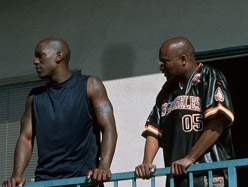 In
the last decade, a number of African American directors have made an impact
in the film industry. Spike Lee, the Hughes Brothers, F. Gary Gray, and
Keenan Ivory Wayans all have had recent success with their films. In 1991,
John Singleton was nominated for best director for his first feature film,
“Boyz in the Hood”. Since then, he has had a string of hits and misses.
Last year, he scored a hit with the remake of “Shaft”; and now he’s
back to his roots with “Baby Boy”, the follow-up to “Poetic Justice”
and “Boyz in the Hood”. He shares with blackfilm.com his thoughts on the
film.
In
the last decade, a number of African American directors have made an impact
in the film industry. Spike Lee, the Hughes Brothers, F. Gary Gray, and
Keenan Ivory Wayans all have had recent success with their films. In 1991,
John Singleton was nominated for best director for his first feature film,
“Boyz in the Hood”. Since then, he has had a string of hits and misses.
Last year, he scored a hit with the remake of “Shaft”; and now he’s
back to his roots with “Baby Boy”, the follow-up to “Poetic Justice”
and “Boyz in the Hood”. He shares with blackfilm.com his thoughts on the
film.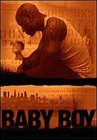 And
if you took at the whole thing of having Tupac’s visage on the wall it’s
because Tupac was a baby boy. He didn’t know if he wanted to be a thug or
a revolutionary. He had no mentorship, and the mentorships that he did end
up having were very dangerous and led to his demise.
And
if you took at the whole thing of having Tupac’s visage on the wall it’s
because Tupac was a baby boy. He didn’t know if he wanted to be a thug or
a revolutionary. He had no mentorship, and the mentorships that he did end
up having were very dangerous and led to his demise.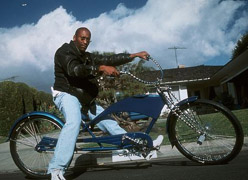 I
really wanted to try to make a film that would show, without promoting,
would show and make a comment on all that, in the sense that they have a
character like Melvin who has gone through that dangerous rite of passage
but survived. Then have a character like Jody who is 20 removed from Melvin,
who basically is that guy. He believes he knows everything, but he
knows nothing. He’s basically contributing to the burden that the women
have. His girlfriend Yvette is the one taking care of their child, she’s
the one paying the bills. She doesn’t want to be alone so she
compensates--she overcompensates for his faults.
I
really wanted to try to make a film that would show, without promoting,
would show and make a comment on all that, in the sense that they have a
character like Melvin who has gone through that dangerous rite of passage
but survived. Then have a character like Jody who is 20 removed from Melvin,
who basically is that guy. He believes he knows everything, but he
knows nothing. He’s basically contributing to the burden that the women
have. His girlfriend Yvette is the one taking care of their child, she’s
the one paying the bills. She doesn’t want to be alone so she
compensates--she overcompensates for his faults.