
May 2003
That's My Face : An Interview with Thomas Allen Harris
|
May 2003
That's My Face : An Interview with Thomas Allen Harris
|
| (May: Main Page * Features * Reviews * Screenings * Teen ) Current Issue * Archive |
|
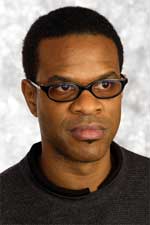
Interviewed by Wilson Morales
 That's
My Face: An Interview with Thomas Allen Harris That's
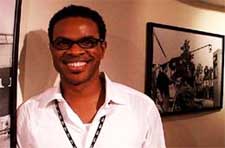
My Face: An Interview with Thomas Allen HarrisStarting this Friday, BAMcinematek presents the U.S Theatrical Premiere of That's My Face (E minha cara) at BAM Rose Cinemas, May 23-29, in Conjunction with DanceAfrica 2003. Directed by Thomas Allen Harris, the film has won numerous awards at different festivals. Harris is Bronx-Brooklyn native who traveled to Africa and Brazil searching for spiritual ancestors and in an interview with blackfilm.com, he talks about the journey he has taken to get a wider audience to see his film. That's My Face will be shown on Friday, May 23 at 2pm and 7pm and from Saturday, May 24 through Thursday, May 29 at 4:30pm and 8pm. For more info on DanceAfrica 2003, go to http://www.bam.org/performances/danceafricafilm.asp BAM Rose Cinemas is located at 30 Lafayette Avenue, Brooklyn, NY
WM: How is it that a film that was shot a year ago and has been making several runs in festivals is finally making its U.S debut at the Bam Theatre as opposed to regular theaters? TAH: That's My Face is a documentary and it’s an experimental documentary, which is shot by three generations of an African-American family totally separate and totally silent and it has a sound score, which means it has a lot of different voices. It’s score is by Vernon Reid. The film doesn’t have a traditional narrative. Any film that is not the standard fare has to find it own audience, and the film did that. I made the film with very little money and I didn’t think it would have a wider audience it has now. It went fro the Toronto Film Festival, Sundance Film Festival, and to the Berlin Film Festival, where it won an award. It won an award at Toronto as well; and now the Tribeca Film Festival, so it has the quadruple crown. I think my film is the only one I know that in 2001 and 2002 has been to the major film festivals, with the exception of Cannes. And it’s getting a chance to be seen by a lot of people both at BAM and at the Sundance Channel.
TAH: I always had a dream of going to Brazil. So I went down
to Brazil and I took a couple of Super 8 cameras during the Afro-Brazilian
Religious Festivals that climaxed in carnivals. I was down there for about
4 months and shot all this amazing footage and when I came back I realized
I didn’t have a script while I was there. It was almost like an art project
to come back with something. With all this amazing and beautiful footage,
I realized that in order to take people to this journey, I had to be a
character in this film. In order to do that, I had to tell the story why
an African-American would go to Brazil looking for my roots. Then I realized
that my mother made a similar journey in the 70s as she uprooted me and
my brother and took us to Tanzania, East Africa. We moved and lived there
for 2 years because my grandfather dreamed of going to Africa. When my
grandmother refused to let him go, he passed his dream to the subsequent
generation. I had the idea, but I didn’t have any footage for any of this
stuff. So I looked for some in my family’s archives, and my grandfather
said he didn’t have any more footage. He actually gave me whatever he
WM: How many years did it take you make this film? TAH: Well, I have to tell you that I was also working full time as a Professor of Art at the University of California, San Diego. I wasn’t working on the film full time because I was also working on other films as the same time, so I worked on my film off and on for about 5 years. I must say that I’m known in the black independent world as “The King of Personal Documentaries”. I have done films on my background since 1991. WM: You seem to have an audience coming to see most of your films, which is your life on camera. Why the fascination? TAH: I think it’s not so much about my life. It’s about the
journeys. I make autobiographical films, but the WM: One of the interesting things of the film is the cinematography and the use of art. Could you talk about how you wanted that aspect to be a part of the film as an illustration? TAH: I shot everything on Super 8 and Super 8 has this feeling of nostalgia. It’s much different than video. Video is somewhat harsh and with Super 8 I was interested in the texture. By shooting Super 8 and shooting it silent, I then had to make sure that my story was being told visually and so with the camera, I was very much into people’s faces. The framing is very close to the people. People are constantly interacting with the camera, and with the camera always moving, it presents a whole new visual style.
TAH: I’m looking for them to walk away with the idea that they can have the courage to follow their own dreams and that those dreams will lead them to a good place. Who would have known that when I started making these corky films 10 years ago, that I would have this huge audience and be offered money to do a new film. This new film I’m making is actually another documentary about my stepfather, who was part of the first wave of freedom fighters who left South Africa and came to America to tell people about Nelson Mandela, who supported the ANC and liberation movement in South Africa. It’s about him and the colleagues in South Africa he left with 40 years ago. The name of the film is called “The 12 Disciples of Nelson Mandela”. My film after that will be a feature narrative film. I’m actually working on a sex comedy and an adventure film, so that where I’m going. WM: What were some of the challenges on making That’s My Face? TAH: This documentary, because it was so innovative, was hard to explain to people. When I was raising money in the form of grants, it wasn’t easy to explain what they were going to see because people didn’t have a framework for it. When you have a documentary where’s there no talking heads, it becomes difficult to get funding. The beginning funding came from people who knew my past work, and the funding in general, came from people who knew my work. Over the course of five years, it took a long time to get the money. The Ford Foundation came on board and provided a huge chunk of money so that I was able to finish the film. That was the most challenging. And secondly, and probably the most challenging aspect of the film was the writing of the script. When you’re writing a personal documentary, the script has to be tight, and you also have to go really deep. You have to go and tell people something that new and fresh. I found myself writing and writing. It was like peeling onions. That was the challenge; to go deeper and deeper to places I didn’t even know existed inside of me.
TAH: Yeah, I think my films talk about black life and Black African diasporic life over the last 40 years, from the 60s to the present. When you look at them together, you get a sense of this black family life and black community life apart from Diaspora. I’m talking about Brazil, South Africa, and the United States. I think that is really important. I also think the idea of black films. Not everybody has to make personal documentaries, but I think it’s really important of us as black filmmakers to really look at different types of ways to tell our stories and to challenge ourselves. To make something that makes sense and give back to the community and be commercially viable. Some filmmakers are doing that and ultimately figure out ways to keep your vision because I realize the more I go forward with making films with bigger budgets, there’s more pressure to compromise, and that’s normal. I’ve been successful in sticking with my vision and I hope my experience will allow me to continue doing that as I do films with a bigger budget and attract a wider audience.
|
| (May: Main Page * Features * Reviews * Screenings * Teen ) Current Issue * Archive |
 WM:
One of the things that you didn’t mention is that this documentary is
about your life. At what point did you decide you wanted to make a film
about your upbringing?
WM:
One of the things that you didn’t mention is that this documentary is
about your life. At what point did you decide you wanted to make a film
about your upbringing? 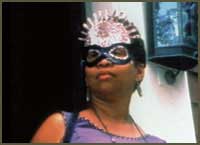 had
for the last film I did. Six months after that he died and a year after
that I was still struggling with a script. How can I tell a story of three
generations without any footage? All of a sudden I had this dream that
if I went back to my grandfather’s house I would be able to find some
more footage. So I went back there and went to the basement and found
hours and hours of Super 8 footage as if his spirit was leading me down
there. The footage was home movies of his family in the 60s and 70s, very
rare stuff. It was shot really well. A lot of it was shot in New York
City around his community. My trip to Brazil ultimately led me to my grandfather’s
archives. If I hadn’t gone to Brazil I would never had gone on this mission
to have something to talk about in regards to my family’s life in the
60s and 70s so that’s how my journey got started.
had
for the last film I did. Six months after that he died and a year after
that I was still struggling with a script. How can I tell a story of three
generations without any footage? All of a sudden I had this dream that
if I went back to my grandfather’s house I would be able to find some
more footage. So I went back there and went to the basement and found
hours and hours of Super 8 footage as if his spirit was leading me down
there. The footage was home movies of his family in the 60s and 70s, very
rare stuff. It was shot really well. A lot of it was shot in New York
City around his community. My trip to Brazil ultimately led me to my grandfather’s
archives. If I hadn’t gone to Brazil I would never had gone on this mission
to have something to talk about in regards to my family’s life in the
60s and 70s so that’s how my journey got started.  way
I define it is much more inclusive than just me. It’s about the community
that I’m a part of, and the people I meet along the journey, so there’re
always a lot of different voices, which is why I included them in the
film. Henry Louis Gates once said that the first novels usually written
by black people are usually autobiographies because they like to create
a shell in a public space. It was really important to me as an artist
to talk about who we are and where we come from in a way that talks to
us as opposed to about us by some white documentary filmmakers doing a
film for a white audience. It’s really about how we as black people communicate
and I feel like there’s very little film and media and television work
that actually deals with that. Most of it is really stereotyped. And because
of the weight of the commercial in naked commercial cinema, you have to
be naked for a huge broad audience, so what I have tried to do is make
films that come from the heart and also from a labor of love and could
still reach huge audiences. Right now my film is being shown all throughout
Europe for about 40 million people and it will be shown to about 10 million
people on the Sundance channel and about thousands of people at BAM. I
could have gone the commercial route about 10 or 15 years ago and go seek
financing in Hollywood and let them dictate the kind of films I should
make. Then I would be in like everyone else in the booty call group, but
right now I’m charting my own perspective of charting an audience who
follows this kind of art. I’m making something that’s new; something that
wouldn’t have existed before. All kinds of people have come up to me and
told me that this is their journey, because when I made the film, it wasn’t
about me. It was about dreamscapes. I made it with enough holes in the
narrative that you could add your own narrative to it.
way
I define it is much more inclusive than just me. It’s about the community
that I’m a part of, and the people I meet along the journey, so there’re
always a lot of different voices, which is why I included them in the
film. Henry Louis Gates once said that the first novels usually written
by black people are usually autobiographies because they like to create
a shell in a public space. It was really important to me as an artist
to talk about who we are and where we come from in a way that talks to
us as opposed to about us by some white documentary filmmakers doing a
film for a white audience. It’s really about how we as black people communicate
and I feel like there’s very little film and media and television work
that actually deals with that. Most of it is really stereotyped. And because
of the weight of the commercial in naked commercial cinema, you have to
be naked for a huge broad audience, so what I have tried to do is make
films that come from the heart and also from a labor of love and could
still reach huge audiences. Right now my film is being shown all throughout
Europe for about 40 million people and it will be shown to about 10 million
people on the Sundance channel and about thousands of people at BAM. I
could have gone the commercial route about 10 or 15 years ago and go seek
financing in Hollywood and let them dictate the kind of films I should
make. Then I would be in like everyone else in the booty call group, but
right now I’m charting my own perspective of charting an audience who
follows this kind of art. I’m making something that’s new; something that
wouldn’t have existed before. All kinds of people have come up to me and
told me that this is their journey, because when I made the film, it wasn’t
about me. It was about dreamscapes. I made it with enough holes in the
narrative that you could add your own narrative to it. 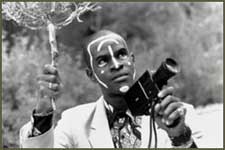 WM:
When folks finish seeing your film, what are you looking for them to walk
away with?
WM:
When folks finish seeing your film, what are you looking for them to walk
away with? 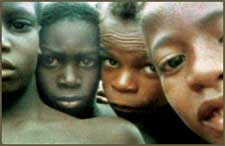 WM:
With most of the films you have done being on your life, is there anything
left to be told? Are there aspects in your films that we can see ourselves
in?
WM:
With most of the films you have done being on your life, is there anything
left to be told? Are there aspects in your films that we can see ourselves
in?