
December 2003
In America: An Interview with Djimon Hounsou
|
December 2003
In America: An Interview with Djimon Hounsou
|
| (Nov: Main Page * Features * Reviews * Screenings ) Current Issue * Archive |
|
Interviewed by Caroline Memnon
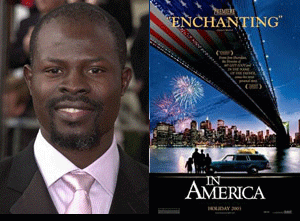 In
America : An Interview with Djimon Hounsou In
America : An Interview with Djimon Hounsou
CM: How did you perceive this character? What attracted you to this character and what did you bring to it? DH: What attracted me to this character was that he was sensible. This Irish family, basically Jim Sheridan’s character came to this country to live the American dream and in search of that his character found his lost soul. The essence of my character was in Jim’s head, and in rehearsal, we would go over the scenes and how he wanted it played out.
DH: No, you don’t want to do that because then you freeze all your senses and won’t be of any use. Rehearsals are set up so that you find out all the nuances about your character. You never want to beat yourself up. It’s about finding the right direction and most of the time the right direction is not what you think is the right direction. That’s why the director’s there; to guide you there. CM: You come from an African heritage and when you’re in films, some of the roles you’ve had also have an African heritage. So in regards to that, when it comes to the accent, is it easier to speak with your native language? DH: Funny enough, every role that I have had, I try to tone down my accent or speak with better diction. Every job tends to push you to emphasize on the accent, so it was confusing for a minute, but now it’s fine.
DH: Here, there wasn’t much of a transition; just the simply fact that I was not working as an actor when I came to America. When I came here the whole learning process was not to speak the language. CM: Was it your intention to transition to a main character? DH: Oh yes, that’s why I came to America. At first, everything was going against me because I didn’t speak the language. Everybody comes from different parts of the world to live out their dream. CM: What sorts of roles do you want to take on in the future? DH: What I’m doing now are more contemporary films.
DH: Yes, I write and I’m creating something that a friend of mine is actually writing. CM: Did you relate a lot to Paddy’s character? DH: In relation to Jim Sheridan, yes I did. Well, I didn’t relate too much time to him cause it’s one of the most distinct characters in the whole story and given the fact I did the condition that I was in when I was in Dublin shooting this film was quite distinct from the rest of the cast. What I mean by that is that I had to lose so much weight and it was a bit uncomfortable because I couldn’t go out to eat with everybody and I couldn’t drink with them as well. I was also tired a lot. That added another dimension to the connection I had with Paddy. CM: What sort of research did you do in relation to your character and the issue of life and death?
CM: What do you look for in a script? DH: A good story, pure and simply. Once you have a decent story, you look at your character. Is it somewhat decent? How is it supposed to be played? At this point, I’m always concerned how African Americans are portrayed in films. I look for a decent project and once you have come across that, you want to know who else is involved with the project. CM: Do you see yourself having an international career? DH: Well, I’m hoping I get to accomplish that. CM: What’s up for you next? DH: Well, I was recently in an episode of “Alias” and I’m
currently shooting Constantine with Keanu Reeves. I play a witch doctor
in the film.
|
| (Oct: Main Page * Features * Reviews * Screenings * Teen ) Current Issue * Archive |
 CM:
When rehearsal didn’t go well on any day, would you lock yourself
anywhere or torture yourself to figure out what you may have done wrong?
CM:
When rehearsal didn’t go well on any day, would you lock yourself
anywhere or torture yourself to figure out what you may have done wrong?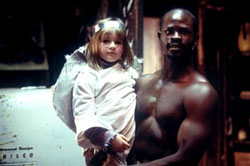 CM:
For your transition from France to the United States, did you do French
films? What was it like when you started to play characters that are essentially
African? What type of work is offered to you?
CM:
For your transition from France to the United States, did you do French
films? What was it like when you started to play characters that are essentially
African? What type of work is offered to you? CM:
Besides acting, do you write? Would you want to direct?
CM:
Besides acting, do you write? Would you want to direct? DH:
When Jim and I talked about it, I suggested a book about African ceremonies
to look. It’s called, I think, “African ceremonies”.
It’s a huge book with 2 volumes. I suggested this to him and this
is also related to the unborn child in the film and how spiritual my character
was. He used that spiritual element to bring that family together. We
talked about it and sat down. I can’t tell specifically what I did
and what research I did. The research was in talking. The idea is to bring
your spirituality and some depth to the story and that’s what I
did with my character.
DH:
When Jim and I talked about it, I suggested a book about African ceremonies
to look. It’s called, I think, “African ceremonies”.
It’s a huge book with 2 volumes. I suggested this to him and this
is also related to the unborn child in the film and how spiritual my character
was. He used that spiritual element to bring that family together. We
talked about it and sat down. I can’t tell specifically what I did
and what research I did. The research was in talking. The idea is to bring
your spirituality and some depth to the story and that’s what I
did with my character.