
|
About | Features | Reviews | Community | Screenings | Archives | Home |

November 2004
Bridget Jones: The Edge of Reason: An Interview with Renee Zellweger
|
| (November: Main Page * Features * Reviews * Screenings * Teen ) Current Issue * Archive |
|
Were you reluctant to return to this role after the first film, particularly in light of the physical changes it required? Renne Zellweger: I don't know where the notion that I was
hesitant to have that experience in the first place came from, or that
I had negative feelings about the experience the first time around. I
don't know where that came from. I read it myself somewhere and I don't
know what brought- - I don't know where that surfaced but it didn't come
from me. It wasn't a negative experience in any respect. It contributed
so much to the experience of bringing Bridget Jones to life the first
time. And so I knew that it was essential in repeating the journey. It
had to be authentic to me. It had to be. And if you're not going to become
the character and be the character, then I don't really see the point
in undertaking the experience. I wanted to have that experience and people
were suggesting to me, 'Oh, it might not be necessary.' Or, 'You shouldn't
do as much as you did last time because it's probably not healthy.' For
me, then it would render the experience pointless from a creative perspective.
I wanted to revisit this character in every respect. Getting to that point,
deciding to go forward and make a follow-up film, it took a while. Probably
because the first experience meant so much to me and because I have so
much respect for this character and also what she represents. I didn't
want to compromise that in any way by following up with a film that meant
nothing just because we could. I wanted to be certain that the motivation
for making this film came from a creative place. And I wanted to be certain
that it was a film that was substantial enough that it could stand on
its own regardless of what had happened with the first picture. I wanted
to be sure that it was a necessary film and that this character had more
stories to tell. I was more comfortable with the idea of making this film
because it's not a sequel in the traditional sense. There is a book that
has been written and so her journey has continued and I had nothing to
do with it. It was there already from Helen Fielding, obvious Do you still identify with her? RZ: I'm trying, like I said. I do my best. It's what I admire most about her is her ever-present optimism in the face of so much adversity. I love that she's able to laugh at herself and get back up and keep on trying. Well, I do my best. I keep on trying anyway. Is it reasonable that Bridget wants a proposal after six or eight weeks of being in a relationship? RZ: I think that's a really good question because it's something
that stood out for me in the filming process. It wasn't something that
I found easy to justify on the day when we were standing in the hallway
and I was trying to think to myself, 'Why? Where does this come from?'
And I think that it's made fairly clear afterward. And if not, I'm not
sure which version of the film that you've seen, but it was an issue that
I've had. I was not comfortable with because I thought, 'Does that imply
that this is a character who's a little bit unrealistic in her expectations
and does it make her seem a little bit desperate for something that ultimately
isn't at the core of what drives her?' Yes, love is important to her obviously,
but it's more specific. It's love with this person. It's not love period
or just the idea of having that manifest itself in her life. I thought
that okay, I understand this. This is- - I think she is aware that it's
inappropriate. I think that at that desperate time, women, we all know
that you don't even bring up 'Are you seeing other people' at six weeks,
let alone 'So, are we doing this for the long haul or not?' No matter
how desperately you want to say, 'Are you calling other people because
I'm not calling other people and I just wanna know if you're committed
to me - ' you don't do it. It's breaking the rules. And I think if anything
that you can love Bridget for it's her inability to sometimes refrain
from those outbursts. And I found justification in that moment, in that
particular quality of her essence, I love that she can't contain herself
and not only is she not gonna say, 'You're just seeing me, right' but
'So, you wanna marry me or not?' And it's completely inappropriate and
I think that after she leaves his house, I think it becomes pretty ev Was it hard to retrain yourself in terms of the accent and the mannerisms? RZ: Certain things about this character just feel right and in playing her, they just sort of seemed to surface from somewhere. I don't know. You pay attention to them, but they find themselves into the day, into the reanimating of this character. The dialect on the other hand, boy, that I had to pay a lot of attention to. It was like starting over again. It- - I was terrified of it because it was something that evolved and became very colloquial in a very specific way last time. And so it just sort of evolved in a really natural way and to try to force that to come back was an interesting process because it is so specific. I have [my voice coach] there every day saying, 'No, that was too precise. Slushier, slushier. ' Because Bridget has kind of a lispy thing that she does. So there was a lot to pay attention to, but let me tell you, I had a lot of help. We heard you're planning to take a year off. RZ: I heard that too. When do we start? (Laughs) The last person who said that was Gwyneth Paltrow, and the next day she announced she was pregnant. RZ: I can only imagine I'm looking forward to tomorrow. It might be an exciting morning. I have no idea. It'll be interesting. I seriously doubt it. It's logistically not possible. But no, I have no- - I don't even know how to answer this. No, no specific reason, no reason that exciting anyway. And I just haven't committed to another film and I'm not aggressively seeking on at this time. I think I need to take a little time and just be a girl. I need to, I don't know, collect some experiences as a person and not just as a person who's emulating someone else. I think it's essential. To tell life stories, you have to have a little life to draw from and I'm a little tapped out in that department. I need to go and just be a girl for a little while. I'm a woman now and I'd like to refamiliarize myself with now what's important to me and what I like now as a woman. Do you mean as opp RZ: Yeah, and living in somebody else's apartment in somebody else's country, in somebody else's body. I'd like to just kind of see where the day might take me if I didn't have it booked up on behalf of some commitment or other. And I can't really take a year off because there's no such thing really. It's just different phases of the cycle of making a film. So now this one's finished and it's coming out, and then Cinderella Man, I have to finish that up and then do post production on that obviously and go around with that. And I think by that time, my year is probably up. My year off will be up. But yeah, I'm not going to go hop in a makeup chair any time soon I don't think. How was your experience on this film different than on the first "Bridget Jones"? RZ: It was a little bit different because I knew where I needed to go. And again, it was a question of can we do it in time? And again, I had a lot of help to get there. Somebody else doing the math and putting the plate in front of me and saying, 'Here, eat this.' And ultimately, it worked out. Emotionally, it doesn't affect me. It didn't affect me except that I was afraid all the time that it would be not right, not enough because we worked so much. We did six days and the seventh day was committed to other work responsibilities. So I was constantly going, so my fear was that there would be fluctuations and those would disappear, yes, exactly. And then it would be noticeable. And I didn't want that. I didn't want to compromise on this film in any respect. It was so important to me that we come from a place of integrity in approaching this project, so everything about authenticating the character's experience was unconditionally- - not mandatory, but essential. It just was. What is Bridget's biggest mistake with Mark Darcy? RZ: Well, it's that thing that we tend to do sometimes, just
projecting our fears or expectations of failure onto what's actually good,
onto what's really fine as it is. I think she also had unrealistic expectations
about the knight on the white horse. And no one can be that all the time.
And then normal is good enough. I think she comes to learn that though.
I think she comes to see that there's nothing wrong, that she should just
leave it alone, let it be good. After the first one, did women on the street share romantic stories with you? RZ: I'm very lucky. I make a lot of friends on the street, yeah. Guys too. I am Bridget Jones. What were the best? RZ: Oh boy, marriage proposals that happened. All sorts of things like that. I could go on for days. It's been four years worth of stories in 25 countries. It's pretty fascinating. Do they think you have the answers? RZ: Me? Do they think I do? Oh god, I hope not. Boy, I hope not. I don't presume to. I don't give out any love life advice. Bad idea. Any extra research and how did you like Thailand? RZ: I'm not really great in the sun, so that was hilarious actually. You'll have to ask Hugh about that. I'm never going to live it down. I seriously look like I was wearing a pup tent the whole time I was down there. All the English folk who don't get so much sun usually, had their shirts off and were vary proud of the blaring day-glow white. And everybody half naked on the beach just loving it at Christmas time and I had at least 22 layers on, because I burn through the hotel wall. I do, honestly, so that was a challenge to shoot the scene out in the water for six hours and try to cover up the sun rash for the next week. That was the challenge. I'm not so great at it, but culturally in terms of what I learned, it was fascinating. It was fantastic. And the shrimp was really great on the beach too. Did the sequel require more preparation than the first film? RZ: This was Didn't go to Thai prison as research? RZ: I was going to make a joke about a wild night in Thailand, but I won't. Did you do your own stunts? RZ: Yeah, I did do my own stunts. Even the skiing? RZ: Yeah, it was awesome. I've never been on, what's the race course called, the slalom? I did the slalom with two members of the Austrian ski team on each side. No, crazy. No, crazier is the man who filmed the thing. He was an extreme skier and he filmed extreme sports, the helicopter, snowboarding and things like that. He was skiing backwards down the slalom with the camera strapped around his torso, that he looked down into and held right here. He never looked up, never. And he was depending on me to tell him when he was about to be killed. By trees or veering off too far to the edge of the mountain never to be heard from again. So it was very exciting. Especially the sun was going down, you couldn't really see at that point but we had to get it because we were leaving. It was exhilarating and insane, and it's amazing the insane things that you'll just go ahead and do because you're running out of light. Should women be offended that Bridget is portrayed as so desperate? What is the character's appeal? RZ: I think it's her humanity. I think it's that she's so
honest about how she feels and remember- - see, what I find is that I
don't think that she's needy or desperate. I think it's her actions that
are completely contrary to what you're suggesting. See, you're privy to
her inner dialogue as an audience member, as a person reading the book.
You're privy to what it is that she's most afraid of or what she anticipates
might be her greatest failure or what her own shortcomings are. But she
never fails to trudge forward and to believe that she's gonna be fine
and she always moves on. And she always succeeds. She always goes for
what it is that she would like to have happen in her life, and ultimately
makes certain that it manifests itself there. And it's not for her about
finding happiness in this antiquated ideology that a man and woman should
be together in order for a woman t |
| (November: Main Page * Features * Reviews * Screenings * Teen ) Current Issue * Archive |
 |
|
Terms of Use
| Privacy
Policy Copyright © 1999-2004, BlackFilm.com
|

 ly.
So, that being said, it gave it purpose. But again, it was just being
careful that we wouldn't do anything that might blasphemize the first
or how people felt about this character because we went forward irresponsibly
with her.
ly.
So, that being said, it gave it purpose. But again, it was just being
careful that we wouldn't do anything that might blasphemize the first
or how people felt about this character because we went forward irresponsibly
with her.  ident
that she knows that she's made a big mistake there. And that not only
is it unreasonable, but it probably might have been the catalyst to the
end of this relationship for having terrified the man with the outburst.
ident
that she knows that she's made a big mistake there. And that not only
is it unreasonable, but it probably might have been the catalyst to the
end of this relationship for having terrified the man with the outburst.
 osed
to transforming yourself into different characters?
osed
to transforming yourself into different characters? 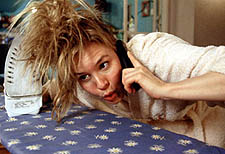
 more.
This was a little different this time. Obviously, I couldn't snoop around
in the office as easily so we didn't try to do that and I'm pretty familiar
with television stuff from the work that I do. So I felt pretty comfortable
in that respect. I felt like I can remember enough from what we had done
before that it didn't just disappear. So I thought, ' Okay, I'll be all
right in that respect.' This time it was more about preparing to go in
terms of script and in terms of being certain that nothing had been left
out and that it was as complete and substantial as it possibly could be.
But everything had been considered and that we were in no way compromising
these characters.
more.
This was a little different this time. Obviously, I couldn't snoop around
in the office as easily so we didn't try to do that and I'm pretty familiar
with television stuff from the work that I do. So I felt pretty comfortable
in that respect. I felt like I can remember enough from what we had done
before that it didn't just disappear. So I thought, ' Okay, I'll be all
right in that respect.' This time it was more about preparing to go in
terms of script and in terms of being certain that nothing had been left
out and that it was as complete and substantial as it possibly could be.
But everything had been considered and that we were in no way compromising
these characters. 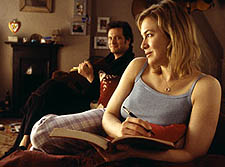 o
feel complete. This is very specific. In the first film, we see a woman
who's trying to come to terms with how she defines happiness for herself,
as opposed to what it is that people project onto her. In terms of what
they expect should make her happy, what she ought to do, what she ought
to look like. Who she ought to be, what she ought to have in order to
have a better life and be a better person and be happy. And by the end
of that film, we see that she's all right with who she is. And she's figuring
out what it is that she wants. She moves onto a job that she thinks will
satisfy her. She stands up to a boss who belittles her and she finds love,
because she believes that it can happen. And in this film, it ' s more
specific. It's a more specific experience of not ruining the good things
in our lives because of our fears and how ultimately, we have to find
something wrong. But in the end, this is a woman who exposes herself to
you and that's what I think people find appealing is that we can relate
to standing in the hallway, wanting to know, 'So, do you like me like
that or not?' And we love that she just goes ahead and blurts it out in
this ridiculous way that makes her seem, like you said, not strong. And
then ultimately, she never fails to get up and move forward. That's strength
to me. That's not weakness and that's not needy from my perspective.
o
feel complete. This is very specific. In the first film, we see a woman
who's trying to come to terms with how she defines happiness for herself,
as opposed to what it is that people project onto her. In terms of what
they expect should make her happy, what she ought to do, what she ought
to look like. Who she ought to be, what she ought to have in order to
have a better life and be a better person and be happy. And by the end
of that film, we see that she's all right with who she is. And she's figuring
out what it is that she wants. She moves onto a job that she thinks will
satisfy her. She stands up to a boss who belittles her and she finds love,
because she believes that it can happen. And in this film, it ' s more
specific. It's a more specific experience of not ruining the good things
in our lives because of our fears and how ultimately, we have to find
something wrong. But in the end, this is a woman who exposes herself to
you and that's what I think people find appealing is that we can relate
to standing in the hallway, wanting to know, 'So, do you like me like
that or not?' And we love that she just goes ahead and blurts it out in
this ridiculous way that makes her seem, like you said, not strong. And
then ultimately, she never fails to get up and move forward. That's strength
to me. That's not weakness and that's not needy from my perspective.