
|
|
About | Features | Reviews | Community | Screenings | Archives | Studios | Home |

April 2006
Down in the Valley - An Interview with Ed Norton
|
| (April: Main Page * Features * Reviews * Screenings * Teen ) Current Issue * Archive |
 Down
in the Valley - An Interview with Ed Norton Down
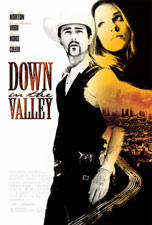
in the Valley - An Interview with Ed NortonBy: Wilson Morales He's played a killer, a racist, a man going to jailer, and other assorted roles, but he's never played a cowboy, that is until now. Ed Norton is one of the best chameleon actors in the field today and each time he's onscreen, he just embodies the role he's playing full of zest. In his latest film, "Down in the Valley", Norton plays a grafter named Harlan who gets tangled with Evan Rachel Wood and his love for her has devastating consequences. In speaking with blackfilm.com, Norton goes his character and trying to revisiting the western genre. Hadn't done anything in a whileä why do this? Ed Norton: It's true. I was taking a little time off. I had
worked on a series of things, and I felt very content and satiated, in
a way. I wasn't burnt out in a bad way. I had some really good experiences,
and I didn't want to just keep going until I had a bad one. So I took
some time, and I was doing a lot of other things. I remember saying to
my agent that something will come along that I won't be able to say "no"
to, and when that happens, then I'll do it. That went on for a while,
and I kept getting things that I found it very easy to say "no" to and
then my agent called me and said he had read this script that wasn't ready
to be a movie. It was very strange and very stream-of-consciousness, but
the guy is really interesting. He said, "I know you and the things that
are in this are going to interest you." I read it and I thought about
it, so I met David maybe three years ago, and we started talking about
it, and I couldn't resist it. It was dancing in so many things that I'm
interested in, and it was so strange and challenging that I started getting
that tickle of that feeling that I get with the most of the ones I've
done that I think are the best ones. I started thinking that it was so
weird that maybe we couldn't even pull it off. I felt that about "Fight
Club", "American History What were some of the elements that attracted you? Norton: In the broadest sense, I felt, as I did about some
of those other films I mentioned, it was a dissection of the way we're
living right now on many levels. It was an examination of things I felt
I recognized in my generation's spiritual issues. This may sound like
a strange comparison, but not dissimilar to "Fight Club," it was about
people trapped in a world that makes them feel very numb and very disconnected
from each other and very inauthentic, seeking desperately a feeling of
authenticity. Harlan, in a lot of ways, is not unlike my character in
"Fight Club" because he's a person willing to engage in desperate fantasy
to create that feeling of the real. Even though those films are very different
articulations of that complaint, I felt that it was a companion piece.
David's from the Valley, and he talked a lot about growing up in the Valley,
feeling such an intense absence of any kind of context. He had no cultural
or spiritual information and no guidance. He said that he wanted to study
how fantasy is sometimes your escape valve for those feelings. I thought
that was really interesting. Obviously, his story was taking place in
the West, and that fantasy that he was interested in was the fantasy of
the Western. I really liked the idea that we discussed for a long time,
of making a Western about the West as he and I and the people our age
are actually experiencing it. Looking at that fantasy and whether it's
something that existed and is lost or did it only exist in movies in the
first place? We don't really know, but I liked the idea of a man and a
girl trying to ride on a horse across the West, but if you did that today,
you'd actually run into about six freeways and seven housing developments.
In that sense, it felt to me like something people would be able to recognize
in their own experiences. Can you talk about working with Evan, and the intimate scenes?' Norton: Well, she's tremendous. I really can't say enough good things about her. She's very young, but she's got a very mature talent. She's a much more naturally talented actor than many adults I've worked with. I think she's got a very mature sense ofãwhat's the best way to say this?ãof what the work can be at it's best. She's at an age when a lot of young women, having to grow up and start doing bigger movies, Evan is in her own way, really pursuing an artistic muse of her own. Even in the time I've known her, she's turned down the kinds of stuff that would turn her into a gargantuan young star, and she's pursuing things that she feels, and I just admire that enormously. I think it's an incredible level of self-possession for someone her age. The experience of working together was very easy. Evan and her mom were both very invested in what the story was about. They both live in the Valley also, and we all talked a great deal about what the movie was about and why we were doing it. How did the intimate scenes feed that, why were they necessary, and then specifically, how were we going to do them and handle it? They collaborated with us on it and they were both fantastic. They actually made it easier on me and David, not the opposite. They were very reassuring, and it was as good a solid a group collaboration that I've been involved in. How did you get Bruce Dern involved in the movie? Norton: (laughs) I don't remember! All I really remember
is David coming to me and saying that Bruce Dern wants to play Charlie,
and I went, "Forget it!" You can't beat that! I mean, he' Can you talk about the subtext about the death of the American Western? Norton: Maybe. The funniest thing is that all the places that we shot these things, that perimeter of the valley, is exactly like that. Guys like Bruce Dern were out there, coming out to investigate and check out what we were doing. We were filming the scene where I take [Evan] on his horse up into the hills, and we could hear all this gunfire out in one of the gulleys, in the trailer homes, and we were like "Good God! Who's out here blasting away into the hillsides?" It was Harlan and Lonnie out there shooting guns somewhere. Bruce is fantastic, a total original. Had you ever ridden a horse before making this movie? Norton: I had ridden, but never to the extent where I trained
for this. I had some great coaches and rodeo riders. It's very har What were some of your specific Western inspirations for the character of Harlan? Norton: There's certain sort of Western anti-heroes that
I loved. In some ways, it's very different, but I loved "Cool Hand Luke."
It's not a Western, but Luke is a character that you love him, but you
know that he's never going to pull it together, and it's that poignancy
of someone who has a certain poetry to them and is beautiful in some ways,
but is deeply dysfunctional in other ways. That's a certain category of
character that we like. There's also the Kirk Douglas movie "The Lonely
or the Brave," but that's kind of the first of the "cowboy being confined"
movies. It's not my favorite movie, although I really like Walter Matthau
in it, he's amazing, but that was in David's mind. I loved the John Ford
movie, "My Darling Clementine." I think Henry Fonda is amazing in that
film. There's so many. "The Searchers" is a great film, Can you talk about the Harlan and Lonnie relationship and why he's interested in him besides him being Tobe's brother? Norton: My theory about it is that Harlan sees himself in Lonnie, he sees a boy looking for guidance or that Harlan gets the chance to be the father he didn't have or something like that. More, I just think Harlan is just in tune to other people who are searching. He sees the way that these kids are needing a sense of themselves or a sense of the world. There's also that thing that when someone is in a deep level of damage themselves, the ability to share what they know is also affirming to them. It reinforces the fantasy that they're trying to create for themselves. Did you have any thoughts about Harlan's true background?
It's not made very clear even though we get hints. Norton: Some of it's intentionally very oblique. I used to say to David when we were cutting the film, "Look, what's your standard for comprehension? How much do you want people to understand the specifics of who Harlan was and is?" And he said that it was very important that he's a mystery and that if everybody understands that he's not all that he says is, but they all have a slightly different interpretation of what that specific history is, then that's good. I admired that and thought it was smart. Every time that they proclaim the death of the Western, it's revised in a new way. Do you think this is part of some trend that is reexamining the genre in a new context? Norton: Well, it's never going to be dead, because the West
is there, and also our National identity is so bound up in the West, in
a sense that our President still puts on a cowboy hat. He's a rich kid
from a Connecticut family who acts like a cowboy. Maybe he's as deluded
as Harlan is, I don't know. There's no denying that the Western mythology
is part of our national mythology, so it's constantly evolving and changing.
You're right. It's gone through different levels of deconstruction. Clint
Eastwood's "Unforgiven" deconstructs the romance of these Western stories,
even though it's still set in those times. I think it was interesting
that Tommy Lee Jones' fi Are you surprised that people are able to read so much into the movie? Norton: People have said a lot of different things, and that is the part of the whole thing that is the most interesting to me is the idea of creating something that lets people bring their own responses and feelings into it, because then it's an actual relationship. People are engaging with the piece. Like Spike Lee or many of my other favorite people I've worked with, I think David's got a sincere commitment to the idea that a film, at its best, is going to ask you to do some of the work emotionally and intellectually. I don't think he ever set out to explain what it was all about, which I really like. Can you talk about some of the other things you've been up to and what you have upcoming? Norton: I produced this film, "The Painted Veil," which will come out in the Fall. We're still working on an adaptation of "Motherless Brooklyn." Sometimes it happens this way. I took a good amount of time off, and then we did some stuff, but it's taken a long time to get "Down in the Valley" out and right. Now, this year, this one, then "The Illusionist" is going to come out in August, I think, and then "The Painted Veil" will be in the Fall, so they sort of stack up, even though you don't really intend it to happen that way. Actually, I'm not that fond of it happening that way, because I think I worry that it undercuts people's ability to get carried away by a character, but they are very different, so maybe it will be okay. |
| (April: Main Page * Features * Reviews * Screenings * Teen ) Current Issue * Archive |
 |
|
Terms of Use
| Privacy
Policy Copyright © 1999-2006, BlackFilm.com
|
 X"
and "25th Hour." Movies like that I generally have had the feeling that
it might not work, and when I've had that feeling, it's generally produced
the more interesting stuff. I felt that about this, and I decided to engage
in it with David, but we spent like six months together, just working
on the script, tearing it apart and rewriting it. Then, we raised some
money to make it.
X"
and "25th Hour." Movies like that I generally have had the feeling that
it might not work, and when I've had that feeling, it's generally produced
the more interesting stuff. I felt that about this, and I decided to engage
in it with David, but we spent like six months together, just working
on the script, tearing it apart and rewriting it. Then, we raised some
money to make it. 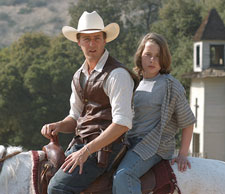
 s
the guy who shot John Wayne on film. He'll tell you that, too, every day.
He's like, "I don't know if I told you, but I'm the only one who has actually
ever killed John Wayne on film." "I think you told me that yesterday,
Bruce."
s
the guy who shot John Wayne on film. He'll tell you that, too, every day.
He's like, "I don't know if I told you, but I'm the only one who has actually
ever killed John Wayne on film." "I think you told me that yesterday,
Bruce."  a
dark film. "Searchers" is so much about racism, and there are so many
different things going on in that one.
a
dark film. "Searchers" is so much about racism, and there are so many
different things going on in that one. 
 lm
["The Three Burials of Melquiades Estrada"], that was an interesting examination,
too, of what have we actually become? Not what were we, but is there anything
left of this set of values, and in a sense, he was saying that that, too,
is going away. I think people have been examining that feeling that something
has slipped away for a long time, but then that's what's fun about "Unforgiven"
or "Deadwood." They're looking at it and saying that maybe this thing
that Hollywood ended up romanticizing was never really that way anyway.
Maybe it was all shit and piss and disease and violence. Maybe it wasn't
quite the new start that everyone thought it was.
lm
["The Three Burials of Melquiades Estrada"], that was an interesting examination,
too, of what have we actually become? Not what were we, but is there anything
left of this set of values, and in a sense, he was saying that that, too,
is going away. I think people have been examining that feeling that something
has slipped away for a long time, but then that's what's fun about "Unforgiven"
or "Deadwood." They're looking at it and saying that maybe this thing
that Hollywood ended up romanticizing was never really that way anyway.
Maybe it was all shit and piss and disease and violence. Maybe it wasn't
quite the new start that everyone thought it was.