
|
|
About | Features | Reviews | Community | Screenings | Archives | Studios | Home |

August 2006
IDLEWILD: An Interview with Director Bryan Barber
|
| (August: Main Page * Features * Reviews * Screenings * Teen ) Current Issue * Archive |
It’s been a natural progression for music video directors to make films their next focus. We have seen it every year with someone new entering the industry. We have already seen Sanaa Hamri do her thing with “Something New” and now it’s Bryan Barber’s turn. Having worked with Grammy awarding artists OutKast for most of their videos, it was only a matter of time that they got into the film business, that he would follow them as well. But unlike some of his colleagues, Barber has had a love for films, especially European film, and uses some of the styles for his videos. For his first film, he gets to team up with OutKast and direct them in a drama, mixed with music and dance, in a film called “Idlewild”. In speaking with blackfilm.com, Barber talks about mixing the styles of foreign films along with music and drama to make a coherent story. What were the challenges of fusing two different styles? Bryan Barber: The fusion was important to me, especially
for a musical. I wanted the musical to transcend color lines even
though they are all African American characters, but the fusion
was important to transport the audience into the 1930s, I believe,
especially with the MTV reality TV generation. I think transporting
them to 30s and expecting them to sit comfortably with
Duke Ellington, and Cab Calloway, and Bessie Smith would have been
a little bit tough because it’s not something they’re
used to. I wanted contemporary artists performing contemporary
songs just to really ground people in that certain reality and
what I was tryin Who is Sally B. Sherman? BB: My great Grandmother. She gave me my first camera when I was 11. A super 8 millimeter. The movie is loosely based on her life. She ran away from Louisiana to San Francisco and lied about her age and for was one of the first black female cable car operators, for a moment. How did your vision change with the increase in the budget and was Coppola’s Cotton Club film an influence? BB: I grew up on Hip hop. Hip-Hop was being born around
the 70s and I was born in 1970-something.But Hip-Hop samples a
little bit of everything. It’s influenced by everything.
Everyone can enjoy it. And so there were a lot of movies that influenced
it. Jean-Pierre Jeunet’s “Amelie”, “Lost
City of Children”, and “Delicatessen”. I
love French films. It was influenced by Lucas’ “American
Grafiitti”. All white characters, but I love that film. The
music transcends all that. I can relate to a coming of age story,
I became invested my emotion in those characters. Minelli and Gershwin.
We had the luck of having Liza come hang out on the set for a few
it was very cool. Vincent Minelli’s first film was “Cabin
in the Sky” with Lena Horne. I reference Cotton Club for
the performances and the fashions. “Color Purple”. “Purple
Rain”, “Wizard of Oz”, “Bedknobs and Broomsticks”, “Pippi
Long Stockings”, and “Escape to Witch Mountai This is a visually stunning film. Can you tell us
about the difficulty or ease of using some of t BB: Music videos are my training ground, luckily enough. I didn’t get into USC. They denied me! Oh, oh that’s gonna come out! “Maybe you shoulda went to USC and the film would have been” (laughs) We had 38 days to shoot the film. I think 38 days, but we had hurricanes come in and that kinda through off our schedule a little bit. Each dance performance was shot in 1 day. I just shot the way I knew how it was pretty simple. There were so many amazing dancers that did the Lindyhop and the Swing and wanted to capture it in a way hat had never been captured on film before. I mean looking at the old stock footage of how people danced at that time its amazing. Throwing themselves in the air, and flipping; and falling on the ground, I thought it was so dynamic. Then we had these younger dancers who had a history of dancing in hip-hop who had to learn how to do Swing, so it just added a whole new spin on it. But my part was easy. They’re part was hard, they had to do it enough times until their feet were swollen at the end of the night. I believe what I captured is phenomenal. I actually want to do some painting. Oil paintings of some of the dancers in the air. It is influenced by Ernie Barnes “Sugar Shack” you might recognize this art work from Good Times and Marvin Gaye’s albums. That was the influence of that and again It kinda lends itself to being a musical. The movie starts off going into vinyl. When you go see it again, you can hear the lint popping. I did that sublimely so you’re mindful that you are listening to a record playing. Are we going to see anything different in the directors cut and are we going to see a definitive video collection on DVD? BB: Definitive video collection is coming soon if we can get all the licensing from the record companies and the film you saw is the directors cut. The extended version that might just be great moments; there is one really funny moment between Zora and Rooster. That will definitely be in it. Why did you call it the Church? BB: Because they invested their time and emotion and faith in the music. He truth of it is that Big Boi wrote this song called “Get up and go to Church” and I wrote the scene around that. I did some research and found out about this Church “soap” was once made and I thought about this juke joint in abandoned warehouse where they used to make the soap. And old remnants of the soap still exist and Church is written on the walls. Did you work with Hinton Battle on any of the moves? How did you two decided to collaborate? BB: I didn’t know Hinton, but my assistant had
studied under him and introduced us. I was thinking about going
with someone younger at one point, but I knew I wanted the dancing
to be authentic then I started looking for some one who had experience
in the Lindyhop and swing. He read th How confident were you that OutKast would be able to handle the comedic timing and dramatic scenes. Did you put them through anything before the start of the film to give them confidence to tackle these roles? BB: Me knowing them, I knew certain things about them. Dre and I have been friends since 1993. They both gave me my first video. We’ve spent so much time together that I just know all these details about them. It was really about them committing to the project and me comfortable enough to say, “I hate what you’re doing right there. Don’t do that.” Did you tell them that? BB: Oh yeah. On some occasion during rehearsals when they were trying to hone in on their characters and how they were going to play them. We were going through a period of honesty. I think it’s important from actors to be honest with their characters. At a certain time, in the early stages of it, it’s not honest. You’re playing with the surface and I hate that. The most important aspect is what’s beneath the surface. Which could lead to paranoia sometimes (laughs), but once they really got honest with their characters, they were unbelievable. I didn’t see OutKast anymore. I stopped seeing Big Boi and Dre. I saw Rooster and Percival. And once they found out what their characters plights were and what made the characters tick and they started doing that on and off screen. It’s like they absorbed it to the point of no return. Why a mortuary? BB: A mortuary is important. There is an important message there. The opening scene in the film is in a funeral home so the message I was conveying was that once you’re in a funeral home , the people in that room to a certain extent sum up your life, that?s you’re legacy. Good or Bad. Whether the people in the room are telling the truth or not. That’s your life. To a certain extent because you can’t defend yourself. The whole idea of the film is to pursue your dreams and once you’re dead whatever you’ve left behind, that’s all there is. So what I was trying to convey is that you have to do all you can with your life before you end up in the coffin. Just apply yourself everyday. The graveyard is the richest place on the earth that is where all the best ideas that never happened lay. The funny thing about funeral homes is that we are all going to visit that place and doing research on how they deal with the bodies. It’s interesting. It’s a stage. The funeral parlor is a stage. You have a director who is the mortician who makes you look nice; then they find someone to tell read your eulogy and tell your life; people dress up and cry over you, some who didn’t really love you; people perform. It’s just another metaphor of the stage, you know all the world’s a stage. The scene with Cicely Tyson was so deep and it was crucial. How’d you come up with it? BB: It’s very important in terms of passing
on a message of being conscious of other people arou IDLEWILD opens on August 25, 2006 |
| (August: Main Page * Features * Reviews * Screenings * Teen ) Current Issue * Archive |
 |
|
Terms of Use
| Privacy
Policy Copyright © 1999-2006, BlackFilm.com
|
 IDLEWILD: An Interview with Director Bryan Barber
 g to say is that if you had been really living
at the time. Cab Calloway would have been the hottest star
at that time. He would have been OutKast or Jay-Z I knew our fan
base was going to be used to OutKast. So I felt that the music
would crossover well especially with OutKast and their delivery
has always been a ”Call-Respond” feel good music that’s
really applicable and makes a connection with the audience. And
if any group could pull it off, I knew that OutKast could do it.
And also it was important, you know, that I kinda pay homage to Cab
and Duke Ellington, Bessie Smith, and Jelly Role Morton because
of their influence on American music. Their music set the pace
for Bee-Bop, swing, jazz, blues, rock and role, R&B, Hip-Hop
and Rap. I think that idea has been lost. My 17 year-old daughter
doesn’t even know who Cab Calloway is. But after this movie,
she might be a little more interest.
g to say is that if you had been really living
at the time. Cab Calloway would have been the hottest star
at that time. He would have been OutKast or Jay-Z I knew our fan
base was going to be used to OutKast. So I felt that the music
would crossover well especially with OutKast and their delivery
has always been a ”Call-Respond” feel good music that’s
really applicable and makes a connection with the audience. And
if any group could pull it off, I knew that OutKast could do it.
And also it was important, you know, that I kinda pay homage to Cab
and Duke Ellington, Bessie Smith, and Jelly Role Morton because
of their influence on American music. Their music set the pace
for Bee-Bop, swing, jazz, blues, rock and role, R&B, Hip-Hop
and Rap. I think that idea has been lost. My 17 year-old daughter
doesn’t even know who Cab Calloway is. But after this movie,
she might be a little more interest.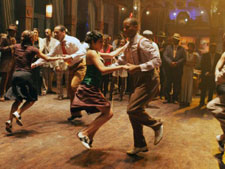 n” fortunately
for me, when I was a younger director, I was told to “Write
for the story, don’t write for money”, so when I was
approached, I didn’t write for a budget. I think that confines
you. They asked if I could expand my script and I said, “Yeah”.
And I was very adamant about this film. I was like Hey. If you
want to do this film, you have to do this film. There is no in
between. I can’t imagine this film having less than
it has. Can you imagine this film if Hinton Battle hadn’t
done the choreography? Can you imagine those dance scenes not being
there? They are such a major part of the film? My D.P is from France.
I wanted someone special. Someone who got the beauty of African
American flesh tones and understood lighting of 30s. Everything
is not flatly lit because they didn’t have a lot of lighting
sources. So there are a lot of shadows and people walking in out
of light. I needed someone who understood the wardrobe. What I
love are the flaws. There are a lot of flaws in the film. I purposely
put flaws in the film. All too often when you see films based in
the in the past; where they go wrong is that they are too polished.
They don’t have flaws. I thought that was important whether
the art direction is chipped paint or wardrobe is frayed material.
People stuttering over their words, I think that’s important
and funny enough I had to explain it “Well we can’t
understand what they’re saying!” I think it was important
to transport you into the moment. You don’t understand everyone
all of the time. I’m a very unconventional person. I come
from music videos, a very unconventional medium. So I was doing
what I know how to do and what I love doing. And I had friends
that wanted to have fun with me and believed in my vision. Had
it not been for HBO, I don’t think I could have gotten it
done. They were very hands off to me as much as possible in terms
of getting in the way of the creative. And really pushed for
me to add all the elements that I felt were necessary. They supported
it even in moments where I was like “I can’t believe
I’m shooting this scene! I can’t believe they paid
for this camera to be here!” But it really worked out well.
They never said anything about the money.
n” fortunately
for me, when I was a younger director, I was told to “Write
for the story, don’t write for money”, so when I was
approached, I didn’t write for a budget. I think that confines
you. They asked if I could expand my script and I said, “Yeah”.
And I was very adamant about this film. I was like Hey. If you
want to do this film, you have to do this film. There is no in
between. I can’t imagine this film having less than
it has. Can you imagine this film if Hinton Battle hadn’t
done the choreography? Can you imagine those dance scenes not being
there? They are such a major part of the film? My D.P is from France.
I wanted someone special. Someone who got the beauty of African
American flesh tones and understood lighting of 30s. Everything
is not flatly lit because they didn’t have a lot of lighting
sources. So there are a lot of shadows and people walking in out
of light. I needed someone who understood the wardrobe. What I
love are the flaws. There are a lot of flaws in the film. I purposely
put flaws in the film. All too often when you see films based in
the in the past; where they go wrong is that they are too polished.
They don’t have flaws. I thought that was important whether
the art direction is chipped paint or wardrobe is frayed material.
People stuttering over their words, I think that’s important
and funny enough I had to explain it “Well we can’t
understand what they’re saying!” I think it was important
to transport you into the moment. You don’t understand everyone
all of the time. I’m a very unconventional person. I come
from music videos, a very unconventional medium. So I was doing
what I know how to do and what I love doing. And I had friends
that wanted to have fun with me and believed in my vision. Had
it not been for HBO, I don’t think I could have gotten it
done. They were very hands off to me as much as possible in terms
of getting in the way of the creative. And really pushed for
me to add all the elements that I felt were necessary. They supported
it even in moments where I was like “I can’t believe
I’m shooting this scene! I can’t believe they paid
for this camera to be here!” But it really worked out well.
They never said anything about the money. 
 e script and he was on fire
to do it and he had so many ideas and he really got and it was
important to me to surround myself with people who got it. What
I was trying to get across and passionate and trying to prove something
for themselves. I try to work with people who are trying
to win their own awards. Hinton had some ideas and he knew some
dancers who were just phenomenal. And he took the challenge we
had limited prep time to put it together and he came full steam
ahead.
e script and he was on fire
to do it and he had so many ideas and he really got and it was
important to me to surround myself with people who got it. What
I was trying to get across and passionate and trying to prove something
for themselves. I try to work with people who are trying
to win their own awards. Hinton had some ideas and he knew some
dancers who were just phenomenal. And he took the challenge we
had limited prep time to put it together and he came full steam
ahead. nd. Being conscious
of helping people you don’t know.
nd. Being conscious
of helping people you don’t know.