
|
|
About | Features | Reviews | Community | Screenings | Archives | Studios | Home |

November 2006
CANDY An Interview with Heath Ledger |
| (November: Main Page * Features * Reviews * Screenings * Teen ) Current Issue * Archive |
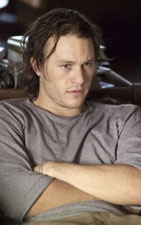
November 13, 2006 Though Oscar nominated actor Heath Ledger can be fairly tight-lipped when he wants to be--enough prodding and pride about his work can get him talking--though it never becomes quite a gabfest. One thing is for sure, ever since the Australian-born, sometime heart-throb, met, got involved actress Michelle Williams and moved to Brooklyn, he's put aside the quest to be this year's hunk. Instead he's willing to do increasingly edgy and career-challenging work like he did as a closeted gay in "Brokeback Mountain," and as he has done in the Australian production of "Candy"--where he plays the heroin-afflicted poet wanna-be Dan who transforms his young love Candy (Abbie Cornish) from art student to fellow junkie. For Ledger he reason why his explored the addict's world was simple--it was from a well-respected book and he wanted to do film in his native country--a place where he hadn't worked in nearly a decade. Does making a film about drugs glorifies them? Heath Ledger: I can't honestly say that it was a concern of mine. I guess because I knew the context within the script, I knew it wasn't really glorifying it. I felt. I was hoping. So I think it ended up being a bit of a cautionary tale above anything. What made you want to do this character? HL: Well, to be honest it was just the opportunity to work at home again. The scripts in Australia are slim pickings these days and it was the best one available. It had been eight years since I've used my own accent in a movie and I was curious as to see what that would be like. What sort of research did you do? HL: Well, physically I stayed out of the sun and I tried to eat less but all the technical aspects of it, Abby and I went to this center in Sydney called NUAOA, which is the Narcotics Users Association Of Australia. And we met a gentleman who has been using and still is I think over the past 20 years or something and he took us into a boardroom and he opened up what looked like a rifle case and inside was a prosthetic arm, which was designed to train nurses and within this center was designed to train young drug addicts how to find a vein and it was a fully functional kind of thing. Inside, the veins are fully functional and the two tubes that you can attach like veins have blood bags and we pumped blood through the arm and you could find a vein and then we find a vein and the nurse showed us how to do that and you could even pump blood out of the arm and put the drugs through and then he s And then the rest like you know for example the drying out sequence, we just had someone on set who could take us through the stages step by step from experience. Now you're in a cold sweat and in this next scene your stomach feels like it's just twisting up into a knot, your headaches, you're botched [?], they just kind of spelt it out for us. And we just responded to his knowledge of it. Yeah, so, that, I guess. Did it take you to get over playing this role? HL: No. Not really. I saved living through the part during that time between "action" and "cut." I'm pretty good at just dropping it once it's over. And certainly once the filming is done, I'm very excited to get back to my own. So yeah, I generally don't find that too difficult. What do you think about celebrities becoming addicts? HL: I don't know... It's obviously that it's not just celebrities in rehab, it's probably a similar statistic to just people outside of the industry. But I do think that drugs and alcohol have been glorified and exoticized in such a way that it gets into the art world, whether it's just watching the way that Jackson Pollock paints with a bottle of booze in his hand and a cigarette hanging out of his mouth, we've kind of connected that to what it takes to create something. When in fact it's anything but the truth. I mean obviously creation comes out of the mind and it's hard to create when you're in that state. But I'm sure drugs and alcohol perhaps would inspire new thoughts and, but, yeah I mean it's certainly not something that I use as a tool or a mechanism to create. What do you think the reaction will be from addicts? HL: I don't know. I really don't. I'm sure they'll see it. But I don't really know the reaction what it will be. What's your favorite scene to shoot or to watch afterwards? HL: Visually, I really li Do you think this is more of a love story than a drug story? HL: I guess it's a love triangle. Them and the drug and I think they're just intertwined. We were all telling ourselves it was more of a love story than a story about heroin. Have you ever done a love scene with someone uncomfortable to be with? HL: Well, I definitely have worked with people that I was uncomfortable with, but I didn't have to do love scenes with them. It's a funny thing. There's nothing attractive about the process when you're doing one of those things, even if the person you're doing it with is attractive, it's just a very unattractive thing to have to go through. But luckily enough, I've worked with a lot of good people. Was that true in this film? HL: Would what be true? That it's a very unattractive process? Yes. Yeah. It is. It's very awkward, there's nothing organic about it whatsoever, there's grips and gaffers and boom operator and lights and focus people looking at your butt and it's just so awkward and clumsy and that's the biggest kind of, objective in scenes, to make it look like it's anything but that, it's so nerve wracking, it's very uncomfortable. How did you feel during the day feeling all these dark things? HL: I don't know I guess we're lucky in the sense that we get to go there and we get to scream about it so you get to purge yourself of it in a way. But it doesn't really affect me personally. Yeah. What did you learn about users? HL: I mean I'm not sure but when I met this one man, the desperation of it and the need to want to be accepted kind of thing and feeling secluded from society, I learned about how they feel alienated by their illness and in learning that, that there's a genuine need for acceptance within society. When they're in the thick of it, they don't see an ending to it Have you known anyone who has treated their partner like your character did? HL: None of my friends have prostituted their girlfriends. Do you like doing improvisation and is there any in this film? HL: Most of the scenes had drips and drabs of improv. Yeah I do, I guess I've never been exposed to a situation of just, ok, you guys meet each other in a park, you're from here, you're from there, ok, roll camera. I've never had something like that thrown at me, which I would probably feel a little uncomfortable with. But I mean if you have a complete understanding of your character and you know what he or she, what is their makeup, where they come from, then it makes it a lot easier. I do like to just throw things out there on the moment you know in an attempt to be captured as opposed to recreate, which is what extensive rehearsals can sometimes take away. Yeah. Neil wanted to do a lot of rehearsal because he came from an extensive theater background and Abby and I were kind of like the heady kids in class who sat at the back and didn't really want to give too much in rehearsal, purely for the reasons I gave you a second ago. It's slightly superstitious of us, but I truly believe in the possibility of creation rather than recreating something that you did in an office space somewhere a thousand miles away, so, yeah, but he did, he respected that and he gave us that room. Did you read the book beforehand or after or meet the author? HL: Yeah I read the book beforehand a couple of times, it was a quick read and the author was onset every day. He wrote the screenplay and he had been through a similar experience and so he was really, he was the source of information I was talking about earlier was coming from him. Are there other writers or directors you would like to work with? HL: Look, most of them are dead. Yeah. Fellini, sure. Cassavetes. But Bob Fosse and… Stanley Kubrick. They're all dead. No, there is. There's a long list of them, I should say. They're not lining up. I wish they were. Terence Malick. I'd really like to be in one of his visual poems. What's your next project? HL: Well, the next thing I am playing is the Joker in the next "Batman". Are you a fan of the Joker? HL: I guess if I was a fan of the comic book characters, it would probably be the Joker. Chris Nolan motivated me to take it, like the opportunity to play this guy. I somewhere inside I kind of knew instantly what to do with it you know. I didn't feel like I had to search for it. I felt like I had a plan of attack already, so that usually dictates whether I want to do something or not. If I feel a connection to it. Have you had any interaction with the Chris Nolan since then? HL: At this point it's pretty much just Nolan. Chris Nolan is pretty busy or was busy with The Prestige and they're sort of still writing the script. Even with me, I don't have a script. I read it once at Chris Nolan's house, but he wouldn't let me leave with it. Have you done any comedies since "10 Things I Hate About You?" Would you like to? HL: Unintentionally, yes. I think I have. Ok. Kind of. I didn't really find them that funny, but yeah. Yeah. I do. I enjoy the physical aspect of comedy. I'd like to do a silent film that's a comedy perhaps. That's something I'd like to do. Has having a family changed your career? HL: No. I didn't immediately get an edge to go out and be a voice in an animated film, but it you know definitely changes the person you are and I think your personal evolutions runs hand in hand to professional evolution, you know performance and the person you are kind of grow simultaneously. So I think it affects performance more than choice, perhaps. What do you like about living in Brooklyn? HL: Everything. I adore it. I love the real sense of community and the neighbors and the coffee shop down the road and I, it's just, we really are left there to live and it's just, it feels like we're on an island when we're just next to one. Can you walk around there? HL: Yeah, yeah, absolutely. I mean, that's the thing, in New York City you're protected by numbers in a certain way. When you're walking in the streets, no one's looking at all the people passing, so, and particularly in Brooklyn. People are really just trying to get from A to B and get through their day. You're in the new film about Bob Dylan and that period in New York. HL: Well, I found the connection in his lyrics, through his music, and through his poetry. And it was an incredible experience. Director Todd Haynes, I consider to be a genius. The footage I've seen of this film is just astounding. Cate Blanchett has given such an incredible transformation in this movie. It's going to blow you away. I mean she walks, talks, sings, smells like Bob Dylan. How does Bob Dylan smell? HL: Not very good. Have you met him? HL: No. I haven't, but you know. What was a turning point in your life? HL: Well, I could tell you that meeting Michelle in Brokeback was something that took me in another direction. In a good way. Well, I've got a baby girl, you know, and I live in Brooklyn. In every sense. Yeah. She was living there for a couple of years before I got there, obviously. Has having a family changed HL: No. I didn't immediately get an edge to go out and be a voice in an animated film, but it you know definitely changes the person you are and I think your personal evolutions runs hand in hand to professional evolution, you know performance and the person you are kind of grow simultaneously. So I think it affects performance more than choice, perhaps. Do you like Christmas here or in Australia? What was a favorite Christmas in Australia? HL: I don't know. They were just always the same. They were always the same every year in Australia. Which was not necessarily a bad thing, but it was, you know, Christmas in Australia is obviously different from Christmas over here. You don't get skies and snowboards, you get surfboards and sun towels and you go to the beach after your Christmas dinner and lunch. I don't know. Yeah. I don't know if I can recall a Christmas particularly. Are you still committed to Brooklyn? I read that you bought a home in LA. HL: Yeah. We are. It was purely Michele was working there and I was, but Michelle was, when Michelle was working and I'm the manny, and when I'm working Michelle's the nanny. And so when she was working, I was in a hotel room about the size of this, and I was just, it was really hard and whether we Are you excited that any of these new films will draw more Oscar attention? HL: No. I've never had high expectations of my work and I certainly I'm not going to let that plague my thoughts and I'm just going to continue to choose what feels right for me at the time and go with it. How do you think the attention being give your co-star Abby Cornish [who has had an affair with Ryan Phillippe--who is separated from Reese Witherspoon] will affect this film's box office? HL: I don't know. It's unfortunate for everyone involved, I guess. It's really none of my business, but the way you asked the question, I guess I cannot not answer it, I guess. I don't know how it affects the box office. I'm not sure if there will be one for this film, so I don't know, to tell you the truth.
|
| (November: Main Page * Features * Reviews * Screenings * Teen ) Current Issue * Archive |
 |
|
Terms of Use
| Privacy
Policy Copyright © 1999-2006, BlackFilm.com
|
 CANDY
CANDY howed us how to tie the tourniquets and there's that.
  ke the stuff shot in the rotating camera motion. I didn't enjoy shooting that. It just made me want to vomit. It was a half a day kind of thing. I didn't like that very much. Didn't sit well with me.
  so they just want to be treated normally. So. Maybe that.
 your career?
 like it or not, you go in and out of LA all the time. So we found a one bedroom treehouse up in the hills out there and it's just a place to drop our bags.