
October 2002
Real Women Have Curves
|
October 2002
Real Women Have Curves
| ||
| (Oct: Main Page * Features * Reviews * Gallery * Teen Current Issue * Archive |
|
Reviewed by Niija Kuykendall
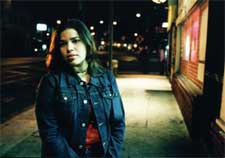
Real Women Have Curves is a beautifully written and directed coming-of-age story set within the environment of a colorful, diverse Los Angeles. The film is from the play of the same title by Josefina Lopez, loosely based on her life growing up. The story is centered around America Ferrera, who plays an eighteen-year-old,
first generation, Mexican American girl, Ana, trying her hardest to cross
the border between girlhood and womanhood, family tradition and individuality
while her close knit family tries their hardest to keep her as their baby
girl. The most insistent in this endeavor is the overbearing, clutching
mother, played with complexity and humor by Lupe Ontiveros. The film spans the summer after Ana’s high school graduation as she struggles
within the grip of transition to make her mother understand her position
as a young woman needing to break away from familial clutches and tradition
and go her own route. Her struggle also includes an effort to understand
the socio-economic dynamics of a Mexican American family living in the
U.S. that are thrust in her face all in one summer after a lifetime of
being protected by her family. The story is not only about Ana growing
up but also includes subtle yet powerful lessons on culture, racial and
class differences within the cultural melting pot of Los Angeles. From
the beginning we see class delineation as Ana travels through a beatifically
shot, predominantly working class Latino inhabited East L.A. to Beverly
Hills to attend high school. In comparative moments like this, cinematographer,
Jim Denault, succeeds in exhibiting cultural and class difference to the
viewer in his excellent photography of the neighborhoods of L.A. He captures
the color, smell, activity and essence of an East L.A. that is overflowing
with hard-working families that must work to keep a balance between tradition,
upward mobility, and twenty-first century familial dynamics in an often-oppressive
no-breaks environment. He juxtaposes this with the chilly essence of a
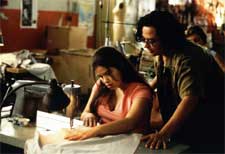
privileged society ignorant of its neighbors in the photography Ana’s journey to social awakening begins the first day of her summer as she begins working in the dressmaking factory her sister owns and is struggling to keep alive. As time goes, Ana’s snobbish self-righteous anger at being forced to work in a “sweatshop factory” diminishes. She begins to realize that her sister is a young entrepreneur trying to keep her business afloat and support the women that work in her factory in face of unforgiving economic times and the surrounding capitalistic business ethic. Ana eventually becomes a part of this family of women factory workers and the dynamics between Ana and the women become an important part of Ana’s woman transition. The film is not only about what Ana learns from this summer of change, but also about what those around her can learn from her new vision of the world. Ferrera and Ontiveros play the relationship between Ana and her mother wonderfully as a tug-of-war goes on between the two for Ana’s body and mind. As much is said by look and inference as is said out loud. Ana struggles to break away while her mother struggles to keep Ana tied to her. This tug-of-war dynamic makes for some very funny moments throughout a film that is a beautifully warm, comedic drama. | ||||||||||||||||||
| (Oct: Main Page * Features * Reviews * Gallery * Teen ) Current Issue * Archive |
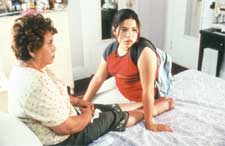 Although
Ana wants more than anything else to go to college, her traditionally
minded mother insists that Ana will stay home, get married, and help her
family as she herself did when she was a young woman.
Although
Ana wants more than anything else to go to college, her traditionally
minded mother insists that Ana will stay home, get married, and help her
family as she herself did when she was a young woman.
 of
Beverly Hills as our protagonist attends a high school in which the majority
of students are of a predominantly white, privileged class.
of
Beverly Hills as our protagonist attends a high school in which the majority
of students are of a predominantly white, privileged class.