Frida
|
 |
| Distributor: |
Miramax Films |
| Director: |
Julie Taymor |
| Producers: |
Sarah Green, Salma Hayek, Jay Polstein, Lizz Speed,
Nancy Hardin, Lindsay Flickinger, Roberto Sneider |
| Writers: |
Claney Sigal, Diane Lake, Gregory Nava, and Anna Thomas
|
| Director of Photography: |
Rodrigo Prieto |
| Music: |
Elliot Goldenthal |
| Cast: |
Salma Hayek, Alfred Molina, Geoffrey Rush,
Ashley Judd, Antonio Banderas, Valeria Golina, Edward Norton, Mia
Maestro |
Based 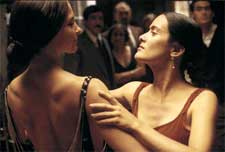 on
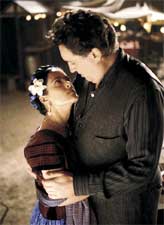
the biography by Hayden Herrera, Frida is a richly layered film full of
the vibrant essence of its subject. Salma Hayek plays the iconic artist
Frida Kahlo with the passion and ferocity that has made the Mexican artist
legendary. The film is a homage to both Frida Kahlo, the temperamental,
full of life-in the face of death woman; and Frida Kahlo, the dark, mythically
surreal artist. The visual work is beautiful with colors and texture imagery
so densely rich that the viewer feels as if the film itself was a canvas
the director took a paintbrush to. The director, Julie Taymor of theater
and opera esteem, does a wonderful job of conveying memory of Frida’s
work using a trick bag full of all sorts of direction, camera work and
editing. She guides the viewer through tragedy, joy and sharp pain on
the roller coaster ride of Frida’s life with on
the biography by Hayden Herrera, Frida is a richly layered film full of
the vibrant essence of its subject. Salma Hayek plays the iconic artist
Frida Kahlo with the passion and ferocity that has made the Mexican artist
legendary. The film is a homage to both Frida Kahlo, the temperamental,
full of life-in the face of death woman; and Frida Kahlo, the dark, mythically
surreal artist. The visual work is beautiful with colors and texture imagery
so densely rich that the viewer feels as if the film itself was a canvas
the director took a paintbrush to. The director, Julie Taymor of theater
and opera esteem, does a wonderful job of conveying memory of Frida’s
work using a trick bag full of all sorts of direction, camera work and
editing. She guides the viewer through tragedy, joy and sharp pain on
the roller coaster ride of Frida’s life with 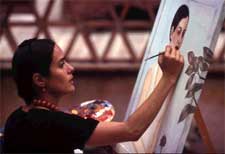 evocative
lighting and production design. While, at many moments, the film does
walk too fine of a line between Kahlo-induced fabulousness and over-the-top
sensory overload, the viewer, even one who knows nothing about Frida Kahlo,
will receive a vivid sense of the tornado of Kahlo’s life. evocative
lighting and production design. While, at many moments, the film does
walk too fine of a line between Kahlo-induced fabulousness and over-the-top
sensory overload, the viewer, even one who knows nothing about Frida Kahlo,
will receive a vivid sense of the tornado of Kahlo’s life.
Although somewhat overpowered by the tremendous visual aspect of the
work, Salma Hayek is an eery reincarnation of her countrywoman (at least
according to our knowledge of Kahlo through books, photos, stories and,
of course, her art). Her fight to get the project into existence amid
industry doubt and rivaling icon-mongers Madonna and Jennifer Lopez ‘s
efforts seems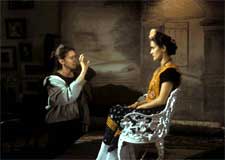 to mirror Kahlo’s fight to be taken seriously as an artist in a world
not very welcoming to a latina communist/feminist of any occupation. Hayek
succeeds in proving her right to the role, and the role’s right to the
big screen, as we watch her uncanny likeness and wonder just how Madonna
or Jennifer Lopez would have pulled it off. Alfred Molina is mesmerizing
to watch as Diego Rivera, Frida’s famously genius husband whose political
public art overshadowed Frida’s own work for most of her life. With the
help of Molina, the couple’s tempestuous, painful joy of a relationship
is really believable.
to mirror Kahlo’s fight to be taken seriously as an artist in a world
not very welcoming to a latina communist/feminist of any occupation. Hayek
succeeds in proving her right to the role, and the role’s right to the
big screen, as we watch her uncanny likeness and wonder just how Madonna
or Jennifer Lopez would have pulled it off. Alfred Molina is mesmerizing
to watch as Diego Rivera, Frida’s famously genius husband whose political
public art overshadowed Frida’s own work for most of her life. With the
help of Molina, the couple’s tempestuous, painful joy of a relationship
is really believable.
Once I got past the sensation of being 80% enthralled and 20% overwhelmed
by the bombardment of 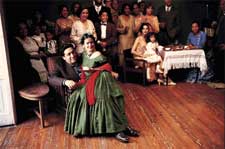 exotic
color and imagery as well as the melodramatic highs and lows of Frida’s
love life and affairs, I was disappointed by the story’s lack of attention
to Frida’s work and thought. The plot is focused on sensationalizing her
love affairs and fits of heartbreak more so than on the mysterious thought
processes and compelling mixture of politics that makes her art as gripping
as it is. Her persona is entirely caught up in Diego Rivera’s character,
which is a shame knowing that Kahlo’s radical life was devoted to being
her own autonomous, womanly individual in a patriarchal, capitally supremacist
world. Regardless of the narrative’s minuses, the movie was wonderfully
intriguing for both fans and nonfans alike. exotic
color and imagery as well as the melodramatic highs and lows of Frida’s
love life and affairs, I was disappointed by the story’s lack of attention
to Frida’s work and thought. The plot is focused on sensationalizing her
love affairs and fits of heartbreak more so than on the mysterious thought
processes and compelling mixture of politics that makes her art as gripping
as it is. Her persona is entirely caught up in Diego Rivera’s character,
which is a shame knowing that Kahlo’s radical life was devoted to being
her own autonomous, womanly individual in a patriarchal, capitally supremacist
world. Regardless of the narrative’s minuses, the movie was wonderfully
intriguing for both fans and nonfans alike.
|