
|
About | Features | Reviews | Community | Screenings | Archives | Home |

September 2004
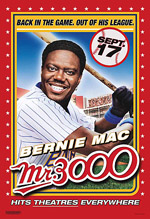
Mr. 3000: An Interview with Director Charles Stone
|
| (September: Main Page * Features * Reviews * Screenings * Teen ) Current Issue * Archive |
| Mr. 3000: An Interview with Director Charles Stone By Todd Gilchrist The main characters in both "Mr. 3000" and your previous film "Drumlin" are talented folk in dire need of a dose of humility. Is this a theme that particularly interests you? Charles Stone III: I think I'm really fascinated by super-talented
people. I always liked the story of the child prodigy who has this magical
talent but it's sort of raw and undisciplined and then all of the elements
of the people around him that try to forge it for the right or wrong reason.
Devon in "Drumline" was kind of like that in the sense that he had this
special power but he had a special weakness, like he could play be ear,
which some kids can do, but he can't read music, which is considered a
basic, fundamental thing. I think in these films, the people are intensely
talented but they haven't found their way; [in "Mr. 3000"], Stan Ross
was this great talent, up on this gold-leaf soapbox saying I am magnificent!'
and in actuality he's not, but his soul compels him to find out why not.
For me, [his friend] Boca, who's an angel in the movie, is just there
to help steer him along. That's why he doesn't make very much sense- you,
he says do your thing,' that's what I'm sayin' and all of that stuff-
I wanted him to be cryptic, and then [Stan's] ex-girlfriend tears him
a new *sshole, and at that point he can finally hear what Boca means [when
he says] that's why I love you,' even though they had been saying it
to one another for the longest time. I'm really fascinated by that kind
of character. Someone said you've done so many different things, with
"Paid in Full", "Drumline" and "Mr. 3000",' and I said well, they're
all similar in that the [main characters] all have a relationship with
the s One of the interesting elements of your films is that they feature predominantly African-American casts, but have a much broader appeal. How conscious of that juxtaposition, or potential, are you when picking projects? CS: Wow. That's a big one. I'm totally conscious of it, and
I'm totally sub-conscious of it. In a way I want to say I just do what
makes me feel good, like when I did the short film "True", that was [the
origin of] the Whassup?' campaign, I did that because it was what appealed
to me, and then the reaction was universal, and there just seems to be
that air about the work that I've done. In terms of the color factor,
that's a big deal, and it's kind of a dilemma. I want to work with Ed
Harris and Julianne Moore and Frances McDormand and Jeff Bridges, all
of these great white actors, even though you never refer to them as white'
actors in the way you refer to other people like he's a black actor'
or I'm a black' director, which in itself is its own issue. But I just
feel like I have an obligation to put out great stories with people of
color because there just aren't a lot of them; that's my opinion. A lot
of people would agree and some of them would not agree, but there are
a great deal of opportunities that you see in film with people of color
in general, but then good ones are few and far between. People say well,
what do you think of "Soul Plane"? Do you hate that?' and I say no. I
have no problem with those kinds of films. I have a problem when that's
all you see- that's where the issue is. It's also what you do with a genre
that we've seen a billion times. I took a gamble and I did "Paid in Full",
because the whole gangster film is kind of burnt out, but I felt if I
could tell a real human story with a little bit of a surreal edge, that's
what I would want to do. It's not provocative or different, it's just
much more of an ordinary human tale, and it gives a sense of humanity
in these characters that people would write off as hip-hop thugs, and
I'm very conscious about that. When I did "Mr. 3000", there are a couple
of things I said: one was that I want to make a great American sports
film, and two was I want to make a great American sports film with a person
of color, just so we could be represented. I mean, baseball today is South
American, Dominican Republic, African American, Korean, Chinese, Japanese,
not predominantly, but a significant amount, so in a way it makes sense
as well, but in terms of the Barry Bonds kind of cats today, but I made
a conscious decision to do that. But I made a conscious decision to make
Boca white, because originally Boca's supposed to be black, especially
with the slang terms. Those are the kind of things me and my friends would
say: do your thing, man,' or that's why I love you, dog,' or I'm just
sayin,' and you can say that word with four different inflections. You
can say you know what I'm sayin'?' in like four different ways, and "True"
was very much about that, about the So until the day comes when studios greenlight an 80 million dollar movie starring a little black child, how do you as a filmmaker continue to tell stories that transcend the appeal of a niche market, especially in light of the way movies are marketed exclusively to African American or one particular audience? CS: It's very easy to say, and I think there's more to it, but I think there's humanity to the characters that everyone can associate themselves with. Even "Paid in Full" to an extent- and it's a dark film that's got slang out the wazoo- doesn't lose its grounding in terms of the human struggle. There's a general respect for how we are as a people, not just as Afro-American people, but as a people that people register with. If the world can embrace Whassup!' so intently, it's the same thing, because that was never about the screaming.' When I wrote the short, it was never about that; I knew that was something we used to do, but what is good about that is the sitting on the phone, watching television and not really talking on the phone- that's the thing. Despite who Bernie Mac may be, though his show is very successful and it seems to reach a wide audience, my films pay respect to how human beings act. Those little nooks and crannies, I think people dig. It's still frustrating to see a majority of one ethnic group covering one film or one kind of film but not another. CS: I want to back up, because you said something about the
segregation part of it, and that you usually don't see a lot of black
journalists at other films that are more quote-unquote white, but you
see them at black' films. The studio has something to do with that, as
much as I do, and in my eyes- and I'm only three films old- it's about
making money. The studio is down to make a good picture for various reasons
but they still have to get their return. They've still got to maximize
[profits]. ["Mr. 3000"] is really an adult film. I mean, it's geared towards
adults, right? But [they are thinking] how can we get teenagers in there?'
It's like how can we maximize the amount of money that we make?' That's
a reality, but when they test these films to find out who likes it and
who doesn't, what's the age range of the audience, all of that stuff,
this tested really well with African Amer How formidable is the challenge of moving to something like "Tekken", which has been discussed as your next project? CS: I don't know if it's next. Hopefully it will be, but they say it's never greenlit until the person calls Action',' but we'll find out how challenging it is because it will be at least double whatever it cost to make "Mr. 3000", depending on whoever we get to play the roles. If I get the three people I really want, the budget will be really big, but I refer to myself as a car salesman. It's like you've got to sell the studio on the car you want them to buy, and then they start to give you the money for it, but they want to test drive it and they're like I'm not sure about the handling,' and you've got to re-enroll them in why this is a good thing they are buying, meaning they're buying my vision. For something like "Tekken" it will be that, but also I partly go into this kind of situation knowing that there's going to be like 20,000 chefs in the pot, but we'll see. Make sure you interview me afterwards, if I'm even alive (laughs). What sort of research have you done for the film thus far? CS: I haven't begun, really. We got the writers going on it, but I do want to just investigate K1 fighting- it's out of Japan- and then they're the Ultimate Fighting competitions that are sprouting up all over the place; I want to investigate those, and just look at the history of the gladiator world through the past. I'm kind of interested getting back to the whole sports super-conglomerate, Nike thing, and also drugs and steroids and the whole anabolic madness, which will be a part of the whole "Tekken" concept in some kind of way which could be interesting. Right now I'm framing it after sort of "Enter the Dragon" as a backdrop, but again, more realistic and more accessible; I want it to seem like it can really happen in today's society, despite how grand and superhuman the characters are. In fact, we're probably not even using some of the more special effects-laden characters. We'll see how that all comes together, but I'm working on my own stuff as well; I've got script ideas that I'm putting into development, short films that I want to do, I just started a production company for commercials called Brown Bag, so I'm dabbling in commercials a little bit again. It's all open right now. |
| (September: Main Page * Features * Reviews * Screenings * Teen ) Current Issue * Archive |
 |
|
Terms of Use
| Privacy
Policy Copyright © 1999-2004, BlackFilm.com
|
 potlight.'
Ace is trying to avoid it, Devon wants it and it blows up in his face,
and Bernie Mac is immersed in it. We open up with him in the spotlight
and we end with him in it as a different man, so there is something about
the spotlight and what it means that draws all three of these characters
together."
potlight.'
Ace is trying to avoid it, Devon wants it and it blows up in his face,
and Bernie Mac is immersed in it. We open up with him in the spotlight
and we end with him in it as a different man, so there is something about
the spotlight and what it means that draws all three of these characters
together."  art of language, to be able to communicate without saying a whole bunch
of stuff. I'm very conscious and it's tough, but I [also] did this in
music videos. My first music video was for Living Color, and after that
I did A Tribe Called Qwest and Public Enemy, and then I went to my producers
and said I want to do some white bands.' I wanted to establish myself
in a genre that was the norm, and that was rock videos, because rock videos
were doing the more creative stuff. That was a conscious decision I made
in my professional life; I think if you listed my three films together
you would think maybe I was black if you didn't know, because of the all-black
casts. But [a person like Antoine Fuqua] is establishing himself in Hollywood;
M. Night Shyamalan is the same way- I've even said to myself why hasn't
he done something with Indian people?' And he's working on one now, apparently,
based on Indian mythology or folklore, but he's already built a reputation
now so people would probably give him money to do a movie that doesn't
have white folks in it. A part of me feels like I don't even have time
to do that. It's a very selfish thing to think oh, are you the only exceptional
filmmaker working out there?' but I'm 38 years old and I feel like there's
a lot of stories I want to tell. I want them to representative of people
of color, and it hits me hard is when I see something like "Harry Potter"-
I'm a big science fiction fan and I love those films- and [I realize]
a studio's not going to put 80 million dollars behind a little black child
unless that kid is marketable, like Will Smith or something. That's what
we hope for, but I want to tell stories that are about imagination, that
excite children like the way "Star Wars" changed my life, but I want to
see people of color in that position. I'm so tired of being in that drawer,
[and] I don't talk about it a great deal, but black kids, Asian kids need
to see that, because there's nothing like it.
art of language, to be able to communicate without saying a whole bunch
of stuff. I'm very conscious and it's tough, but I [also] did this in
music videos. My first music video was for Living Color, and after that
I did A Tribe Called Qwest and Public Enemy, and then I went to my producers
and said I want to do some white bands.' I wanted to establish myself
in a genre that was the norm, and that was rock videos, because rock videos
were doing the more creative stuff. That was a conscious decision I made
in my professional life; I think if you listed my three films together
you would think maybe I was black if you didn't know, because of the all-black
casts. But [a person like Antoine Fuqua] is establishing himself in Hollywood;
M. Night Shyamalan is the same way- I've even said to myself why hasn't
he done something with Indian people?' And he's working on one now, apparently,
based on Indian mythology or folklore, but he's already built a reputation
now so people would probably give him money to do a movie that doesn't
have white folks in it. A part of me feels like I don't even have time
to do that. It's a very selfish thing to think oh, are you the only exceptional
filmmaker working out there?' but I'm 38 years old and I feel like there's
a lot of stories I want to tell. I want them to representative of people
of color, and it hits me hard is when I see something like "Harry Potter"-
I'm a big science fiction fan and I love those films- and [I realize]
a studio's not going to put 80 million dollars behind a little black child
unless that kid is marketable, like Will Smith or something. That's what
we hope for, but I want to tell stories that are about imagination, that
excite children like the way "Star Wars" changed my life, but I want to
see people of color in that position. I'm so tired of being in that drawer,
[and] I don't talk about it a great deal, but black kids, Asian kids need
to see that, because there's nothing like it. 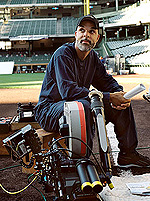 icans,
so they're really going to hit that target hard. What I'm saying is that
the studio is a big influence on the choices they make about how they
want to present a film, which could bear a lot of influence on segregating
a film, or bringing a lot of people together. I was like, you don't need
to make a trailer that is promoting Bernie Mac just being funny,' but
if you watch the trailer it comes off as a broad comedy. You go see the
movie and you go, oh sh*t!' it's still funny as hell, but it's got much
more heart, but [the trailer is designed] to make sure that people who
love Bernie Mac are going to go see a Bernie Mac film, and to get those
people into the seats. I'm like, why can't you create a trailer that's
got both elements?' They have the power to enroll people that they think
aren't going to come see this movie, but they don't want to spend too
much money on that because it's a risk. But they're going pretty broad
with this.
icans,
so they're really going to hit that target hard. What I'm saying is that
the studio is a big influence on the choices they make about how they
want to present a film, which could bear a lot of influence on segregating
a film, or bringing a lot of people together. I was like, you don't need
to make a trailer that is promoting Bernie Mac just being funny,' but
if you watch the trailer it comes off as a broad comedy. You go see the
movie and you go, oh sh*t!' it's still funny as hell, but it's got much
more heart, but [the trailer is designed] to make sure that people who
love Bernie Mac are going to go see a Bernie Mac film, and to get those
people into the seats. I'm like, why can't you create a trailer that's
got both elements?' They have the power to enroll people that they think
aren't going to come see this movie, but they don't want to spend too
much money on that because it's a risk. But they're going pretty broad
with this.