
25 Years Later: Catching Up With Just Another Girl On The I.R.T Director Leslie HarrisPosted by Wilson Morales
March 14, 2018

In 2017, we saw seven African American female directors (Dee Rees, Angela Robinson, Stella Meghie, Maggie Betts, Janizca Bravo, Amma Asante, and Sabaah Folayan) have their films released in theaters by studios. That was a record amount, but still nothing to cheer about. With Ava DuVernay’s A Wrinkle In Time currently in theaters and the 1st Black female to direct , hopefully we get to see more Black female directors have their projects shown on the big screen.
Two decades ago, that wasn’t the case. Julie Dash opened the doors after her film Daughters of the Dust became the first full-length film directed by an African-American woman to obtain general theatrical release in the United States. The following year, another Black female director came on the scene.

Today at the Alamo Drafthouse in Brooklyn, NY, director Leslie Harris will be in attendance for the screening and Q & A of her feature film debut Just Another Girl on the I.R.T.. The film first premiered at the 1992 Sundance Film Festival, where Harris became the first African-American woman director, writer, producer and executive producer to win a Special Jury Prize for Best Feature Film.
This year marks the 25th anniversary of the film’s theatrical release (March 19). Set in Brooklyn, the focuses on Chantel (Ariyan Johnson), a high school student who is sharp and proud, unafraid to argue with her teachers or customers at the bougie shop in which she works. She expects more out of life, but when she is faced with a crisis that can throw her world off-kilter, she struggles to stay strong.
With a budget of only $100,000, Harris wrote, directed and produced the film and then set out to get the film distributed through Miramax.
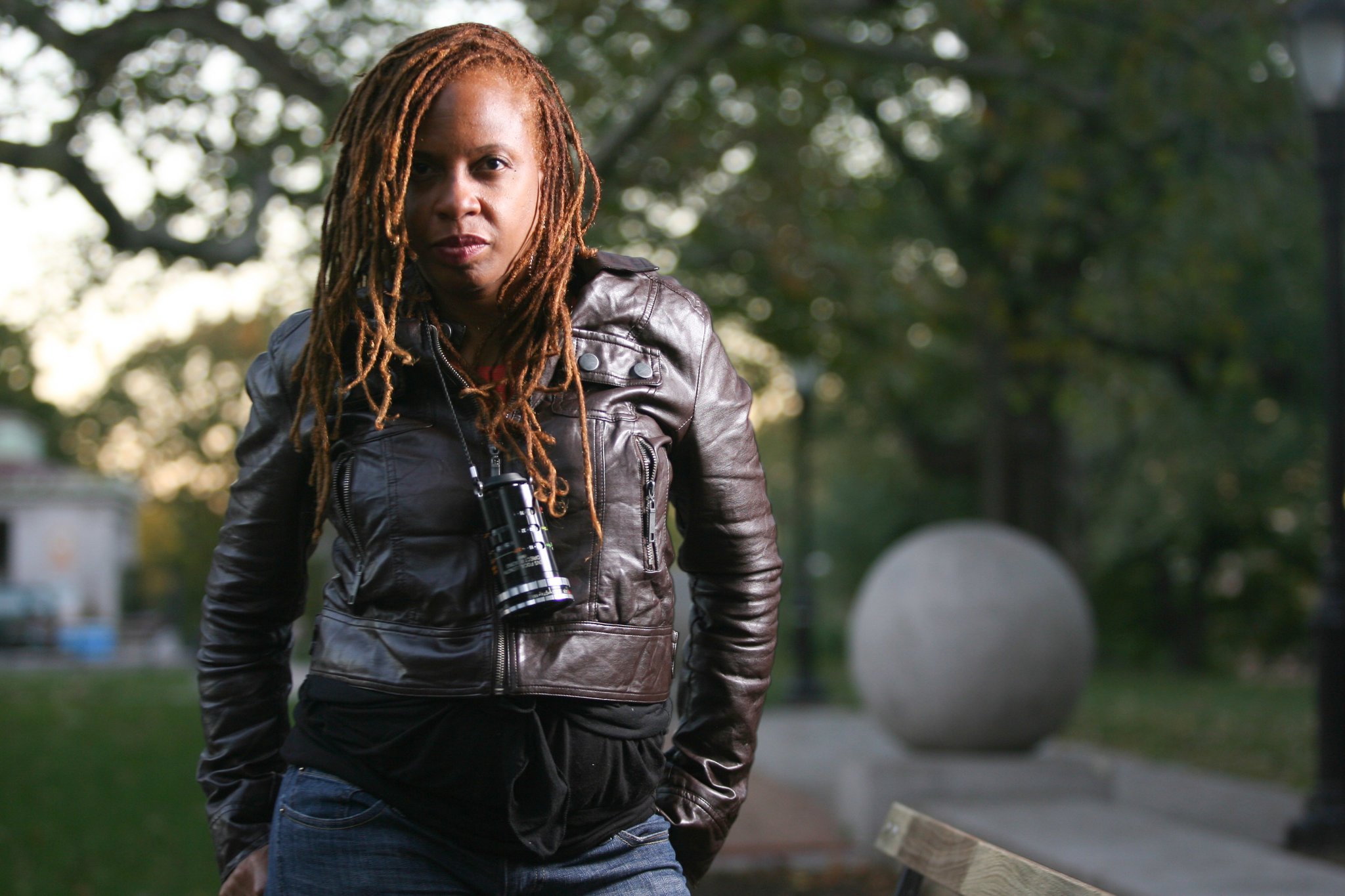
Blackfilm.com caught up with Harris as she reflects back on the film while still advocating for more female filmmakers of color.

It’s 25 years later. Did you ever think you’d still be talking about this movie?
Leslie Harris: Not really, but I’m happy. It’s funny because with social media, which we didn’t have 25 years ago, it has a little resurgence of the movie and fans, in sense of young people so that’s nice, I think.
Why do you think the story’s still relevant enough that people are bringing you back to festivals, showing the film again, and talking about getting it made?
Leslie Harris: Well, you know what’s interesting is I look at the comments that I get on Twitter and the tweets I get, and also people who I meet, and it seems like the film is still relevant today. I also think that with the character Chantel, she’s very Afro-centric, with her hair, with the single-layer twist, reading Malcolm X, talking about when she’s in the classroom, “Art education is mis-education” about the whole thing about the African maps. And so in just having a story, a fun, dramatic story. I think there’re elements in the film that was done 25 years ago that young people can relate to.
As a filmmaker back in the ’90s who wrote, directed and produced her own film, you were able to orchestrate enough attention to get this movie released. 25 years later, we’ve seen more filmmakers from Amma Asante, Angela Robinson, Dee Rees to Ava DuVernay. What have you seen that’s gone further?

Leslie Harris: I believe that one of the big changes that I’ve seen since I did the film 25 years ago is there’s more black women who want to make movies. 25 years ago, I felt alone, to be honest with you. Julie Dash had come before me. There were women filmmakers out there, but they weren’t getting any recognition or notoriety. It was hard for them to get financing too. I think that’s the big thing.
And so, even with my film, I just had to buckle down and say, “I wanna do this myself and have that black entrepreneurial spirit.” And I just created my own company and I said, “I wanna see-” because at that time, I wasn’t really seeing black women on screen, in theaters. Even on television at times it wasn’t- “Moesha” came after IRT. It was really bad, in terms of our representation, black women.
I think in the last 10 years, I’d say, it’s been progressively getting better, in terms of for television, it’s good. You have Being Mary Jane, you have Scandal. But that really happened, pretty much, in the last, I’d say, 10 years.
Now for those who haven’t read anything about yourself, what happened after this movie? Did you get any other offers? What happened between there and the next project? Or did you continue to work behind the screen?

Leslie Harris: Well, I feel like that for theatrical movies, it’s still a big problem for black women directors and writers, producers. We do have some- we have Ava, Dee Rees, it’s coming up. But that still isn’t good enough, you know? Just to name a couple people, it’s still very dismal. I’m in the Directors Guild and the amount of television is very dismal. There’s only 21% and I just saw this the other day, 21% of the television shows are directed by women. And that’s just women. Not women of color, women.
And that’s not good. And then if you go for theatrical, it’s dismal, really, in terms of the amount of white male directors who are directing, as opposed to women of color. And when I came up, I did the festival circuit with Quentin Tarantino, Robert Rodriguez, and Bryan Singer. They all went on to bigger careers, you know what I’m saying? And at that time, look at Julie Dash for example. It’s not just me.

And so it was tough. We had to endure a lot of discrimination, basically, in the industry. Even now, and I also like to write films. Right after I did IRT, I wrote several screenplays that dealt with a black woman as the lead. I was told by studios and agents it just couldn’t get financed. If you think about it, with the Oscars that just passed, how often is it that we have a black woman nominated for a lead?
After IRT, Showtime asked me what I would like to do for Black History Month, and I did like a short film. It was a period piece about Bessie Coleman, who received her international pilot’s license two years before Amelia Earhart. We did a period piece on that. Then I went around the studios, saying, “I want to do a longer feature on Bessie Coleman,” and a lot of some of the comments I got was, “Bessie Coleman wasn’t important.” Two executives actually said that to me.
So where are you these days? Are you touring around, talking about IRT? Are you teaching? What’s happening?

Leslie Harris: Well, I have taught at NYU. Right now, I’m not teaching now at NYU. During the summer I’m shooting a documentary on the making of IRT, but not just the making. It’s my experience being a black woman as a filmmaker, writer, producer. I have several scripts. But the film I’m working on now is called “I Love Cinema.” It’s a political, it’s a woman who’s obsessed with movies, and I’m obsessed with movies. I love movies.
She has to be challenged by her belief in just being focused on movies, but there’s a whole world out here about politics and racism and all that. It’s her coming into her activism; and the director Michael Moore is going to act in it. So we’re hopefully shooting that this summer, raising the money. But that’s the whole thing is that when you want to do a project like I did with IRT, that was produced. I produced it through my company.
There’s stories that I want to tell and a lot of times that’s more difficult than I think people realize, if you’re not going through the studio.

What advice would you give a female filmmaker trying to get her film off the ground?
Leslie Harris: I guess my advice is figure out what you want in filmmaking because some people want to make Hollywood movies, and that’s fine. But some people want to make indie films, whether you’re male, female. Some people want to make a film that actually has a statement, that is a personal vision or a personal outlook. So I think that the best advice I can give is really find out what your niche is, what is your passion? And don’t stop until you get it done.
My passion is to make movies that I feel depict black women in their complexity. Even as Just Another Girl, she wasn’t just a good girl, she wasn’t just a bad girl, she was a complex character and I want to continue to do that. And yes, it’s taken me a long time, but it will happen. I believe tenacity is more important and also the industry has changed. When I was doing IRT, no one was talking about black women filmmakers. We had Julie Dash before. I think that I love theatrical movies, and there’s no reason why we can’t have more women directors during theatrical releases.