
Self-Made: Madame CJ Walker Series Review By Kelisha Graves

What happens to a dream deferred? Does it dry up like a raisin in the sun?…Or does it explode? -Harlem by Langston Hughes
Even if circumstances in post-slavery America conspired to cause Sarah Breedlove –born two years after the end of slavery– to dry up like a raisin in the sun, her rejuvenated ego as Madame C.J. Walker enabled her to explode onto the beauty culture scene full-force. After her own miracle hair growth is achieved, she is transformed and empowered. If merely occupying space wasn’t enough, she made sure to carve out enough space for herself and others. The rags-to-riches odyssey of this woman helped increase the bandwidth of black beauty culture. Her mission for “growth” was literal and unearths deeper questions about the ways in which black women asserted ownership of their aesthetic.

Walker’s era was one of tremendous uplift and upheaval. Born a girthy black girl in postbellum America, orphaned at age 7, and married at 14, it might have seemed that her options in life would be confined to the cotton field, the washer-room, or the kitchen. Nevertheless, her venture into hair-care sales broadened her possibilities. Walker exists in a tradition of historical black “boss-women” entrepreneurs like Elizabeth Keckley and Maggie Lena Walker. For scholars of African American history, the 19th and 20th century is typically considered the era of the battle for the souls of black folks. As the series reveals, central to this era was also a battle for the manes of black women.
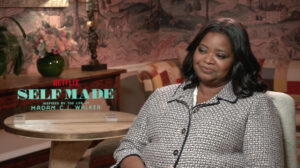
The four-part series directed by DeMane Davis was decently and creatively done. Octavia Spencer portrays the gutsy entrepreneur whose mission to make black women feel beautiful made her a millionaire. Having worked as a laundress, Walker’s future as “a baller, shot-caller” was by no means foreseeable or inevitable. Spencer is fully present as Walker and her portrayal doesn’t disappoint. I only wish the story had offered more substance in the way of Walker’s formative years and her overall life journey. We only catch pithy glimpses of Walker’s childhood in the last episode.

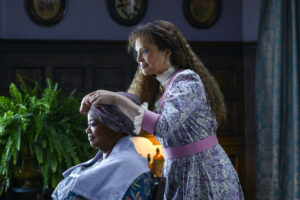
Spencer’s performance is supported by veteran thespian Blair Underwood as Walker’s auburn-colored ad-man husband, Charles Joseph (C.J.) Walker. Tiffany Haddish is entirely herself with obvious ounces of “she-ready” as A’Lelia Walker, the feisty and unpredictable offspring of Walker. Carmen Ejogo (who portrayed Coretta Scott King twice in HBO’s Boycott and Ava Duvernay’s Selma) portrays Walker’s rival, Addie Munroe. Like Spencer, Ejogo excels in period pieces. Addie Munroe’s character is a spin-off of the other black woman self-made millionaire, chemist, and beauty mogul, Annie Turnbo Malone. In fact, it was Malone who gave Walker her first job as a hair care sales agent. In this case, and as the series bears out, the protege overshadowed and outshone the progenitor.

The story composition was creatively envisioned and seemed purposefully modern. The series played out like a jazz song interspersed with random boxing scenes between Walker and her rival and day-dreamy sequences. Each episode represents some troublesome and exhilarating period in Walker’s life. The music is intentionally anachronistic. The use of various contemporary songs intends to bridge Walker’s quest to our times —to let us know that female enterprise is still the bomb! Thereto, the historian in me would have liked to hear more era-appropriate tunes as a way to situate the audience aurally in the era. What’s clear is that the classic charm of a traditionally composed bio-series is forsaken in deference to a more modern rendition.
Netflix’s investment in African American stories should, I hope, forebode a trend. We need more African American historical stories brought to theatrical and dramatic fruition. We need Fannie Lou Hamer’s story (Octavia Spencer would be excellent in this role), Booker T. Washington’s story, Frederick Douglass’s story, Anna Julia Cooper’s story, Mary Church Terrell’s story, Nannie Helen Burroughs’s story, Elizabeth Keckley’s story (Lisa Arrindell would be great in this role), and Marcus Garvey’s story, etc.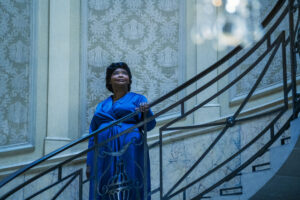
Netflix’s Self-Made is recommended for its novel rendition of Walker’s rag-to-riches story. In the meantime, viewers should take time to read the book on which the series was based, On Her Own Ground, written by Walker’s great granddaughter A’Lelia Bundles.



Loading…