
Rick Yune and Claudia Kim Talk Netflix’s Marco PoloPosted by Brad Balfour
December 11, 2014

In order find a story line that combines drama, sex, exotic visuals, action with historical possibilities, Italian explorer Marco Polo’s time spent in the court of 13th century Mongol ruler Kublai Khan provides all the necessary elements for a great television series.
That’s why Netflix and the Weinstein Company joined forces to turn the story of the legendary excursionist’s time working as an emissary for the great ruler into a 10 episode series that will debut on Netflix on December 12th at 12:01am PST.
The global cast includes Lorenzo Richelmy, Benedict Wong, Joan Chen, Chin Han, Zhu Zhu, Olivia Cheng, Claudia Kim, Mahesh Jadu, Tom Wu, Remy Hii, Uli Latukefu and Rick Yune.
With our fascination of exotic locales and unusual travel experiences, the story of Polo’s long time spent in this court now makes for a compelling story on Netflix’s extended small screen.

In order to makes this sprawling production it had to include experienced cast members such as action actor Rick Yune (Kaidu), who’s been in major Hollywood productions such as The Fast and the Furious, Die Another Day and Olympus Has Fallen and less well known actors such as Claudia Kim (Khutulun) who has established her career in Korean television until recently when she became a cast member in the upcoming Avengers film.
Recently the two actors sat down to give a look inside the process of turning their characters — who may or may not have really existed in history — into living beings.
You have had a lot of experience with films versus TV. How did making this contrast with your experience. It’s sprawling. you can be in a film where there’s a huge cast. Here, you have cast coming and going, you live a little bit here and there. You don’t necessarily see the whole context of the series until it’s completed. So I’m curious about how this was — inside and outside the experience of making these episodes.

Rick Yune: This has been no difference between any of the big budget movies I’ve done, which are pretty interesting. ’ve had a couple moments in television that I’ve done and you can feel the difference from what fm is like.
I can understand what you’re speaking about because there’s generally been a difference in scale and you feel it. In this one, it’s been probably one of the biggest productions I’ve been on and it’s been actually more allowing than a lot of the films I’ve been on, as far as bringing out the moments, the time that you can have in working with the scenes. Hands down, the greatest creative experience of my life.
And for you?
Claudia Kim: For me too, I’ve mostly done dramas in Korea. I’ve been wanting to do a movie for the longest time.
That was mostly films or TV in Korea?

CK: TV. And I did The Avengers. Marco Polo happened at the same time for me. So working that schedule out was a bit of an issue, but I was fortunate enough to make both things work. And also anything international gets my attention, and to have an international cast and crew, working with them was an amazing experience for me.
This show is of course focused on the Mongols and their relationship to China of that time so in some ways it’s very relevant. You’re shooting in Kazakhstan or Malaysia, and have actually traveled through many different locations like Marco Polo. I don’t know if you saw the TV series “In the Footsteps of Marco Polo,” there’s actually a show that tracks–these guys actually spent five years…
RY: What was the one back in the 80s?
In a way, Marco Polo was one of the first international character, having to adapt to different cultures to talk to the Chinese culture. We don’t think of the Mongols and Chinese as very different yet for you, you see the difference. You two come from very different cultures — people don’t really think of that.
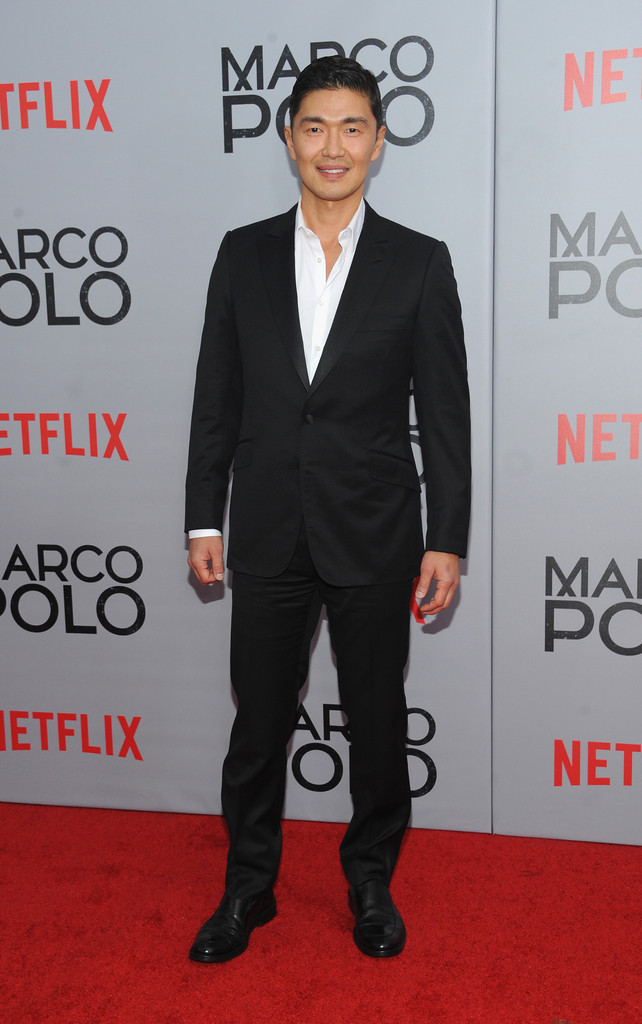
RY: You have to bring a part of your experience and a part of yourself to whatever you’re doing. For me it was no difference between growing up here and living in Mongolia. Basically the Mongols were superpowers back then, and they had to take into consideration the growth of China, and that was the challenge. So my character’s the one who wanted to stay true to the philosophies and the tradition of the Mongolians and Kublai sort of wanted to go in the direction of the Chinese.
I’m Kaidu, the great-grandson of Genghis Khan, who’s the most powerful ruler of Central Asia. So there’s not that much difference between now and then.
Because Genghis Khan used more brutal ways, he killed whoever got in his way.
RY: That’s true! We might be a little bit more political now.
So what were your thoughts about the role your character plays in the context.

CK: First of all for me, I felt like Marco Polo doing this project because it’s like the cast from the West meets the cast from the East[Laughs]. We’re coming together as one and that was a very new experience for me.
Also getting to play such a strong character who is so fierce and playful and fun at the same time was a huge challenge for me. I auditioned but I didn’t dare think that I could take on a character like this so it really helped me grow as an actress and a person.
Was it a big transition for you to be playing, knowing that you’re going to be seen in a much larger cultural context than just sort of focused for the Korean audience?
CK: Of course.
How does that change things in terms of where you see yourself going?
CK: It’s something I’ve always wanted and yet, I limited myself more. I thought okay, it’s not going to happen until like, maybe 10 years, or 20 years. So I’m really grateful that Netflix allow me to do this.
For me, as an Asian, there aren’t a lot of roles like this. It’s not a typical Asian character — especially regarding that a lot of the Asian cultures suppressed women so much, and to see how contradicting that is in Mongolian culture, how women were encouraged to be strong and expressive. It’s altogether surreal.

There’s some documentaries you should see about Mongolian families. There’s The Story of the Weeping Camel really shows you how powerful the women are, even in just a normal Mongolian social world.
RY: They say women are the foundation of a strong culture. Says a lot, you know?
It must be interesting for you because often you’ve played somewhat of a villainous character from time to time, and here you get to play a character who is a lot more complex, little less caricatured.
RY: You know how they do us! [Laughs]

In White House Down you were quite a villainous character — so you are sometimes cast that way.
RY: That’s audience’s decision, but what’s interesting is the feedback I was getting on the character, which is people were actually rooting for some of these characters. I think that’s the way to do it. First of all, I don’t think you can be a good hero unless you can be a good villain.
That’s true. A lot of people will agree with that. You learn a lot about acting by doing that.
RY: When I saw Daniel Craig’s earlier work, he was playing all these roles that were similar because a lot of Brits are cast that way. And he’s an amazing James Bond. When I play my roles, I look at them as human beings, number one. There’s good and bad. So ultimately there should be no judgement.
What I loved about Kaidu is all of the different elements that could come out. Iit’s more of a function of the fact that there was more time to explore these nuances and these moments. Ten hours, compared to an hour and a half or two. You have the father/daughter relationship, the man’s trying to stay true to his lineage and then also, you have caretaker of his village and his people and the little kids there. All these components the writers were able to bring together. People are going to be able to watch it in ten hours.

You have some serious martial arts training. So did you and Tom Wu [the martial arts trainer] get a chance to talk or work together?
RY: Not really. He’s extremely seasoned and an advanced professional. Normally when you get together with a guy like that, it’s not about the movements at all, but it’s about the intention and the vibe of it. At least that’s what I go for, you know, and how it works within the story.
That’s the most important thing because as far as anything is concerned, whether it’s anything physical, to making love, to shooting a gun, to riding a horse or anything, it’s the vibe that goes with it that’s more important. That’s the difference between something that’s going to be watchable and something that’s not. So with Tom, we didn’t have any scenes, but yeah.
Some people have different approaches in developing their characters. Sometimes they don’t want to know everybody in the cast, just to flesh out their characters on their own.
RY: Actors are unique individuals. [Laughs] You’ve got to kind of allow for–this is their office.

Watching everybody meeting here, seeing each other is like old home week. Some of you who aren’t in scenes together, may not have yet met. Were there people here you had met that you hadn’t me before?
RY: We met everybody. It was fun. Everybody’s working, also, so during that time there’s some people that want to stay within character, others that are like me, that are joking around all the time.
How much do you get to insert into your character your own way of working out in your head who this character is. You’ve explained about the complexities of the character, and explained about the role of women. That’s particularly the challenge of the historical drama, where we don’t really know who they are.
RY: Generally what I look at when I look at a script or the whole production is what I understand is the foundation that was laid down. But they’re not going to know my character better than me because I’m doing it. So there’s going to be a give and take there.
Ultimately, when I’m working I don’t have any expectation or preconceived notion about what’s going to happen. These are the highest-level guys that we’re working with. John Fusco, Dan Minahan, Harvey Weinstein, Netflix. It’s like putting together an NBA team or anybody else, like Navy SEALs. They all know what they’re doing. Just put them together, they know what the mission is. You don’t really have to talk anymore.
That’s a lot of what went on here. Different directors came in and out, they were all spectacular. Ultimately it was like, “What are you going to do?” “Okay, cool.” “Step back for a minute, let me float with this for a second.” Then it just went–that’s when the magic is.

You trust your intuition. How much you try to make this character a human in the context of how we see it, or how much you try to figure out what he would’ve been like in that culture. It’s interesting what you’re saying, that’s very enlightening.
RY: I don’t think people have changed that much, that’s the thing.
CK: It wasn’t forceful. None of it was forceful. It was all very natural and you know, yes, we are given these significant and incredible characters, but we’re looking at them from a very personal–we have this humble approach to it.
RY: Humble?! [Laughs]
CK: Yeah! You know, it’s just like, “What would you do?” We were just asking ourselves constantly on set like, “What would she do?” She’s just normal, she’s not so different.

Except that they weren’t normal because they were in this high-level social setting where you can’t be really normal. That’s what was fascinating, watching certain martial arts films, certain films like Last Emperor or Farewell, My Concubine. They couldn’t be like normal people because they were meant to be perceived in a certain way, behave in a certain way as royalty. That was one of the constraints.
CK: I think so, but I think they would’ve tried harder to become normal. [Laughs]
RY: What would the perception be of people in Asia, of House of Cards?
That’s an interesting question.
RY: Do Americans behave that way because that’s how Americans are portrayed? [Laughs] You know what I mean?
You might be right!
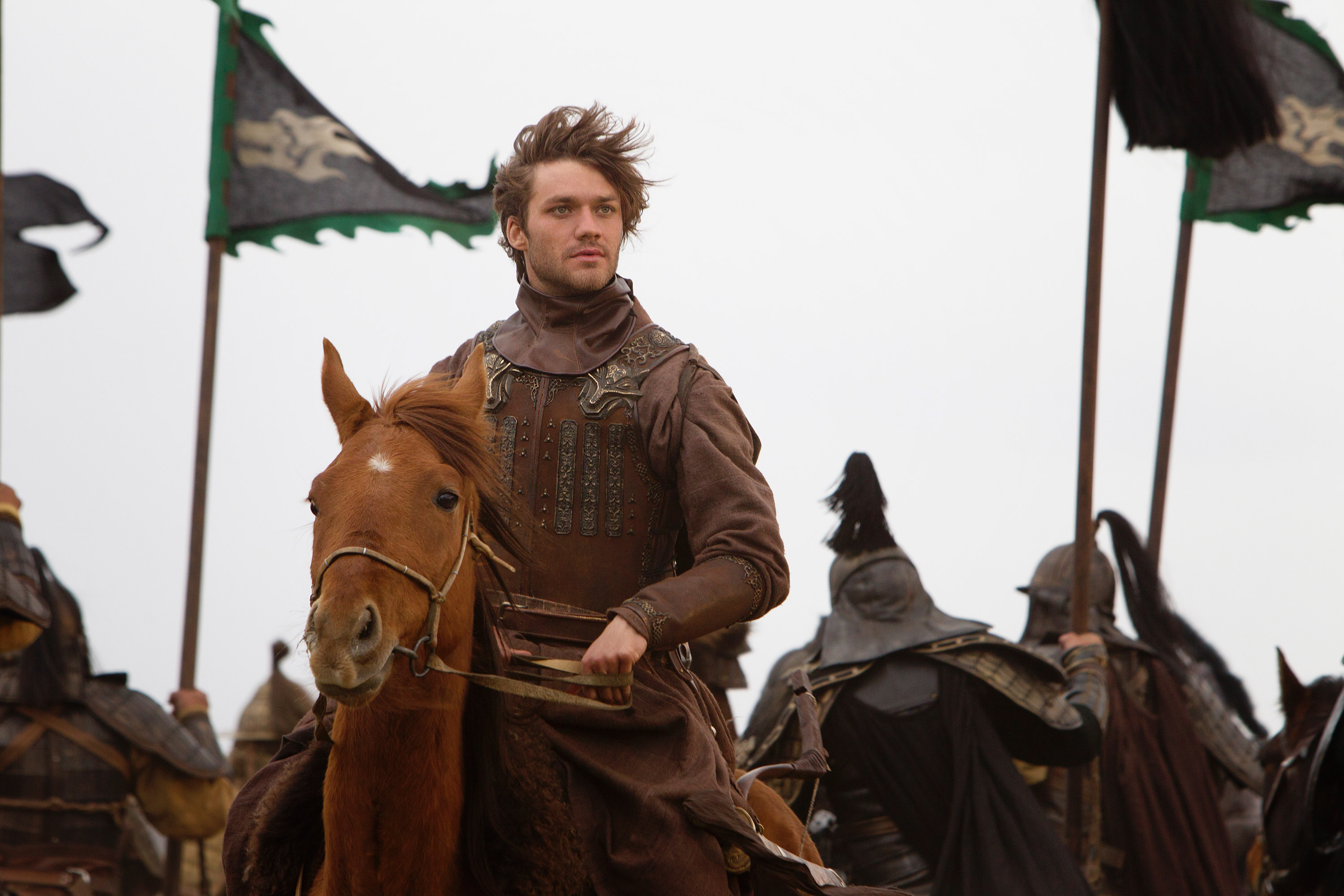
RY: Is that the way they really behave? I didn’t find this in a martial arts story. I could relate it more towards what goes on in “House of Cards,” “The Sopranos,” you know, “Game of Thrones”.
Is this the biggest challenge you’ve had for you in films, the most strenuous?
RY: Perception?
Just in terms of the work involved.
RY: Well, it’s all about timing. Because the other ones, you didn’t have enough time. You have to fit the story within an hour and a half. Like the last one, there was so many different situations happening with the character, but it couldn’t be fit–it had to be a three-hour movie at that point, so you couldn’t have–but this one we’re allowed to, so you could see more.