
Bobbito Garcia and Kevin Couliau talk Doin’ It In the Park: Pick Up BasketballBy Wilson Morales
May 21, 2013

Coming out this week is Doin’ It In The Park: Pick-Up Basketball, NYC, which explores the history, culture and social impact of New York’s summer “b-ball” scene, also known as “pick-up ball” and “playground basketball.”
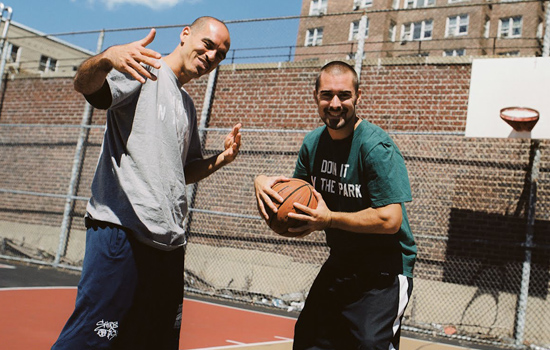
Directing the film were Bobbito Garcia and Kevin Couliau, who visited 180 courts throughout NYC’s five boroughs within 75 hot summer days to create their debut documentary. The filmmakers traveled to a majority of the locations by bicycle, carrying cameras and a ball in their backpacks. The film’s title refers as much to the subject matter as it does to the method of filmmaking, providing an unprecedented perspective on America’s most popular, and accessible, free recreation, which has influenced an international lifestyle.
A self-proclaimed “pick-up basketball activist,” Bobbito Garcia has played in 35 countries throughout five continents, and has acted as an ambassador for the sport, giving clinics and donating sneakers in multiple developing areas. He’s also the critically acclaimed author of “Where’d You Get Those? NYC’s Sneaker Culture: 1960-1987” (Testify Books). In recent years, “Kool Bob Love” has done sideline reporting for the NY Knicks on MSG Network, voiced NBA 2K video games, and has hosted ESPN2’s “It’s the Shoes” series.

Kevin Couliau is widely recognized as the most prolific outdoor basketball photographer of the last decade. His images have appeared in Reverse Magazine (France) and Fadeaway Magazine (UK). As a videographer, his work has been seen on the Canal + (France) “New Explorers” documentary series, Jordan Brand’s annual Quai 54 TV/DVD series, the New York Knicks “Battle of the Boroughs” videos, and Nike’s “Basketball Never Stops” campaign. In 2010, he directed a music video titled “Heart & Soul Of New York City,” which has accumulated 1,000,000+ views online and counting. He currently lives in Paris.
Blackfilm.com recently speak with both filmmakers as they discussed the process of making this documentary.
You’ve been involved with basketball nearly your entire life, so what attracted you to do this project?
 Bobbito Garcia: Kevin and I approached it as “Pick Up Basketball.” We don’t even use the term “Street Ball” because that gets misinterpreted a lot for what that represents, because of media and marketing. Pick Up Basketball is both very dear to the both of us. He’s from France and I’m from New York. As you mentioned, I grew up with the sport. Essentially we decided to make a documentary because there was a void in the catalog of films. No one had ever really tried to do it in New York, which is the mecca of the sport and what we tried to create and I think we accomplished was a really fair and honest portrait of not just the sport, but the actually community and the culture. That’s why we made the film.
How did the two of you connect?
Kevin Couliau: Bobby and I met in 2004. I was starting basketball photography in my own playground and shot some pics and sent them to Bobbito, who at the time was the Editor-in-Chief and founder of the basketball magazine Bounce. He ran the photo in the magazine with my email. It was my first photo published in a magazine. I was excited and went to New York a few months later, met Bobbito, and brought him some French records from some friends of mine and we started playing basketball everywhere around town. I went to Bed-Stuy with him playing basketball and we played 21 right behind his apartment. This is how we made a connection and since then we always kept in touch. When he came to Paris, we played basketball together and vice-versa when I came to New York. We kept collaborating on many projects. On the documentary side, we both have covering basketball for years. I was influenced by films like ‘Hoop Dreams’ and it was really inspiring. In a way, we both were envisioning this documentary even before we knew each other.
How many parks did you visit while you were shooting the film?
BG: The official count is 180 courts. We did that in 75 days and 90% percent of that we visited on our bicycles. We played in all of the parks. As you see in the film, Kevin and I had a rule where if the court was empty, we would play 1 on 1. If the court was packed, Kevin would take his tripod out, and he would do his close-ups shots and then we would play whoever was there. We had so much fun.
How many hours of video did you capture?
 KC: I think we had about 160 hours of video. It was a huge process to edit this movie because we had so much footage, and we did a lot of traveling back and forth from editing it in Paris and New York City. My brother David Couliau also came on board to edit the film. It wasn’t easy because it’s an amazing footage about a culture and it’s difficult to create natural links in the film. I think we succeeded in doing something really good.
What challenges did you face in making the film? Did you face any resistance when you showed up in different parks?
BG: Luckily, a lot of people recognize me when we would show up to the parks. If they didn’t recognize us initially, sometimes they would think that we were cops. Eventually, one kid would recognize me from one of the projects I’ve done in the past and then it would be all love. The only borough that we had problems shooting the film was in Brooklyn. With a couple of courts we had to get the official sign-off from the local dude who ran the parks, but most times, everyone would be ecstatic to be on camera and asking when the film is coming out or is going to be on youtube. There was an overwhelming amount of love.

KC: We didn’t have to worry so much about permission. New York City is a place that is being shot by every tourist. We shot with a Canon 5D Mark II and a small microphone and a small tripod. We never had any problems in the parks about using video equipment and doing interviews.
Can you talk about setting up the film with chapters of the history of the game from the park perspective?
BG: I wrote the script and did all the interviews. Some of the interviews were set up like Pee Wee Kirkland and Fly Williams, and then other times like Mark Norman aka The Movie would be in the park with a 40 ounce and a brown paper bag and we thought that he would be great to put on camera. When I was interviewing them, I posed the questions so that it would be in sections from behavior patterns, cultures, history, and definitions. There were other stories that came out of it that Kevin created in deleted scenes that’s now on our on website. There are some deleted scenes that will be on the DVD and Blu-ray.
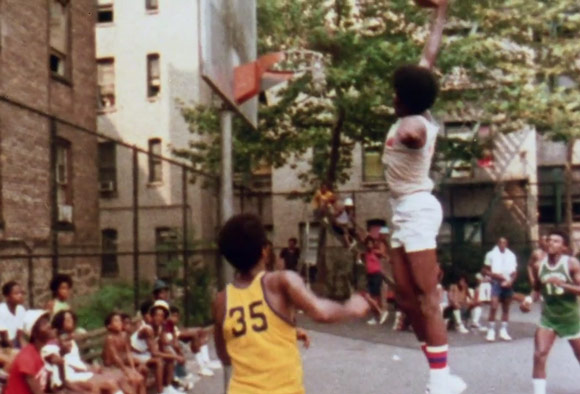
KC: When we started shooting in 2010, Bobbito didn’t have the script written. The both of us didn’t have experience in making movies or documentaries. This was an interesting process to start shooting and then writing the script and editing the film. We were lucky enough to have my brother David and Thibaut de Longeville, who was the director of the documentary Just for Kicks. The both of them really gave us input on the structure of the documentary and how to attract a general audience, not just basketball fans. Thibaut contributed on the storyline and editing and producing.
BG: Thibaut from 360 Creative and David were invaluable to the rhythm of the film.

What has been the reaction from those who have seen the film and what have you learned as learned as filmmakers?
BG: From being at screenings, the ballplayers want to play immediately after the film. When we showed it at Rucker Park outdoors last year for free to 600 people, as the end credits went down, I saw kids playing in the dark on cue. I wanted to do a Q and A after the film, but they were already playing. For Kevin and I, that’s what we want to see; for people to be inspired to play. We’re big advocates and now we’re ambassadors based on the world tour we are ready to embark on that will be presented by Nike. We’re going to Mexico, South Africa, The Philippines and other places. The non-ballplayers, from those who are film buffs and those who love the music score, and other individuals were blown away by the honesty and portrait that we made. We’re fortunate to get a lot of love from a very diverse audience.

Was there a point in the film where you wanted to show that basketball was a place to have fun and meet friends?

KC: I’m always fascinated about New York City. This may be the only city in the world where people play that many sports and living in Paris I see that a few friends are playing a few sports, but when you are over 20 you stop playing. In New York, you can keep playing basketball at any age. When I come to New York, I play against guys who are in their 70s, or women, or tourists. There are many people from different origins and backgrounds and New York City is the only where you can experienced that. The richness and beauty of the playgrounds and how they are integrated in the urban landscape of New York City is pretty unique.
BG: One thing I want top add is that a lot of people have told me after the screenings how much they loved the film. One guy said to me that his girlfriend isn’t a Knicks fan but loved seeing this film. I’ve received a lot of compliments from a lot of women so I think we are opening up the curtain to a lot of people as they realized how beautiful and positive things come from playing in the playground.
Doin’ It In The Park: Pick-Up Basketball, NYC opens in theaters Wednesday, May 22nd, 2013, at Harlem’s prestigious Maysles Cinema (mayslesinstitute.org), founded by legendary director Albert Maysles (Grey Gardens). A limited national release follows, including special one-night screening events, powered by Tugg.com.