
ImmortalsAn Interview with Mickey Rourke
by Wilson Morales
October 31, 2011
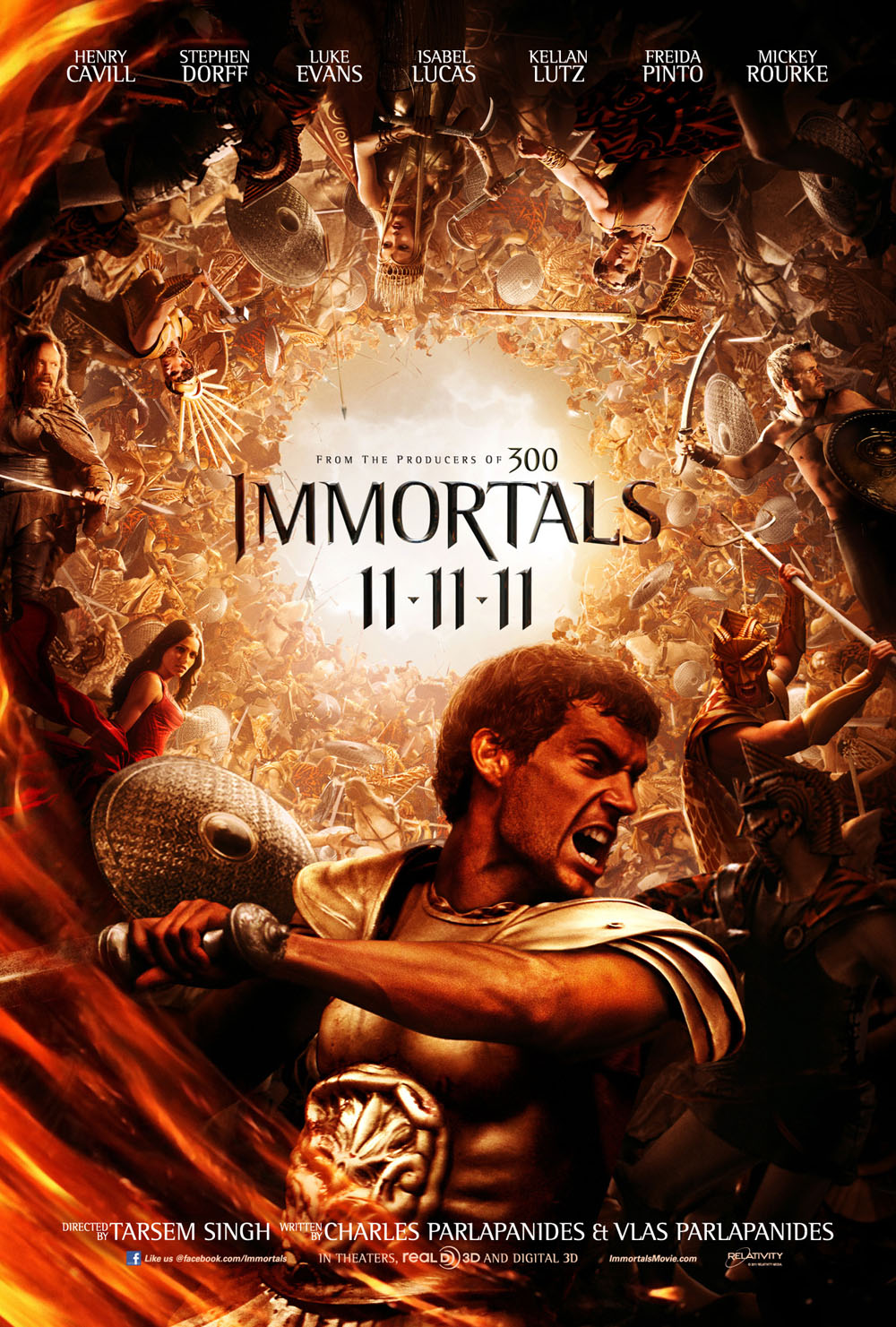
Coming out in a few weeks (Nov.11) is ‘Immortals,’ the latest film from the guys who produced ‘300.’ Directed by Tarsem Singh (‘The Cell,’ ‘The Fall’), the film stars Henry Cavill, Luke Evans, Mickey Rourke, Frieda Pinto, Isabel Lucas, John Hurt and Kellan Lutz.
Theseus (Cavill) is a mortal man chosen by Zeus to lead the fight against the ruthless King Hyperion (Rourke), who is on a rampage across Greece to obtain a weapon that can destroy humanity.
For Mickey Rourke, he seems to be in a better position now that the frenzy of coming back into the business has died. Having his career be “resurrected” after an electrifying Oscar nominated performance in ‘The Wrestler,’ Rourke is more humble and resigned to be in the spotlight again.
While promoting ‘Immortals’ and his role as King Hyperion, Rourke opens up about life after the nomination and being given the opportunity to be in the game again.
Well, first congratulations Mickey on Monday. Hands and footprints in the cement at Grauman’s.
 Mickey Rourke: You’re probably more excited about that than me. Yeah.
At this stage in your career after the resurgence, I think that’s a fantastic thing.
Mickey Rourke: Thank you. I don’t have to sit in my house anymore waiting for the phone to ring for twelve years.
Is that not a big deal to you at Grauman’s?
Mickey Rourke: Not, you know what, maybe a long time ago it would have been but for some reason maybe down the line it will be but you know right now it’s uh, I hear they’re putting everyone in there. No, not yet. Maybe in a couple of years it’ll mean something to me.
Career-wise, what does mean a lot to you over the last couple of years?
Mickey Rourke: I think probably to be honest with you, when I was out of work thirteen, fourteen years whatever the hell it was I remember writing I went back to Cannes with Rodriguez for ‘Sin City.’. And I was sitting in the car and I thought, ‘Oh my God I’m getting a chance again.’ Because all the years go by and it’s thirteen years or that many years and you’re living in a room. After like seven years go by I think, ‘Yeah, I really fucked up,’ and then ten years go by and it’s like they’re not gonna let me back in the door again. Especially I was out here and this is the worst place to be when they grind you into the ground, they can’t wait to do it. And I helped them do it. I really thought I could turn it around in a year or two and they’d let me back in but it just didn’t happen and so I thought it’s too shameful and degrading to feel like this. I was really close to going back to Miami and doin’ I don’t know what but I wasn’t gonna sit around and be yesterday’s news. That’s just too hard. I remember buying a pack of cigarettes. I was in the line and it was like two in the morning. Some asshole, some fat guy goes, ‘Hey didn’t you used to be…?’ (laughs) Oh, God. And he mentioned the wrong name! I remember walking two blocks going, ‘Oh fuck!’ I’m very grateful that period is over. And I’m very capable of having that happen again so I’ve gotta watch myself on a daily basis, you know?

Do you feel a sense of redemption in a way?
Mickey Rourke: I don’t look at like that word closure. I don’t believe there is any. Man, I could fuck up tomorrow easily, in the next ten minutes. I could be right back where I was so it’s like, a guy who gets out of jail. You’ve got to behave. I had to change. There’s a big part of myself that’s never gonna change – certain things. But I did have to change. Realize that I had to be accountable. Before there were no rules with me and I wasn’t accountable. I didn’t care what the consequences are and now I do. There’s a part of me when I work with this doctor, I’m trying to put all these pieces together. He calls that change. Change for me was really hard because I had built myself up to be a certain kind of man my whole life, as men are where I come from. I thought I got to handle things different that’s gonna make me feel like a real pussy. For me it was hard to turn the other cheek. Even thought it’s a stronger choice. It was very hard to make the change, but I had to in order to survive. Otherwise they would have won.
So you think somehow that change made you a better person?
Mickey Rourke: Absolutely. Yeah. Even though I was reluctant and still. I mean not so much any more. It’s kind of getting easier because I’ve tried to consistently make that change all the time. It’s little things like, they need you in five minutes. Where before it would have been, ‘Fuck you,’ you know? ‘I’ll see you two hours later!’ And you can’t do that. I had some really bad psychological reasons why I behave that way. I had to put that in the past and bury it as much as I can.
So in regards to this film, how much fun did you have on set?
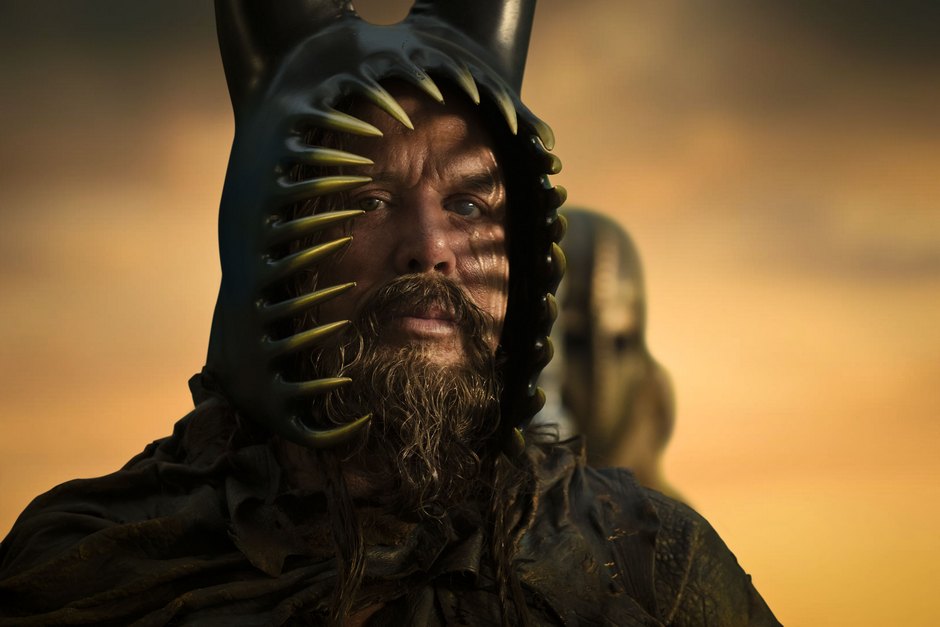
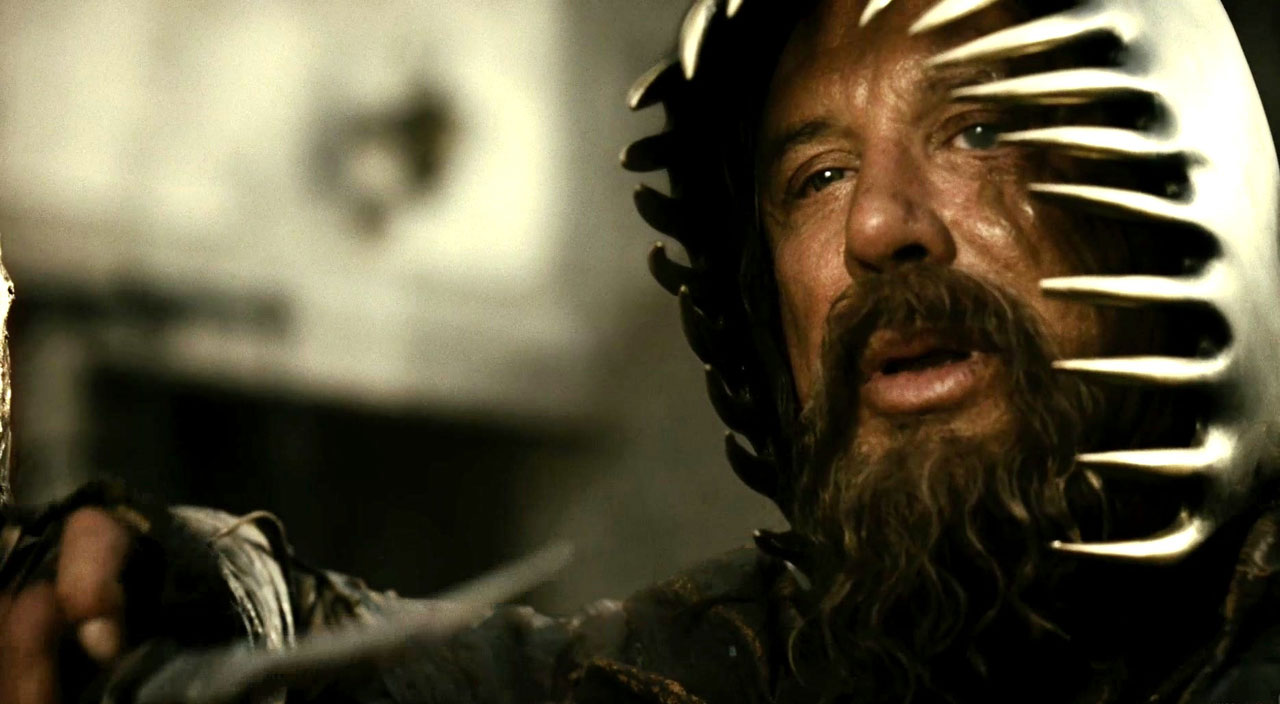
Mickey Rourke: It was, well, the days would start out bad because the lady, Iko? She spent three years doing the wardrobe and it was heavy. It took me an hour to put my pants on. It was like this layer and another layer. Then a layer up here. Then a belt over here. Then another layer and a gauntlet over here. It was like, ‘Now I have to stand?!’ And the shoes were like 300 pounds a piece. It was nice once I got dressed and put all… then it was another two hours in the makeup chair. The main reason I took the movie was to work with Tarsem. I saw his commercial reel and I saw the interesting Nike reel he did where he had the faces on all the athletes. The masks. I saw, he brought some drawings of the different characters. I thought this guy is very prepared, you know. And I like working with guys who do a very long pre-production because they know exactly what they want. And because he comes out of commercials, he has such a fabulous look the way he lights everything. He can take this material to another level. So I don’t necessarily know if I would have done this movie if it wasn’t Tarsem involved.

Do you like being the tough guy or would you like them to see you as a big softie?
Mickey Rourke: No, I would have rather been one of the guys dressed in gold. Really! I saw those outfits and I went, ‘Fuck! That’s the real me.’ I fought very hard in the last couple of years playing bad guys. I find them much more interesting than the good guy. You don’t get paid as good but um, really. The bad guy just doesn’t always have to be one dimensional. You know? It’s to try to find layers and reasons to justify why he is what he is. Find moments. I know gangsters from the old days that I would sit down with. I’d bring a girlfriend to the table and I’d go, ‘That’s so and so.’ And he’d be the nicest guy. She’d go, ‘Oh I can’t believe people talk about him like that. Did he really kill 12 people?’ And I’d go, ‘Yeah.’ So I try to find the moments where he’s not that clichéd evil bad guy and it’s a big fight. I had it on ‘Iron Man 2.’. And they won. Going to work for Marvel and them breaking Favreau’s balls and wanting just a one dimensional villain. So the performance and all I tried to bring to him ends up on the fucking floor. That could cause you not to care as much. Not to want to put that effort in when you try to make it an intelligent bad guy or a bad guy who justifies what his reasons are. So I fight for that all the time. This character was hard because he was written as pure evil. It was ok. I can only try to justify the King’s actions so far. I mean, I know when he’s chopping the guy’s balls off, it doesn’t look too good.

When you’re playing a guy who’s that pure evil, is it hard to sympathize?
Mickey Rourke: I never look at the guy as that pure evil. I always try to find there’s a reason. Maybe it’s Theseus’ problem, you know?
But you figure out a reason why…
Mickey Rourke: …why I behave. Absolutely. It’s like territory. It’s back home it’s like, this is my territory. I got a reason to do whatever I want in my territory, or you could say in my house. He considered everything his house. Once again working with Tarsem and Henry. Henry’s very young, enthusiastic. He was running around doing push ups and cartwheels. I remember when I used to get that excited. Maybe he’d better work on his lines. No. But it’s nice to work with someone who’s beginning their career, seeing them so gung ho. Tarsem was excited. It was a very good…. I worked a total of eight days maybe on the movie.

You have a pretty good history of physical discipline. So did you have to do anything different for that short period of time?
Mickey Rourke: I had just come out of surgery. I had torn my bicep and I just had bicep surgery. I lost my whole tendon. The operation didn’t work. So I was actually worried about just being able to tie my shoes. It’s one of the reasons I wore a gauntlet up here (motions to top of his right arm). I had a big scar. I’m going to have to have a cadaver tendon put in to fix it. I was arm wrestling some rugby players at four in the morning. We had been drinking at a pub in London and I lost. But we became good friends and out of that actually I got interested in meeting these guys. They gave me a magazine about their club. They play with a team called the Huddersfield Bears and we became friends. I was reading the magazine. There was an article about Gareth Thomas, the rugby player who announced that he’s gay. I came back home and was watching ‘Pardon The Interruption’ and they were talking about Gareth. They were saying how brave he was for coming out and announcing it. I got on a plane and I met Gareth and I asked him, ‘I’m wanna make your life story.’ I think I beat the studio out there by about four days and he gave me the rights. We’re gonna do this movie now. He announced his retirement three days ago and hopefully in March – I’ve been writing the script for the past year. Hopefully we’ll do it in March.

You’ve also got the movie ’13’ in theaters now.
Mickey Rourke: It’s a piece of crap. If you don’t believe me, call up Jason (Statham) and Ray (Winstone).
You said your costume was very heavy. But it doesn’t look it when you’re fighting.
Mickey Rourke: Well, the sword was made out of fucking rubber. They have the real sword there and they have the rubber. So with my arm like this, I’d say, ‘Gimme the…’ I think I did my stuff with my left arm maybe. Because I still had, I had just gotten the scar from here to here because the tendon didn’t… the whole tendon in the bicep left. There’s no muscle here that’s up here now. It looks like a twelve year old. So now they have to put somebody’s dead tendon in here. I can do it but it only works a little bit of the muscle.
But it will heal eventually?
Mickey Rourke: No. I have to have a dead person. Do you wanna volunteer?
Mickey, have you seen the movie?
Mickey Rourke: Yeah.
What did you think?
Mickey Rourke: What did you think? It’s entertainment, you know? It looks great. I didn’t wear the glasses. I’m just not in a mood to put them on. They told me there’s a difference. I thought Tarsem did a hell of a job. It’s a wild looking two hours of something you can escape to and go, ‘Wow. That’s different.’

Do you like watching yourself on screen? Or do you prefer not to?
Mickey Rourke: I prefer not to, but with this because it was such a far out character, I was able to watch it.
Just now you’ve been pretty honest about your feelings about films you’ve made, after you’ve seen them. That seems to be some of your essential “Mickey-ness” alive as you change.
Mickey Rourke: I mean, I can’t just say everything is great, it’s fantastic and go and see it. I’m just not built that way. I’ve never done a film like this before and I enjoyed – whether I liked the movie or not – there’s an audience for it. I’ve seen other movies in this kind of genre. For what he [Tarsem] was trying to do, I think he accomplished what he needed to accomplish to get people into the theaters to see something like this.
I guess what I’m getting at is how easy is it for you to keep your essential parts of your character in life that you want amidst all of the Hollywood posture.
Mickey Rourke: It gets easier. I’ve come to terms with it. It’s getting easier. You realize this business is political and it’s a business. That may have been hard for me to do twenty years ago but I’m kind of accepting it.

Do you think that if people would be as refreshing and honest as you are in the Hollywood industry, would work a little….
Mickey Rourke: …I don’t know. It’s such a business and it’s all about making the dollar. At the end of the day, there’s just so much politics involved. Any time money is involved, there’s a lot of gray. It’s not really black and white, you know? You don’t know who’s blowin’ smoke up your ass.
Is there a project looking back that you’re most proud of like ‘The Wrestler’ or ‘Rumble Fish’?
Mickey Rourke: The most fun I ever had on a movie – I look at whenever I had the most fun on a movie was ‘The Pope of Greenwich Village.’ It was the most fun I had working with Stuart Rosenberg – the director – and Eric Roberts. That was just fun. We were in New York City. It was just a time… what the story was about. It was just fun to go to work every day.
You were saying that your arm wasn’t well but the fact is that fight scene, the huge fight scene is quite amazing. What was that like to shoot?
Mickey Rourke: Well, the arm, I can do things. Aesthetically it’s not good. Physically it’s healed enough to – unless I’m doing curls. I can’t do curls. Danielle knows, he trains me. He takes the food away from me.

Frank Miller just said that the character you played in ‘Sin City’ would be back in the sequel. Will you be back?
Mickey Rourke: Depends how bad they want me. Ya’ feel me?
Did you like that character of Marv?
Mickey Rourke: Yeah I did. But I don’t like. I’m claustrophobic, so the three hours of make up. Because you have to keep it on for thirteen-fourteen hours a day. It’s latex and glue and that stuff that gets my eyes all red. I forget what it’s called. A chemical? It’s a nightmare. And the chair, you’ve got the teeth in. I remember I picked up some chick at a bar in Texas and I invited her to the set to have lunch at the lunch break. I couldn’t take the shit off. Fuck it. I never saw her again. I mean, she did meet me the night before but…