
My Week With Marilyn Press Conferencewith Michelle Williams, director Simon Curtis, and Kenneth Branagh
by Wilson Morales
November 23, 2011

Coming out this week is ‘My Week with Marilyn,’ starring Michelle Williams as the iconic legendary actress Marilyn Monroe.
The film tells the story of Colin Clark (played by Eddie Redmayne), an employee of Sir Laurence Olivier’s (played by Kenneth Branagh), who documents the tense interaction between Olivier and Marilyn Monroe during production of ‘The Prince and the Showgirl.’
Also featured in the film are Judi Dench, Dominic Cooper, Emma Watson, Julia Ormond, Dougray Scott, Zoe Wanamaker, Toby Jones, Philip Jackson, Geraldine Somerville, Derek Jacobi, and Simon Russell Beale.
During a press conference held in New York, Michelle Williams, director Simon Curtis, and Kenneth Branagh talked about their experience working on this film.
Can you talk about being compared to Sir Lawrence Olivier? Did you find it to be a curse?
Kenneth Branagh: I’m flattered by it, but you couldn’t help but fall short. It was also the fate of people like Tony Hopkins and Derek Jacobi and other generations. It was an indication of how remarkable Olivier’s position was. He was just THE actor. The world’s greatest and most famous and he dominated in that position for so long that if you ever remotely went near a part that he played before, you were compared to him. I decided to be flattered by it and then get on with it. This was a strange moment when Simon came to me about this to sort of lay that particular ghost by simply going at it head on; and playing him in a script that took him serious and not as a performer but as a person. That’s how I got over it.
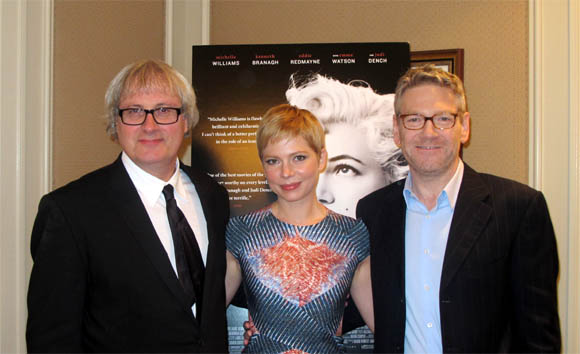
Kenneth asks Simon about picking up the book.
Simon Curtis: I literally did buy both books in a bookshop. There’s no mystery there. I fell in love with the story about this young man who had a passion to work in films and who got this phenomenal opportunity.

Did the book deliver what you expected?
SC: Yeah, but I had always been fascinated by the collision of Marilyn and Olivier. I couldn’t believe my eyes when I read ‘My Week With Marilyn,’ which was the second book and told the story of this moment this young man had with Marilyn.
Did you believe what Colin had to say?
SC: I did believe him. I think there are lots of versions of what happened in London in 1956. Our starting point was Colin’s version.
Did you cast Eddie after he won the Tony?
SC: It was after he won the Tony, but I had known and followed his work for a long time and felt that he was able to play the part. He went to the Eaton school just as Colin Clark had and he brought an amazing quality to the character.

How difficult was it to learn the choreography, and perform the opening musical number?
Michelle Williams: I’m not a singer or a dancer. I haven’t been on a stage since I was ten years old. In some ways, because of that, I felt that when I was able to put the nerves aside, I felt a tremendous outpour of joy. Like a little girl whose dreams came true for the first time. I was able to tap into what made Marilyn Monroe so luminous in those singing and dancing numbers. What I experience is that when you are in that state, your critical mind has to turn off. There’s no room for it because you’re remembering steps and lyrics. It’s like trying to pat your head and rub your tummy at the same time. That’s what makes those performances of hers so magical. She’s not thinking. They took everything else in this in movie for me just a tremendous amount of preparation and the willingness to start at the very beginning. They allowed me to make mistakes along the way and not be hard on myself and to realize that it’s part of the process.
SC: I cast Michelle knowing she was a phenomenal actress, but it was really exciting to see that she was also a phenomenal singer and dancer as well. That was a real joy to discover that.

What did you find surprising about the characters when you did the research on them?
SC: One of things Michelle and I talked about was how intelligent Marilyn was and we both were touched by Marilyn’s hunger to be taken serious as an actress. We sympathized with her with the work we did on this film and hope audiences will do the same.
KB: So much of it was sort of surprising but once you got under the skin of it all, I found, that despite the facts we show the frustrations in the film that Olivier had, we also see a series of on-set photographs that were very interesting to me. Half of which has Olivier concentrating on making films and I’ve had that look as well. Half of them are of him looking at Marilyn like a kid on Christmas morning.

What are your thoughts on method acting?
MW: I supposed whatever works. For this film, as Kenneth mentioned, I had never done anything that required “technical know-how.” This is the first time I started from the outside in because I knew I was going to have a long way to go. I, after 31 years, am different from Marilyn and for the first time I started externally, which is a switch up from me. Just like Marilyn, I am not trained. I sort of popped into classes now and then, and read lots of books. At 31, I’ve made some hodgepodge of my own personal experience of what I know works for me at the moment; what I’ve learned from other actors. The people who were driving the method were alive and in the room and how exciting would that have been to been directed by (Elia) Kazan or have (Lee) Strasberg by your side. Now we get second hand information; the soup of the soup passed on. I’m still finding out what works for me.