
NBA’s Charles Barkley Talks TNT’s The American RacePosted by Reyna Wang
May 10, 2017

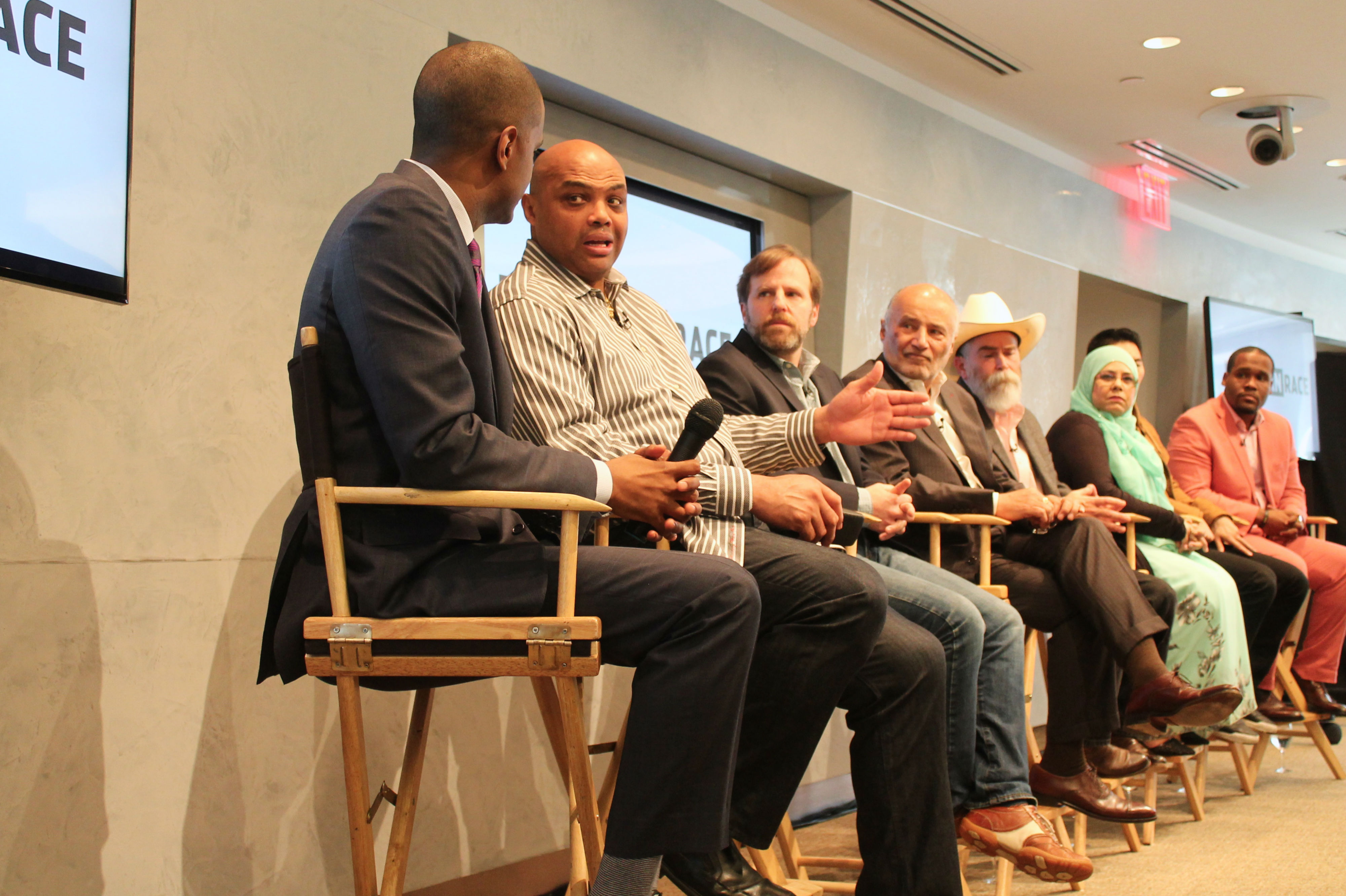
In American Race, a two-night television event airing on TNT, sports commentator and former NBA star Charles Barkley tackles what CNN analyst Bakari Sellers calls “the most difficult conversation to have in the history of the United States of America.” The show documents Barkley’s journey across the country as he engages in honest and thoughtful dialogues about race with a diverse series of Americans. Through his conversations with cultural experts as well as everyday people, Barkley challenges himself to understand how discrimination affects different communities while amplifying the voices of their marginalized members. In a panel moderated by Sellers at the Paley Center for Media, Barkley and executive producer Dan Partland are joined by five of the nation’s leading activists to discuss their experiences in the filming of American Race and why they believe it is imperative to start conversations about race today in the U.S.
Barkley explained that American Race was born because he’d wanted to start his own television production company for three or four years, and he knew he wanted to do positive programming, a form of systematic education that teaches beneficial behavior over time.

“I’ve been bothered by the negative stereotypes of minorities on television, especially of black folks,” said Barkley, adding that years of discomfort with this stereotyping is what compelled him to start the conversation about race. “If you’re black on television you’re probably going to be some kind of thug, or gangster, or portrayed in a negative light. If you’re some type of Muslim or religious person, you’re going to be blowing stuff up. If you’re Hispanic, you’re going to be some type of gangbanger.”
Partland explained that initially, he and Barkley had discussed doing a show about sports when Ferguson happened, but they eventually decided to directly address racial unrest, “the real story going on in America.” The tension between cops and the black community, which has recently received an increasing amount of nationwide attention, makes conversations about race even more relevant, and Barkley believes it is important to remain open-minded during these conversations. “I never try to judge other people,” said Barkley. “I never tell anybody that they’re wrong—we can agree to disagree.”

However, this is easier said than done, and Barkley admits, “It’s a hard show. None of the conversations were pleasant, for they all have to do with some form of subjugation or exclusion.” He joked, “I needed a beer after every interview.”
The clips that were shown at the panel and the conversations that followed made it clear that American Race is indeed a hard show, one that grapples with issues that are difficult to digest but nonetheless affect millions of Americans in their day to day lives. Part of the difficulty of racial issues is that they are not always black and white (no pun intended), and the first clip shows that there can be dissent even within a racial community about how they should be perceived and handled. It starts with Barkley stating that when the black community judges cops, “we spend all our time talking 5% screw up” from split-second decisions, even if cops do 95% of things correctly. However, Diane Butler, the mother of Tyrone West (who died in police custody), responds by rejecting the notion that it takes cops only a split-second to make a decision and retorting, “tell me why it took 15–20 minutes to beat my son to death.”

This confrontation after Barkley attempted to apply respectability politics to black people’s’ relationship with cops was a surreal experience for him. “I had never met a person whose son or family member had been killed by the cops,” Barkley remarked, emphasizing the importance of interacting with real people who bear the burden of discrimination. “As we go on to different episodes, people throw words out there like ‘muslim ban,’ but they don’t really know any Muslims. People talk about undocumented immigrants, but they don’t know any. These are actually real people.”
Addressing Barkley, Billy Murphy, a Baltimore civil rights attorney, commented, “the thing we’ve always loved about you is that you are strong, wrong, and willing to learn.” He continued by stating that the problem in America is “We don’t see the real people. We don’t live by walking a mile in their shoes. We talk about them in such ignorance—all of us—because our public schools are forbidden to talk about the history of African people, who were kidnapped and brought to America, and how are we going to know what’s going to today if we don’t know what happened yesterday?”
Sharmina Zaidi, a Muslim activist and Dallas restaurant owner, added, “There are so many things we don’t know,” providing the example that until her community was threatened by the Muslim ban over the past year or so, she “was completely ignorant about the Japanese internment camps.” Zaidi pointed out that “We like to blame other countries for whitewashing their history lessons and hiding things from the people, but we’re doing that here too.”
Justin Normand, a sign maker from Dallas, plays a unique role on the show. He explained, “I was raised in Louisiana in a bigoted household—bigoted against African Americans, gay people, Muslims—basically everybody, and what happened was I got grown and left for college and I had my career, and I met wonderful people, colorful people, from all walks of life. I’d always been taught they were these horrible, horrible people, and I met them and they became my friends and I realized it was all phony.” Normand’s notability as an activist came as a result of his public support of the Muslim community after the 2016 presidential election. “I had been hearing my Muslim neighbors bullied and pilloried and called things that they weren’t and held accountable for things that they weren’t doing, and somebody had to speak up about it. Somebody had to say, ‘This is wrong,’” recounted Normand, adding that “In Texas, probably like here, the white, male, Christian voice is missing. The loud mouth that’s normally there is oddly silent, and people need to hear from our demographic because there are plenty of decent white, middle-aged men—there are plenty of good ones in this room right now—and we need to raise our voices. We can’t be silent on this anymore.”

Another clip opens with Peter Jae Kim, Korean-American activist and actor from Los Angeles, stating, “in America, racism is black and white,” implying that people of other races, like Asians, are often ignored in discussions about race. In the clip, he brings forward the example of a Chris Rock joke at the Oscars, during which he brought forth three Asian kids who were supposed to be accountants, implying that Asians are good at math. Kim says, “At a moment when I felt like we were supposed to be empowered all together, were left out of the conversation.” He also claims, “The biggest victims of the LA riots? Right here—K-Town. The unspoken, unheard story is the biggest victims are right here,” referring to the Asian store owners whose stores were looted during the riots.
Kim feels that while discrimination facing black Americans and undocumented immigrants, for example, is very visible, that facing Asian Americans is not, even though, as he stated, “We have our history: we have the Chinese Exclusion Act a century ago, we have the Japanese internment camps.” Kim believes this invisibility results partly from the way Asian American children are raised, explaining that their parents often say, “‘What’s so hard about being Asian? We’re in this country. Work hard. There’s nothing to complain about. You know how hard it was in Asia?’” However, Asian kids born in America have no Asian role models to look up to, because as Kim stated, in the media, Asian “women are sexually fetishized” and men are stereotyped as “incompetent fools.” Since this generation of young Asian Americans feels that they have no voice, many Youtubers social media stars appeal to the mainstream deprecation of Asians by turning to self-deprecation to gain viewers and go viral, a trend that is upsetting to Kim as an actor, who finds that the only roles available for Asian actors are stock characters, often expected to be physically weak and to speak poor English.
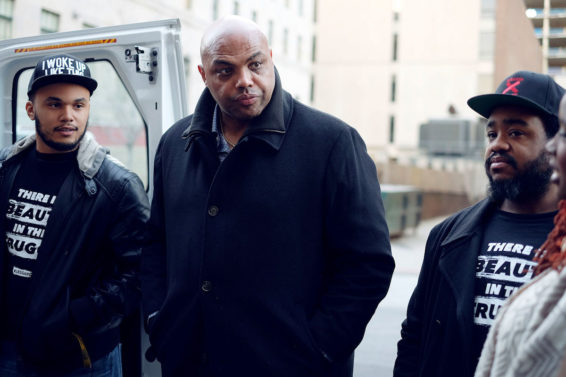
Many of the panelists admitted to never having thought much about Asian people before, including Atlanta civil rights and criminal attourney Gerald Griggs, who stated, “In America, we really do need to have a real conversation about race because the oppressed people are starting to oppress eachother,” referring to the fact that until recently, even as a politically involved person, he had never in his life thought about the oppression of certain marginalized groups like Asians and Muslims.
The last clip shown at the panel began with a jarring quote by self-proclaimed Nazi and alt-right leader Richard Spencer, who responds to Barkley’s question of whether he believes in white privilege by stating, “Yeah, white privilege is wonderful, and I want to expand and deepen white privilege.” Barkley and Griggs’s conversation with Spencer reminds us that race-related disagreements occur not only on the level of how racial inequality should be resolved but also on the level of whether racial inequality should be resolved at all. This interaction challenges the philosophy of “agreeing to disagree,” and it further emphasizes the urgent need for conversations like those in American Race to be had in homes, schools, and neighborhoods across the country.