Simon Pegg Gets a Pint at ‘The World’s End’By Max Evry
August 22, 2013
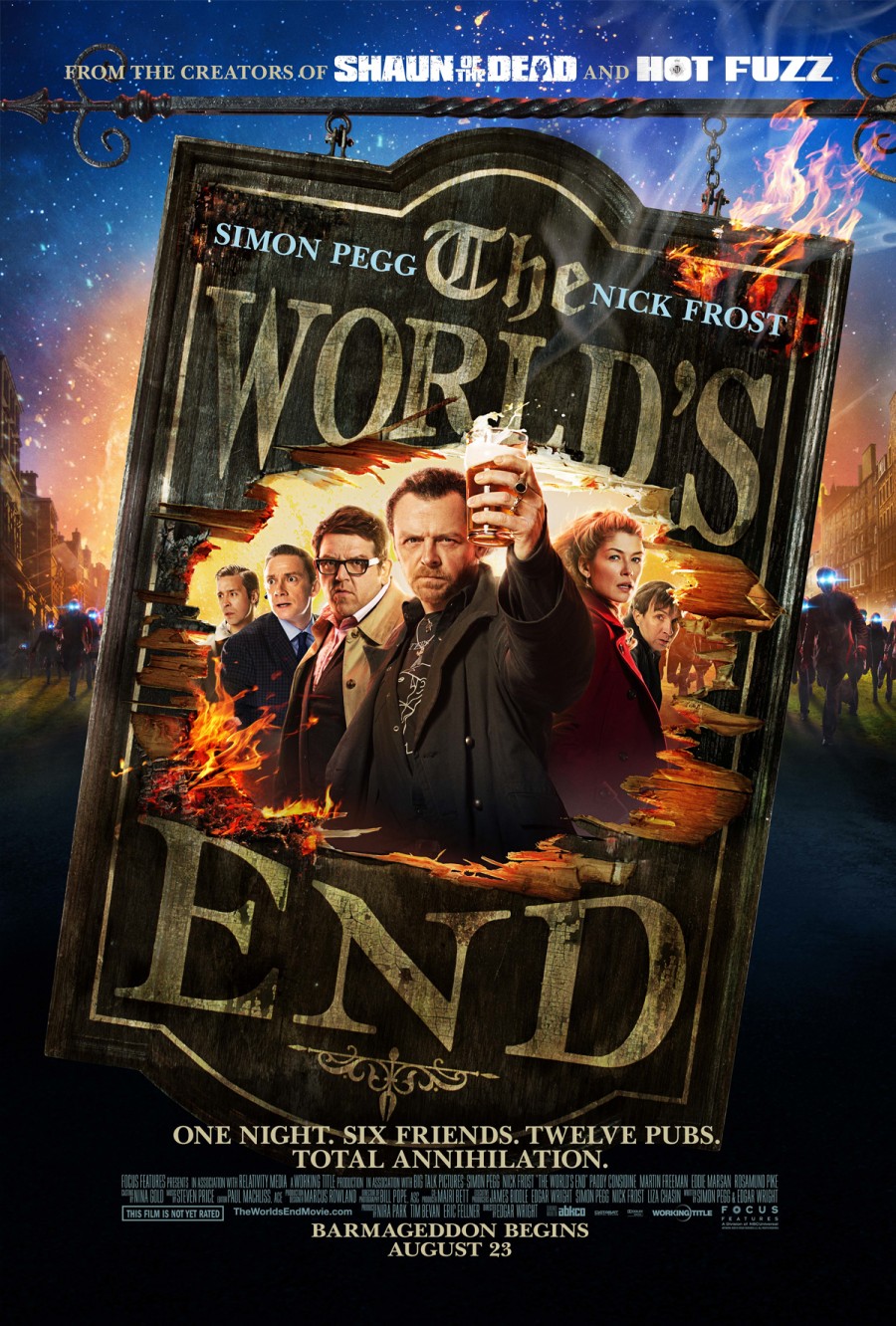
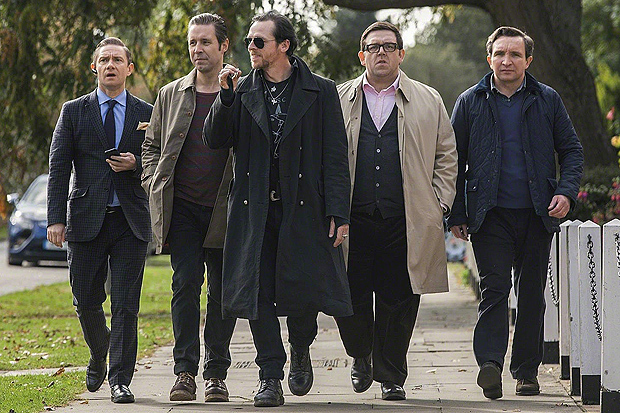
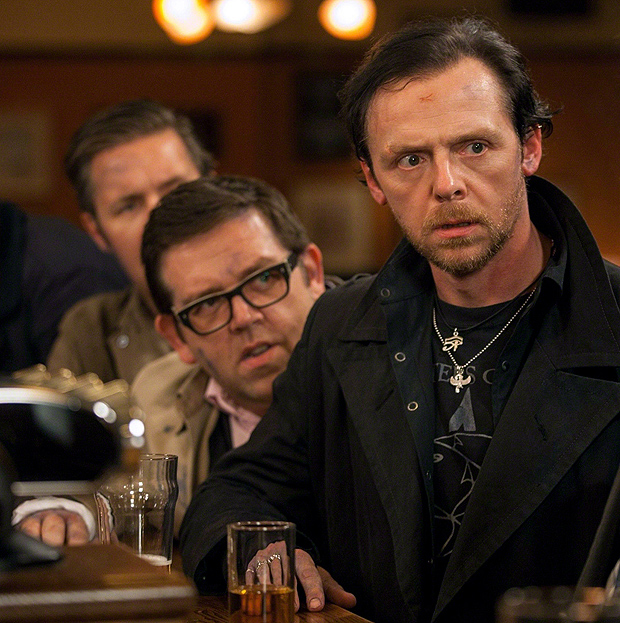
In “Shaun of the Dead” Simon Pegg played an average man in a zombie plague. In “Hot Fuzz” he was an above-average supercop thwarting a town conspiracy. Now in “The World’s End” he’s a decidedly below-average loser named Gary King who’s trying to win back the glory of his youth by taking four old friends (Nick Frost, Paddy Considine, Martin Freeman and Eddie Marsan) on an epic pub crawl in their old hometown.
Unfortunately those plans happen to coincide with an alien invasion, and Gary & co. have to fight their way through a legion of blue-blooded robots to make it through the night. This hilarious capper to the informal Cornetto Trilogy reunites Pegg with Frost and co-writer/director Edgar Wright in what is an undoubtedly satisfying conclusion to an incredible series.
At what point in working with Edgar did the term “Trilogy” first come up?
SIMON PEGG: I think probably on the “Hot Fuzz” press tour when we realized we’d been able to make two films, and those films were in essence thematically connected tonal sequels in a way. They were not direct sequels and didn’t have the same characters, obviously, but they were definitely variations on a theme. We figured if we could possibly do it again we could wrap it up in a nice little threesome, as it were. Do it again to refine the ideas we’d started working on. It wasn’t like we set out to make a trilogy, we would never be so arrogant to assume we would get to make three films.

What do you mean by “refining” your ideas and motifs?
PEGG: There are ideas in “The World’s End” which we’ve explored before, the thing about the battle of the individual against the collective, the idea of losing one’s identity, the notion of an extended adolescence, that kind of thing. Now more than ever, at 40, we’ve had this extended adolescence for another 10-years since “Shaun of the Dead.”
You and Nick Frost have written things on your own, Edgar has done things on his own. What has changed since you last got together on “Hot Fuzz”?
PEGG: It was great! I think we hit the ground running this time. We’ve done this twice together, and we learned a lot about the technical aspects of screenwriting, the practical aspects of screenwriting, the creative process, and third time’s the charm. We went away for our little weekend together, we discussed our concept designs. We’d had the idea in 2007, the basic idea of going back to your hometown, finding it oddly different, strangely familiar, feeling alienated then realizing it’s aliens. That was the idea initially. We loved the idea of ennui that you get when you return home, there was a definite real reason for it being an alien invasion because Edgar had noted one time that going home to where you grew up is like “Body Snatchers”: everyone seems the same but nobody recognizes you and its kind of odd. Science fiction felt like the natural genre we would use as our Trojan horse, in this case to say the things we wanted to say. We sat down and just wrote, and it came very easily this time. Me and Edgar in a room together. We start very broad, literally on big pieces of paper on a flipchart, we outline what we’ve got to do and it gets smaller and smaller down to a script. Eventually Nick is the first person to see it and he reads the whole script, gives his notes on it, we go away and apply those and eventually get into a rehearsal period with the other actors and then we’re shooting. It felt to me like the smoothest one.
There are some spectacular Jackie Chan-esque fight scenes in “The World’s End.” What input did you have in the staging of those?
PEGG: The important thing for us in all the fight scenes in the movie is that we retain the characters. Often in films when you cut to action sequences stunt performers have to take over and as such the characters the actors have created vanish slightly in favor of the action. What we wanted to do was to make sure the characters were maintained throughout the action, and that meant us doing it. Not only that, it meant we could shoot it differently, there didn’t have to be lots of cutaways. We shoot it almost like it was one continuous shot. You shoot wide and circle the fight, using whips to cut so it feels like one continuous shot, and it’s us doing it! We always wanted it to be where the fights were, particularly for Nick’s character, all this simmering rage he has, all this resentment towards Gary, all this dissatisfaction he has with his own life, it just bursts out of him. We used to call him the Pink Hulk, ’cause he had a pink shirt on. That was all in the script. Gary fights one-handed ’cause he’s trying to protect his pint, Andy fights like a berserker, because Paddy’s a boxing fan he uses all these haymakers like a brawler, Martin was wriggling out of stuff like a Hobbit, which he picked up from somewhere, I dunno. Eddie hides under tables.

There is an upcoming Gallery 1988 tribute to you guys, there are so many artistic homages to Cornetto Trilogy on the web… including drawings of you and Nick kissing! What’s been the strangest fan tribute you’ve encountered?
PEGG: The one you just said. (laughs) People constantly surprise me. Nothing’s weird, really, because it’s all art and art isn’t weird… well some of it is. (*doing a snobby voice*) “Some of the modern stuff’s a bit not my cup of tea!” It’s always very flattering that people take the time to create these alternative posters. One thing the death of the film poster has spawned is people creating their own, and not having to be slaves to the draconian marketing ideas. “There’s gotta be a face and big letters, red and white!” All these talented people are doing posters that don’t have to sell the film. They can infer what the film’s about, and it’s beautiful. I’ve seen a few of these paintings. I’m worried I’m going to spend an absolute fortune -which I don’t have- at this gallery ’cause of all these beautiful pictures people have drawn. I love the fact maybe what we’ve done has inspired people. That to me means more than box office receipts or anything. If I make a film and it makes a billion dollars at the box office that means less to me than making a film then someone goes home and creates this incredible piece of artwork ’cause it filled them with inspiration. That is surely the most important thing you can do.
Speaking of inspiration, you’ve actually gone out and worked with John Landis on “Burke & Hare” and now you’re working with Joe Dante on another film…
PEGG: I’m not now, unfortunately. Joe and I will work at some point but scheduling precluded it, unfortunately.
But you initiated that project?
PEGG: Yeah, absolutely, Joe’s a friend.
Is it important to you to approach these great filmmakers who haven’t been able to get a film made lately and help them out?
PEGG: It’s more about working with the people who inspired me when I was young. It makes me laugh that John Landis has to go to Europe to get a film made when he made so many important films in the ’70s and ’80s, but that’s not what it’s about these days ’cause Hollywood’s not run by filmmakers anymore. It’s run by bean counters. To get to work with people like that, and also to work with people who can get films made like J.J. Abrams that’s still a chance to work with someone. All I want to do is work with good people, irrespective of whether they’re considered bankable or not. That’s really immaterial.
“The World’s End” is in theaters everywhere August 23rd.