
Straw DogsAn Interview with Director Rod Lurie
By Wilson Morales
September 15, 2011

Coming out this week is ‘Straw Dogs,’ a remake of Sam Peckinpah‘s 1971 film of the same name, which is directed, produced, and written by Rod Lurie.
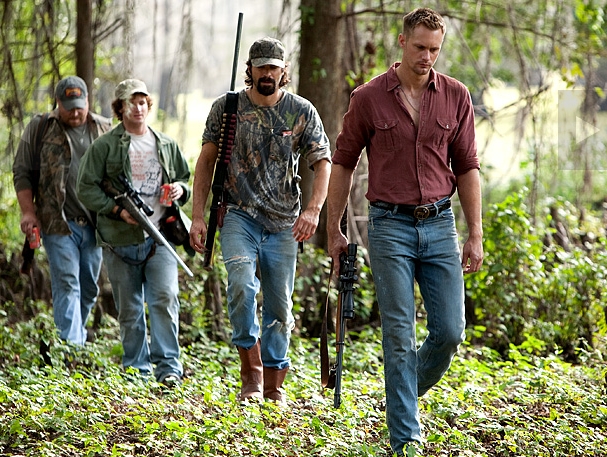
David and Amy Sumner (James Marsden and Kate Bosworth), a Hollywood screenwriter and his actress wife, return to her small hometown in the deep South to prepare the family home for sale after her father’s death. Once there, tensions build in their marriage and old conflicts re-emerge with the locals, including Amy’s ex-boyfriend Charlie (Alexander Skarsgård), leading to a violent confrontation.
Lurie, who previously directed ‘The Contender,’ ‘The Last Castle,’ and ‘Nothing But The Truth,’ is entering a new zone as he tries something other than the political arena.
In speaking with Blackfilm.com, Lurie covers his reasons for the remake, casting the three leads, and will audience will lured by the violent nature of the film.

Why a remake?
Rod Lurie: Well, you don’t have to do anything. You don’t have to do ‘The King’s Speech.’ You don’t have to do ‘Contagion’ and you don’t have to ‘The Godfather.’ Movies don’t have a need but they should a purpose. When ‘Straw Dogs’ was presented to me as a possibility to buy, along with my partner Marc Frydman, you have to say, “Why are we going to do this?” If it’s going to be a straight remake, then it doesn’t make any sense.
In the original Straw Dogs, Peckinpah was trying to say that all men are biologically coded to violence. He was a believer in the ‘Territorial Imperative,’ which was a book written by Robert Ardrey. The book said that with genetics, we all have violence inside of us and it’s waiting to come out and we have to be careful about that. I don’t believe that for a second. I believe humans are conditioned to violence. In my film, you will see that a man is violence towards the end, but only because he has to and not because it’s in his nature all along as it was in the original film.
I’m not criticizing Peckinpah. That was his point of view and I have mine. I thought it would be an interesting experiment to make a film in which we tell the same story but we tell it from different points of view entirely.
Most people remember the original as a rough film to view so as a filmmaker, were there any challenges to bringing that same aspect to the film?
RL: Well, here’s the thing. There’s something faulty in what you’re saying. You say that “most people remember” and we did a poll before we started film just to see how many people had even heard of the movie ‘Straw Dogs.’ The answer was something less than five percent of the population had even heard of it, let alone seen it. It’s not a movie that most people can make comparisons to because they would have seen the original Straw Dogs. For most people, this will be a fresh look at the story.
I wasn’t concerned about the original although I may have seen it like 30 times.

Can you talk about casting the three leads?
RL: The most important with the role of David Sumner, who’s the lead, was that it not be an actor that will remind people of Dustin Hoffman. We didn’t want that type of Hoffman-esque actor. I think if we did that, the particular actor would have an impossible burden to carry. No matter how good he was, there’s way he would survive it as far as comparisons. In fact, when I talked with Hoffman, he gave me some suggestions. I wanted an actor that wouldn’t sum up memories of Hoffman and can make his own and James Marsden seems to fit that bill very well. Although he’s a great mimic and for the fun of it, at times, he would do a take as Hoffman. Sometimes, those were the best takes, but I couldn’t use it.
As for Kate Bosworth, I’ve always admired her. I watched her in a movie called ‘Girl in the Park,’ which has never been released; not even on DVD. I had a copy and it was bravura acting I had not seen from her. She had not been quite challenge before in that way before. When you see her in this film, your jaw will drop to see how good she is and how sophisticated and mature the performance is. You will see how deep inside the character she gets.
Peckinpah had a difficult time casting that role. He couldn’t get a name actress, and the head of Screen Gems brought her name up. I loved the idea and thought she would never do it, but Clint knew her and said she has a lot of courage. Sure enough, she did.

As for Alexander Skarsgård, I had seen him in ‘Generation Kill.’ I had not seen one frame of ‘True Blood.’ If you see him in ‘Generation Kill,’ he makes a lot of sense in this role. When I met him, it was surprising because he’s not very intimidating. He’s very Swedish sort of speak. He can pull it off which I think did.
How was the shoot in Louisiana?
RL: It was either very hot, and brutal or it was a like a typhoon. The rain was incredible sometimes to the pull when we were shooting, we had to stop, because it rain every 50 minutes. Had we taken many days, we never would have finished the film. It was so intense down there. I liked the people there a lot. I may end up living there someday.
What are your expectations from audiences who see this film?
RL: I hope that everyone wants to go get a drink afterwards. The film is really intense and by the time people they would have been shaken, but in a good way. There’s a half hour sequence in which they will be freaking out and if they want to get a drink, it makes me very happy.
What’s next for you?
RL: The next thing I’m going to do is a television series, and as far as my next film, there’s a project I’m currently negotiating on.