
Talking With The Cast Of WE’s Growing Up Hip Hop – Egypt Criss, T.J. Mizell, and Angela Simmonsby Brad Balfour
January 7, 2016

It’s been more than 35 years since the first hip hop singles emerged on the New York streets; those singles such as “Rapper’s Delight” were able to spread the experience of the live deejays and rappers who appeared in the Bronx and Brooklyn starting late in the ‘70s. What appeared to be a fad to some has not only become a lucrative institution, but it has also spawned various movements and permutations — old school, gangsta and more — as well as a whole generation of stars who have sired a new crew of hip hop royalty.
These “kids” are now producing creative work of their own and though they may not have “street” experience, it’s fascinating to see what several stars of hip hop and rap accented R&B have wrought.
Somewhere along the way, a light bulb went off and someone thought, “Why not make a reality series that offers a look into this new generation who all know each, and interact with each other. Why not give audiences a chance to have an inside look.” What a fascinating idea.

So Music legends Damon Dash, Rev. Run, Russell Simmons, Master P, El DeBarge and Pepa — key players for many year — engaged their kids to further the concept. They christened the show, Growing Up Hip Hop, pulled together Egypt Criss, T.J. Mizell, Angela Simmons, Romeo Miller, Kristinia DeBarge, and Boogie Dash to show the dynamic between this group of well-known hip hop legends and their next generation for an insider view.
“Growing Up Hip Hop” premieres Thursday, January 7 at 10PM ET/PT on WE tv.
The series follows the next generation of hip hop royalty as they attempt to step out from the shadow of their famous families.

Formerly known as Lil’ Romeo, musician/actor Romeo Miller is not only son of Master P, he’s on track to take over the music empire his father built. Along the way, he leans on close friend Angela Simmons — the daughter of rap pioneer Rev. Run and niece of Russell Simmons — for guidance and support. A hip hop socialite, model and fashion designer of Foofi, her own line, Angela hopes to translate her fashion success into a career independent of her father’s fortunes.
Namesake of his father, Roc-A-Fella co-founder and media mogul Damon Dash, the younger Damon “Boogie” Dash is like father like son. But “Boogie” is also an entrepreneur having co-founded Chipz Cookies as well as a record label and NYC art gallery.

Kristinia DeBarge is the daughter of James DeBarge from the legendary yet troubled group DeBarge, and a singer/songwriter in her own right. With her father currently in prison, Kristinia leans on her uncle, hip hop legend El DeBarge, as she grapples with family and fame.
Daughter of two rap icons — Salt-N-Pepa’s Sandra “Pepa” Denton and Naughty By Nature’s Treach — Egypt Criss is actively pursuing a solo music career.
Stepping into his father’s shoes as a DJ, TJ Mizell — son of the late Run D.M.C. DJ, Jam Master Jay — spins at events and venues around the world, yet is haunted by his father’s mysterious and still unsolved murder.
With their work lives intertwined with their overprotective families always nearby, these friends each face challenging and sometimes surprising situations as they strive for independent success.

In two different sessions — one with Egypt Criss, T.J. Mizell and Angela Simmons — and another with the other three, Romeo Miller, Kristinia DeBarge, Boogie Dash, it felt like being in an episode of the series which included “the conversation with the interviewer.” Maybe it will become a reality in a future taping but for now here, is the actual conversation before you. These sessions took place at the London Hotel near the year’s end.
When you all were kids growing up with hip hop, how much did you actually know of its origins? Did you go back and talk about it, or read about it? Though you’ve grown up with it, you weren’t there when it started.

Angela Simmons: It’s something we learned from being around it. Like you said, you don’t know much growing up around it, you just kind of see it, but then as you get older, being around it, you pretty much are learning, and you’re around all these different people that are part of hip hop, so I feel like it’s something that came naturally, to be honest with you.
T.J. Mizell: Yeah, the same [for me]. I feel like being in the car with my mom and dad all the time, like listening to what they were listening to. And what they listened to every day and the type of stuff my mom listened to every day, I feel like that was hip hop. That’s what it was. I would have a drive from Queens to Manhattan every morning and we’d listen to like, Angie Martinez on the radio.

AS: I totally remember that.
TJ: Before, it was either that or my mom’s CDs. And if it wasn’t CDs, it was tapes before we had CDs in the car. That’s taking it way back when I was younger…
Egypt Criss: With me, my mom has done this for so long that she herself isn’t a fan of listening to music on the radio. Any time I try to turn on the radio, she’s just like, “Girl, you know I’m tired, please turn it off.” It’s not that she doesn’t like the songs, she’s just done this for so long, she’s like, “I hear music all the time.”
I just got to learn it from going to her concerts and just seeing how her music is performed and she brings in ‘80s, like old music to her concerts, saying, “Where are my ‘80s, baby?” and all of that. So, that’s how I learned it.
Were there records that you listened to and brought in — some kind of obscure jazz from the ‘30s or something like that — or did you find yourselves building on your parents’ interests or the legacy you’re a part of? Do you find yourself sometimes wanting to go completely away from hip hop?

AS: I would say I’m all over the place. If you looked at my playlists, you’d be like, “Uh, whose iPod is this? Whose music is this?!” I would say I’m very diverse in my music. I’m not just hip hop, I really like music overall.
I feel like growing up around hip hop, it’s not just hip hop. My dad’s songs, it was infused with rock, you know, so I just feel like I’m very open to sound, and I love music and talent. I’m a very creative individual as a fashion designer, and being that you have to put on fashion shows, you have to know music. T.J. and I collaborate all the time for stuff like that.
AS: So naturally, we’ll sit down, and he’ll be like, “Oh I didn’t know you wanted to go that way.” I’m like, “Yeah, a little bit…” All that stuff that is out there…

TJ: Oh yeah, I like that!
AS: I’m all over the place. I can’t just do hip hop. So, for me, it’s a mixture. My parents, we would be coming home from church, you’re hearing Anita Baker, you’re not just hearing–yeah, so like, I grew up on everything, really.
TJ: For sure. It’s a misconception, just like she said. People think like, “Oh, your pops is in Run DMC, you must be like, a classical hip hop genius.
But they were obviously into rock and roll as well…
TJ: They were obviously rock and roll, and that’s honestly what I grew up on. I grew up listening to a bunch of indie rock bands. I love Blink-182 and Sum 41…

AS: Take it there!
TJ: I love Mayday Parade, I like all those bands. And being the kid that would go to those concerts, like the Warped Tour, or those festivals that these bands would perform at, and watch the DJs perform electronic music as well. So, this is a time where like, Skrillex, which Skrillex now was Sonny Moore from First to Last, and he was like, a screamer in a rock band.
I would see them, and I watched his whole progression into electronic dance music and what is EDM now, and that’s kind of like what I grew up on. So like, I’ll do like, hip hop sets when I have to in the club, but I’d rather be playing crazy wild festival trap, hip hop infused with a bunch of crazy bass music.
That’s where the energy is. Hip hop is where the energy was back in the day, hip hop and rock, and Run DMC and Aerosmith like, made that perfect fusion, and I feel like what I’m doing now is doing the perfect fusion between Southern hip hop and electronic dance music.

EC: For me, my mom stills obviously performs, but when she was even more big back then and performing, going on tours, I wasn’t allowed to go on tours with her and get to experience all these different…
She was a tough cookie.
EC: Yeah, because I was so tiny and she wanted me to live a pretty basic, normal life. She wanted me to get to know that life, instead of just diving into the famous life. So, I went to all public school and everything, yeah. And I got to get a taste of both worlds, honestly. And I actually just had to learn by the radio. Just like, learn these types of music that’s playing right now.
You have lots of music that everybody else has — but then you have a broad, eclectic range, so I can imagine the conversations you have had, separate from when the camera’s on.

AS: Yeah, totally. We grew up together, so automatically, we have a bond. And our families are all like–it just all makes sense. I would say that T.J. and I probably collaborate the most because, naturally, I do all these big fashion events, and I know he understands me, I know he gets it. He knows how to infuse the perfect music where it’s not just one genre of music we’re listening to, so he’s my first like, “T.J., please, are you around?”
I just hit him up for an event that I’m doing next week. “I need you, please.” So, I feel like we’re constantly doing that, and when he does stuff, he’ll reach out to me and it’s vice-versa, and we’re just getting to start to do that now, you know. She’s starting to do her performance thing, so you know, down the road, there’s always open space for things to happen like that.
What were some of the things you are picking up from each other and getting turned onto? You’ve learned something about performance from a fashion show point of view, or maybe, hearing about a different side of music that she’s discovered which is completely unrelated, maybe like folk music or something.

TJ: Even with fashion, too, like just being a part of her fashion shows. Like she was saying, we’ve collaborated a lot, I have learned so much, just behind like, what goes on behind a fashion show and the productivity behind it, and how wild it actually is, and how everything has to be like, perfectly on the dot, by the minute. You know, there’s a lot of work that goes behind that.
That just like, made me think about the way I go about my events a little bit differently, you know? Just like, having them very, very strategically produced, so everything runs smoothly. But yeah, just like, learning that, and also just being able to spread my musical tastes around and like, of course, like you said, getting that back in as well, because that makes me a better DJ.
What have you both garnered and have added to; you’ve got a perfect model here, for example.
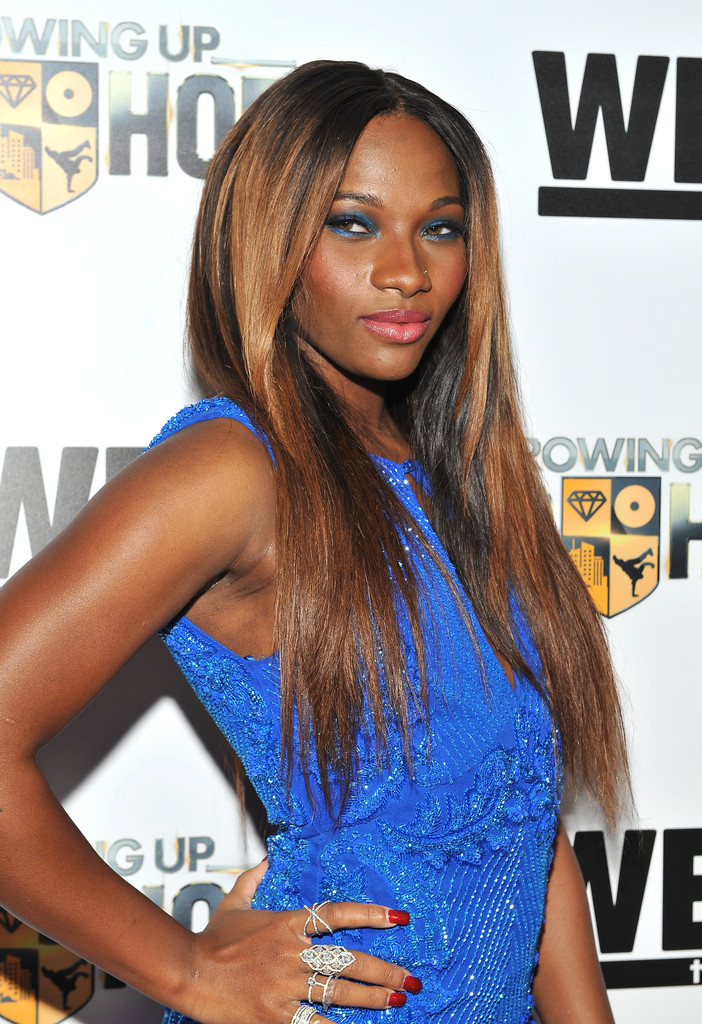
EC: Thank you! Like, I know that if this continues, I’ll get to collaborate more with them, and as I get older, I can get into more clubs where you DJ at, I’ll be able to actually get a view of his tastes, and I can go to fashion stuff that she works with, and I’ll get to learn. Everything that he’s saying, they have to get everything on time, they have to be here or there, they can’t be late–
AS: I’m OCD, so I’m sure T.J. really experienced that. I’m like, “We have to go through this five times!” I’m a crazy woman before the show starts.
Do you think this gives you a unique perspective on both your parents’ history and the history of the music, or do you find yourselves sort of pushing that aside, in some way?

EC: I think that being on this makes us actually more to it than what our parents have grown up with, because as the title “Growing Up Hip Hop” it’s just like we’re coming from them. So, we’re getting–it’s not even that we already know how it’s like with how they grew up, but this also gives us a taste of what all of our parents are growing up with. Because like, it’s not like–I know they grew up together, but we didn’t all grow up together, but we can actually get a feel of, “Oh, you’ve been through this, you’ve been through that.”
And everybody’s toured the same circuits…
AS: Well, a different time and generation, I think what’s cool about the show is that we all can come together and like, this wouldn’t have been something we probably would have naturally been doing by ourselves. Coming together, you’re like, “Oh, wow, we really all really do have a lot in common.” It’s really pretty crazy when you look at, “Wait a minute, so your parent and your mom and your dad…”

You think about it, and it’s your dad or it’s your parent, but when you actually sit down and you’re all in one room, like, “Wait, they’ve done some things.” You know? And like, we are children of and we’re all out here doing our own thing now actually, as well. And what’s dope is like, all of our parents are super supportive.
I could almost say all of our parents are okay with us going in any field. My dad was like, “You wanna be a doctor? I support it. Whatever you wanna do.” At one point, I was like, “I want to dance!” He was like, “Whatever!” And I think that’s what’s cool.
It’s the opposite of where celebrity parents are saying, “Don’t do into this stuff!” You always hear about [that].

TJ: Because they’ve experienced it, they’ve experienced what it was like to go after their dreams and get it, and succeed and be a pioneer in that, you know? So, they know what that’s like. They’re like, “I’m not going to handicap my children and tell them that they have to do this when I know damn well that they can do whatever they want to and they can very good at it.”
EC: Throughout this, I’ve gotten to know a lot of you guys and I know that [??] has like, a different perspective, the way that she’s grown up herself, so it’s like, not exactly the same as everybody else, which is also another great reason, like, we’re getting a whole new taste of everybody.
Have you guys ever hear about “I was reading this article, back when they were touring,” or “they didn’t tell me about that!” I don’t mean dirt and gossip, but aren’t there things you’d be afraid to ask your parents like, “Did you guys really smoke a j with… or whatever?”

AS: You learn everything! But at the end of the day, all of our parents were rock stars, so you can only imagine–I mean like, it was a great time I’m sure, and I think that’s what’s the coolest is like, being able to be where they’re at now and they were so on top of the world, and I feel like all of our parents are super humble and great people.
That’s what makes us who we are, you know? Because they don’t make you feel like they were rock stars, and you go, wait a minute, but you… You go back and see all those pictures, like, “You were…”
EC: I was like, on YouTube before and like, Google, and I see all of like, “Peppa, top ten female fighter,” like, got in fights in random places, I’m just like, “My mom got in fights with people? And won?”

TJ: It’s dope being able to like, run into people, their friends.
AS: Oh, they got stories, yeah. “We used to be on tour together!”
TJ: My father passed when I was young, I was around 11 years old, so there was lot that I didn’t get to learn about him, you know, until I got older and I moved back into the city, and I started running into people that like, did business with him or that were his like, his right-hand man at this record label or they had full, personal stories. And I feel like through these people–there’s this guy, I feel like he’s my uncle, Ricky Powell, he’s a famous photographer. I hang out with Ricky every Tuesday. There’s a group of us that do dinners, and he’s like, the forefather behind it. But like, listening to him tell me stories about them being on the road….

AS: They were dope.
TJ: And your dad being like, “Let’s ball right now!” And going outside to play basketball.
Have you guys thought of writing about all this. it’s a fascinating thing to analyze their careers from your point of view. Not just in terms of how it’s taught you stuff, but it gives you a way to step back.
TJ: My younger brother and I, we’ve been doing a bunch of research on my father and Run DMC, just like, looking — the best is watching the old interviews. That’s the best, because you actually get to… Because they’re literally in our position right now, doing what we’re doing, speaking to somebody. You actually get to see their personality when they were younger than us.

I’m 24, and I was watching videos of them when they were like, 19, 20, not even knowing what to do, being very shy and we watched the progression of them, their mannerisms and how they were shy, and then, four years later, everybody was into their swag. They ruled the world, that’s what they did.
EC: It’s weird too, because I was looking up on YouTube, and my dad was talking about 2Pac and everything. It’s just crazy what the links bring you to, because I clicked on one and it was Eminem talking about my dad, saying how he studied his work. I’m just like, “Whoa, Eminem!” I love Eminem, and he’s talking about my dad. He doesn’t know me yet, and just the fact the he will, and it’s like, really exciting.
You have your egos so well in place that you don’t seem to be much of a pain in the ass. Rock and roll stars, hip hop stars, they can be though. What do you think keeps your egos in check? You’ve seen it, you know that your parents and their friends have done all this stuff so you can’t get too crazy with your egos — is that it?

EC: For me, my mom and dad have given me a lot of stuff, and they’ve made sure that I was happy. So, I wouldn’t want to just be this brat, or go against them and be sassy to them when they’ve given me everything. It wouldn’t make sense if I’m just giving them bad attitude when they’ve just given me nothing but love. That’s the only thing that keeps me–that’s not the only thing, that’s definitely what keeps me grounded. Just to follow the rules and make them happy.
AS: I would just say my upbringing in general. My parents made sure that we were very grounded. We understood what it was to have and not have at the same time, you know what I mean? Like, we were never brats.
There’s such a thing as being spoiled and yes, we were given a lot as children, but at the same time, they taught us to work for what we needed to get and what we wanted out of life. So, I would definitely say it was my upbringing that keeps me together. My relationship with God, just like, overall spirituality really helps me.

TJ: They had to work at it. They didn’t come from like, crazy stuff. So, they had to kind of work for what they got. Like, on both sides Even my mom, she was a flight attendant at 18, and that’s because she wanted to travel the world. And she made it happen for herself, you know? So, that’s kind of what they instilled, I’m sure that’s what they instilled in all of us.
AS: My mom’s actually a school teacher to this day. She works in a public school in Queens and like, I guess I’ve seen it all. My grounding comes from seeing both sides and you know, I get it. Parents divorced, four parents, I get it.