
The HelpAn Interview with Mary J. Blige
by Wilson Morales
August 7, 2011

Coming out this week is the ‘The Help,‘ which is based on the bestselling novel by author Katheryn Stockett.
Directed by Tate Taylor and set in Mississippi during the 1960s, the film stars Emma Stone as Skeeter, a southern society girl who returns from college determined to become a writer. In doing so, she but turns her friends’ lives-and a small Mississippi town-upside down when she decides to interview the black women (played by Viola Davis, Octavia Spencer) who have spent their lives taking care of prominent southern families.
Also featured in the film are Bryce Dallas Howard, Chris Lowell, Jessica Chastain, Allison Janney, David Oyelowo, Aunjanue Ellis, Cicely Tyson, and La Chanze.

Singing the lead single, ‘The Living Proof,’ to the soundtrack of ‘The Help’ is Grammy winning artist and actress Mary J. Blige.
Blige is no stranger to lending her voice to soundtracks, having recorded ‘Stronger’ as the lead single from the soundtrack to the Lebron James basketball documentary ‘More Than a Game’ in August 2009.
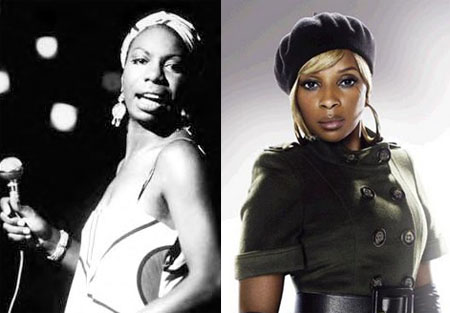
Blige was last seen on the big screen in a supporting role opposite Taraji P. Henson in Tyler Perry‘s film ‘I Can Do Bad All By Myself.’ She’s slated to legendary singer Nina Simone in a biopic but filming hasn’t started on that yet.

Blackfilm.com caught up with Blige as she spoke about her song for ‘The Help,’ the Nina Simone project, and her upcoming role alongside Tom Cruise, Julianne Hough, and Alec Baldwin in the film adaptation of the 80s jukebox hit musical ‘Rock of Ages.’
You’re not old enough to remember that era. Why does it resonate with you?
Mary J. Blige: Well, my involvement with the film first of all it came through management and a guy by the name of Tony Siler at the label had a film in television. It resonated with me not just because she’s a survivor. She ended up surviving to be able to tell her story through her book. The only way she was gonna survive was through walking in love and forgiveness and that’s the only way I survived is through walking in love and forgiving people. And that’s what inspired the whole song. My Aunt Larruper was a maid when I was a child, and both my parents are from Savannah, Georgia. And they would ship us down South every summer, so we got a chance to see a little bit of the help. My aunt was one of those women and she worked for a wealthy white family that loved her to death, like really loved her and she raised their children just like Aibileen would say, too, to the little girl, “You’re smart, you’re kind, you’re important.” I believe she was saying some of the same things to those children, so that’s my relation to the film.

What inspired you to write a song for the film?
MJB: When I saw the film, I cried so much. I got angry. I went through so many different emotions but the thing that stood out to me the most is the courage that this woman had, the courage. Just based on that alone is what made me say, “I’m in.” If she had been portrayed as whimpering, like “Oh, master this and that,” and had simply conformed to the system that was trying to beat her down, I wouldn’t have had anything to do with it. But she was like, “I’m gonna stand!” And not only that, there was someone with a white skin willing to help her.
Do you think today’s generation fully understand how life was in the 50s and 60s with segregation?
MJB: It’s important for them to see how far we’ve come and it’s also important for you to see the courage we had to have. Someone had to have the courage to say I’m going talk to save us all and of course I would tell them to see it for that reason. Someone has to stand up and break the curse or the cycle or whatever it is so we can all have what we’re supposed to have in life.

Now that you have appeared and acted in a few film, would there a hesitation on your part if a role was offered to you to play a maid? Do you have some reservation in not knowing the role but knowing you’ve been sent a role to be a maid? Is there something that goes through you that says “no, I can’t do this as a black actress because I might be disrespecting the race by doing that?”
MJB: This is a business at the same time and okay, “I’m not gonna play, I’m not gonna play a hooker.” That’s what I’m not going to do. I’ll play something in charge. I’ll play a gentleman’s club owner. Why not? Playing a maid is honest. It’s what the situation was and that’s the job that you have. That’s the work that was given to you and if you feel that you can play it, play it. I wouldn’t, I would not say don’t do it. I say do what works for you. If you’re comfortable with playing a prostitute so be it. If you’re comfortable with playing a maid, so be it. If it doesn’t bother you, that’s everybody else’s issue however they feel.
Can you talk about ‘Rock of Ages?’
MJB: I don’t start shooting till the 25th but we did the table reading and it’s good. I play a gentleman’s club owner. But she’s very beautiful. She’s super fly from the 80s and she is the light in the dark place. No matter where we go, wherever we are, whatever we have to do, there’s a job for us to do in those places. So if you’re a maid that maid had a job to do. It’s about the history of these people and what they had to do. So you have to compartmentalize and separate and give people a break already.
What’s the status on the Nina Simone project?
MJB: Well, the film got pushed back to October because of the ‘Rock of Age’ schedule and how close everything was. My relation to Nina Simon is not only she was a great artist she was like so many of us, you know, I don’t want to say it because every time I say it I get, I don’t want to say it. She just was an amazing woman and had a lot of courage. She was an activist. She stood up for what she believed in and that’s my relation to her. she stood up for what she believed in but the side of her that nobody sees. She was human and she went through a lot of human things based on the information that I have that I read. I would like to get more from whoever I need to get it from so they can stop saying things about me because I won’t get it from them but come give it to me if you want me to have it. So yeah, it’s happening.
How do you key into step back into another time? You’ve got to shed all of your experience today as a 21st century woman in order to accurately portray somebody living in the 1960s. How do you key into that?
MJB: You have to do a lot of research. You have to go on line. I have a lot of YouTube of her and I, you know, just watch her, study her, read about her, talk to different people about her but mostly you gotta get in. You have to look at this character and just become whatever she was and you have to do like I guess go and go watch time pieces on her. You have really dig in and get a coach. I have to get a dialect coach. A dialect coach helps you with how she pronounced words and piano coach and just everything that comes with it you have to get involved.

Is there anything out there today you think that people could really latch on to that they’d be willing to give their lives up for? Do you know think that people today would just be willing to do what these women did? Because they would have lost their lives for telling their stories in a real sense.
MJB: Yeah, there’s a couple of things. This a tough one, this interview. I think how women are treated, period. This should be what women should stand up or hold together or ban together to get us, you know, fair chances and more respect in all the businesses that we’re in because, you know, if we turn forty we’re nothing and nobody. If men turn 40 they’re everything. But if we all, you know, as women ban together and just say or just have one woman and say well, I’m not gonna go down like that. I’m not going out like that and that’s what Aibileen (played by Davis) did. She said I’m not going out like that. Well, I’m saying the same thing. I’m not going out like that. I don’t care what you think or believe about me. I believe something else.
How far could that happen like the Wal-Mart case? This class education progressed to Supreme Court. I mean there was evidence everywhere and it was millions and thousands and nationwide and this was in court. Because they have a non discrimination policy they didn’t complain about discrimination. And it would cost Wal-Mart too much. That was the other thing. We need to step backward and look beyond what we saw in this age.
MJB: Women and children are suffering greatly and if people would get together like those women in that movie for that things could change but no one wants — no one has. People are scared because their jobs are like walking on tightropes. If a bomb goes off everybody falls and lose it so it’s hard. It’s hard right now and people are compromising because they want a paycheck, you know, and I understand that. That’s understandable. I got a family to feed but who’s gonna be the sacrificial lamb? Somebody’s gotta do it.
 Do you find yourself at a career crossroads where you have to choose between music and acting or do you think you can always keep them parallel or if they intersect?
MJB : I don’t think I’m gonna have to choose between music because this is what I love, it’s my first love and my fans love me for it. As far as acting it’s something that I’m in the water testing, trying, it’s working. I don’t think I’ll become Meryl Streep because I’m gonna — I don’t want to just play anything. I don’t want any role and a lot of things I’m nervous to do. So I’m gonna do the stuff that, you know, that I can do, that’s believable, that people will believe me for.