
Kerry Washington talks Django Unchained, working with Foxx again, and ScandalBy Wilson Morales
December 24, 2012

On Christmas Day, one of the most anticipated films of the year will be release. Quentin Tarantino’s western ‘Django Unchained’ stars Jamie Foxx, Christoph Waltz, Leonardo DiCaprio, Kerry Washington, Don Johnson, Jonah Hill, Walton Goggins and Samuel L. Jackson.
Set in the South two years before the Civil War, Django Unchained stars Academy Award winner Jamie Foxx as Django, a slave whose brutal history with his former owners lands him face-to-face with German-born bounty hunter Dr. King Schultz (Academy Award winner Christoph Waltz). Schultz is on the trail of the murderous Brittle brothers, and only Django can lead him to his bounty. The unorthodox Schultz acquires Django with a promise to free him upon the capture of the Brittles–dead or alive, and help him look for his wife, the German-speaking Broomhilda (Kerry Washington).
For Washington, it’s been a fabulous year, especially with her TV series, ABC’s ‘Scandal,’ gaining more viewers in its second week.
Blackfilm.com recently sat down with Washington as she discussed her role in ‘Django,’ working with Foxx again, and the growing popularity of ‘Scandal.’

Broomhilda is a fighter. From her getting lashes to her being in the box is from her being defiant. Is that how you would describe it?
Kerry Washington: Yeah, I do. There are two dynamics for me that are really interesting about this character. One, that she’s a fighter, she’s a runaway, that these two people, at a time when two black men and women were not allowed to get married and be in love because that kind of commitment would get in the way of the business of selling human beings, they say “no, we love each other, we’re going to run away to somewhere where we’re allowed to have that commitment.” That’s exciting. The other thing is I think she is a little bit of a princess in a castle, a little bit of a damsel in distress, and that was exciting for me because as black women we really weren’t allowed that fantasy. Because of how our men were treated and how our families were torn apart we were never made to believe that our men could protect us and rescue us. That element of being a damsel in distress is interesting and important.

How long did it take you to speak German, or did you know it going in?
KW: No, I did not know German, and it’s a really hard language to learn. I actually have these recordings of my early-on lessons where the teacher would be like, “It’s not this sound, it’s this sound,” and you can hear me go, “What is the difference???” (laughs) There’s like seven versions of every vowel in German. When I got the role I was really excited and honored, but I was also terrified. I went through this period of being paralyzed with fear where I was sort of taking in information and doing research but I couldn’t put it on its feet. I didn’t know how to begin to create her, because her life scared me so much. So I was reading a lot of books, re-reading a lot of the narratives, watching a lot of documentaries, but I wasn’t really developing the character, per se. Literally what was getting me out of bed was I had to figure out how to ride a horse because I’m gonna have to get that horse to stand still during explosions and gunshots, and I don’t know how to control the horse. So I had to go to the horseback riding lessons and German lessons, those were the two things that kept me engaged until I could wrap my head around her as a person.
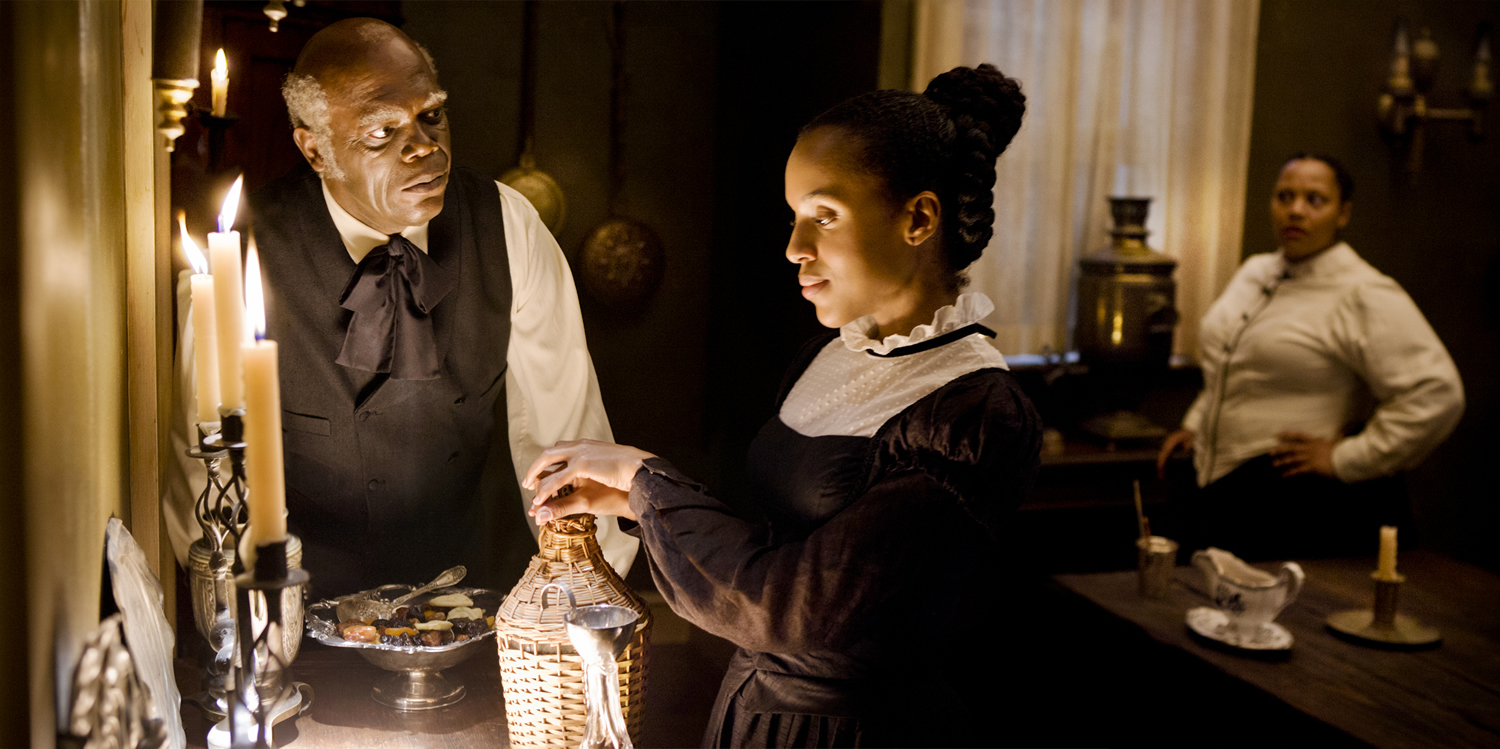
Broomhilda is sort of privileged because she grew up in this German household. What makes her a composite to other slave ladies who were out there, or is she something special?
KW: I think she is in some ways so universally understood because I think we all want to be loved in the way that Django loves Broomhilda. We all want to believe that somebody loves us enough to slay the biggest dragons, even if that dragon is the institution of slavery itself, in order to be with us. The pain that she endures… when we were filming, being able to shoot on an actual slave plantation it changed the process for us because we were walking on sacred ground. When I did that whipping scene I knew that in that very space people had lost their lives, in this culture, in that time. It was a day in the woods, you could hear the birds and the bees buzzing and the butterflies, but the first time that whip cracked in the air everything stopped. It was like all of nature thought, “Oh no, it’s back, that evil is back.” I felt very connected to and grateful to all the women who lived through that so that I could be here today connected to that time.
We remember “Roots,” and I can’t recall any film or TV program that had that much of an impact. When we see some of the brutal scenes, even balanced with the comedy, was there ever a discussion of what was too much?
 KW: I don’t remember an exact conversation about that. I do remember Leo saying, “I don’t know if I can say or do these things.” For me what’s exciting about this film is that it’s a hero’s journey, and so many films about this period of time are about black people wanting and waiting to be freed by white characters. This movie is about a black man having his own freedom and then rescuing his wife, but the agency was in the black man’s hands. That’s tremendous, I don’t know if we’ve ever seen that before! To have a hero’s journey you have to have enemies at the gate, and those enemies were Calvin Candie and Stephen. That brutality serves a purpose because if you understand how awful it was then you understand what a hero Django is. For a free black man to go into Mississippi to rescue his woman you have to show what he was up against to understand what an enormous hero he is. What you see in the film is awful, and it was much worse in reality. When I first read the script I read about that metal mask he’s put in after we’re sold to separate plantations, and I thought that was some crazy Tarantino “Pulp Fiction” invention. Then during production I walked into the design offices and there were 20 or 30 photos of actual masks like that were used on slaves, and I felt ashamed. I think of myself as a well-educated African American who knows my history, and I didn’t know that was real!
Neither did I.
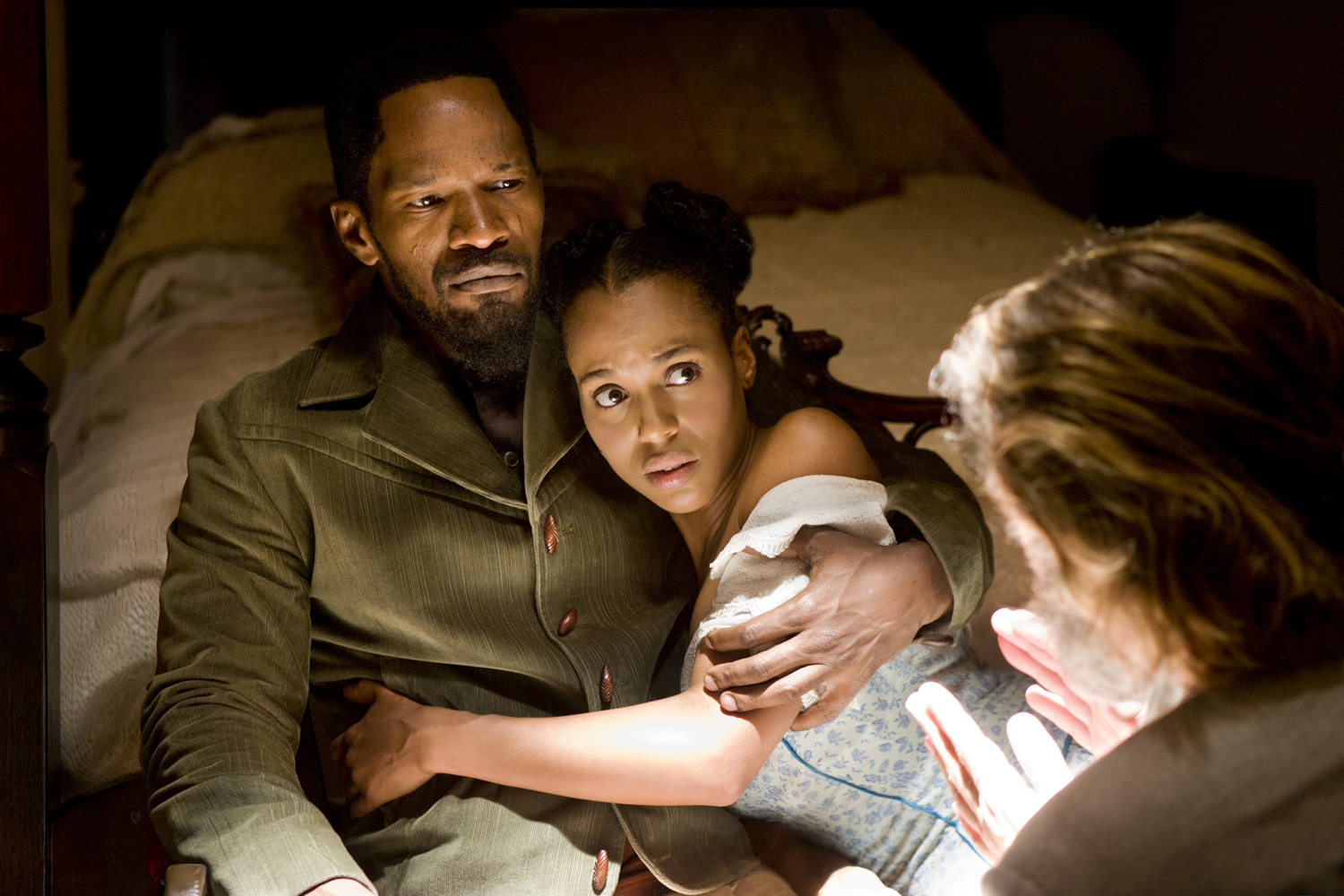 KW: When we were at Evergreen they have all these artifacts, it is an archaeological site. You could see shackles for CHILDREN, for toddlers. It was horrifying. We know about it, but to experience it makes you understand it more in a way that I think is important. Incidentally one of most important things I read in preparing for the role is this phenomenal novel called “Book of Night Women.” If you have not read this book, Wilson, it’s tremendous. It takes place pre-Civil War in Jamaica, actually. It’s the new “Beloved.”
This is your second film with Jamie after ‘Ray.’ You don’t have much screentime, but was it more comfortable?
 KW: I almost feel like I was playing two different characters because I was playing Broomhilda in these horrific situations, but I also had this other character to play which is the Broomhilda of Django’s heart and imagination. The Broomhilda that Django envisions, and we had to communicate a lot without words. I don’t even think that Tarantino intended this at the beginning, but there is this very cool cinematic poetry because this is about a husband and wife being reunited against all odds. Jamie and I in the film are being reunited as husband and wife, and there’s something cool about that. I can spend the rest of my life thanking Jamie for all the love and support he showed me in the process of making this film and it would never be enough.
Can we get an official black love story from Hollywood? This is a black love story but there’s a lot more into this…
KW: It’s a classic Tarantino film, and maybe more of a love story than we’ve ever seen from him in a way because the love story is the whole impetus for the western adventure journey. You mean like a “Love Jones?”

Yes, no one’s doing that anymore. We see a lot on the indie level, as opposed to a studio taking a chance.
KW: Well “Think Like a Man” was a good ensemble love story.
I finally caught the last episode of ‘Scandal’ yesterday. How exciting is it that your show is gaining an audience week after week?
KW: I want to thank you for all of the support and love you show the show every single week because it really helps the show. Our fans, when people Tweet about it, it means the world to me because I think social media has been massively important in the success of our show. We only exist because you guys are watching. You guys don’t watch? We don’t have a job. I am so grateful because I love what I do and I love working for Shonda Rhimes and I love our show. It’s like being on an Olympic team, everybody is so good.
What can we expect for next season?
KW: We’re just finishing up episode 13, you guys just watched episode 9. The twists and turns will continue. You’ll learn what happens to Huck. It’s unexpected. Two episodes from now there’s an episode coming up and I burst into tears on my way to work reading it. That’s my Olivia Pope answer for you!
When are we going to see “We the Peeples”?
KW: This spring, Mother’s Day weekend. That is a black love story. There are some. This is Craig Robinson and I, and it’s really fun.

What’s a good reason to see ‘Django Unchained’ on Christmas day?
KW: It’s got everything you would want. You will laugh, you will cry, you’ll be horrified and inspired. It is a true rollercoaster ride!