
Angela Bassett talks Olympus Has FallenBy Wilson Morales
March 19, 2013
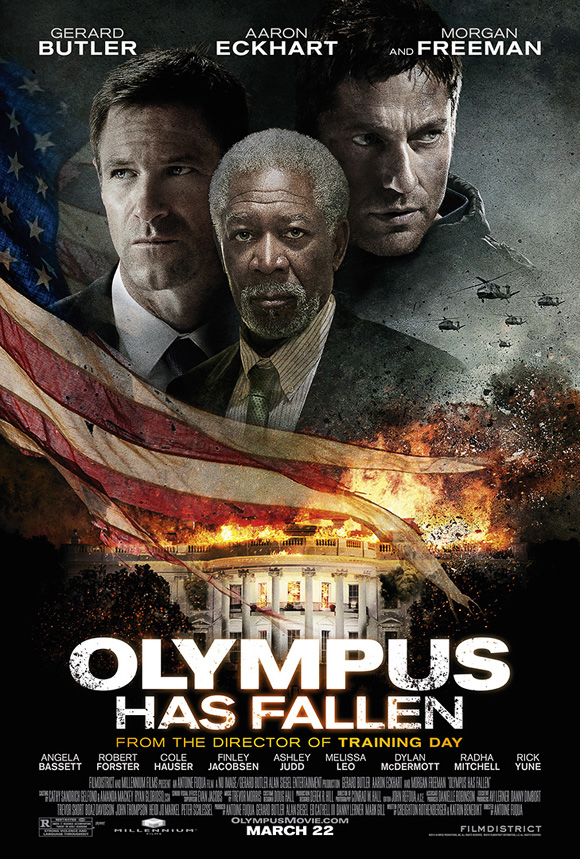
Coming out this week is Antoine Fuqua’s action thriller Olympus Has Fallen, which stars Gerard Butler, Aaron Eckhart, Morgan Freeman, Angela Bassett, Dylan McDermott, Ashley Judd, Melissa Leo, and Rick Yune.
In the March 22 release, the White House (Secret Service Code: “Olympus”) is captured by a terrorist mastermind and the President is kidnapped, while disgraced former Presidential guard Mike Banning finds himself trapped within the building. As our national security team scrambles to respond, they are forced to rely on Banning’s inside knowledge to help retake the White House, save the President, and avert an even bigger disaster.
For Bassett, who plays Secret Service Director Lynn Jacobs, the role is one that normally would go to a male but Bassett makes sure that any woman can pull of being in charge of a male-dominated environment.
With a recent turn as Coretta Scott King in Lifetime’s Betty and Coretta and the upcoming Kasi Lemmons musical, Black Nativity, which reunites her with Waiting to Exhale director Forest Whitaker, Bassett is will seen in theaters throughout the year.

In speaking with Blackfilm.com, Bassett talks about her role in Olympus Has Fallen, shooting the film in Shreveport, Louisiana and her upcoming projects.
How was shooting in Shreveport for this film?
Angela Bassett: Hotter than the hinges of hell. It was blazing! There was no food to eat, not even in my hotel. Here’s a catalogue and you can order it from somewhere. It’s hard enough to find something on the menu and now I have to find a place outside of the hotel. I was in and out so that was good.
What does it take for a female to be the head of the secret service? Does she need to have experience on the job?
AB: Probably a lot of sacrifice. I would think it would help if she experience on the job, there are a lot of administrators who are good at that. I think my character has put her time and served a couple of details.
Having played the head of an agency at the center of attention, and although this is a commercial action thriller, do you look at things differently when you hear of certain things that’s happening in the world where a person in the position you played has to make a decision?
 AB: I don’t think so. You just have more of an awareness and completely fully, but it’s more intriguing. It hits you and impacts me a little deeper. Having been in the situation room and interact with retired secret service agents and having heard their stories of places they have been and things that they have had to do. It might throw you against the wall. You can’t imagine what they are going through.
How was working with Antoine? Is he very technical or the opposite?
AB: He’s certainly technical. You go into his office when you arrive and you can see that he’s detailed oriented. His preparation is impeccable and yet, he’s a people person. He’s about the character and not just the look and the detail and the technical aspects. He has all that to support what the actor does.
Is Morgan intimidating?
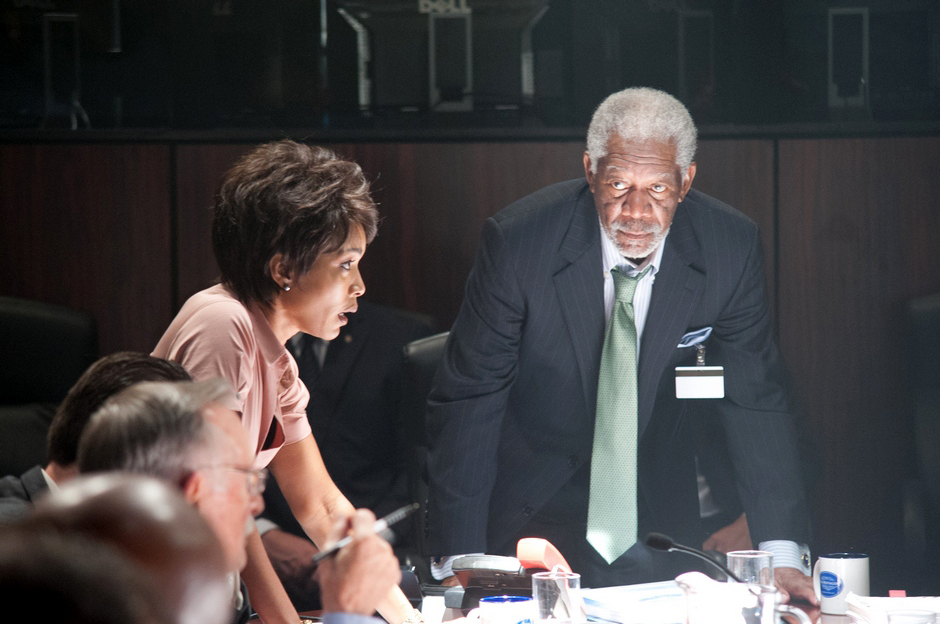 AB: The things that intimidate us is usually in our own mind. I was intimidated before I got to Shreveport. I was like, “How is this going to go? He’s done so much. He knows his way around. He could probably direct this movie.” He was just there to give. It was wonderful to literally and see the ease and when some things needed clarification, he was there to lend a hand with the situation.
You are no stranger to doing action films. Strange Days is a favorite of mine. What attracts you to the films that you do?
AB: With this film, and Strange Days, the directors offered the parts to me. That’s a huge compliment to an actor and both of them were Kathryn Bigelow as a director. To work with a female director is a treat, a benefit. To work with someone who is a master of their craft and to have a script that is about character like the one in Strange Days, and Secret Service Director Lynn Jacobs in this one. It’s not about things bursting into flames, but real character pieces at their core.
You have the Kasi Lemmons musical Black Nativity coming up later this year. Will you be singing in the film?
AB: You will hear me. You are going to hear me, so that’s exciting because you haven’t. You think you have, but that wasn’t me singing in What’s Love Got To Do With It. This is new territory for me. I don’t consider myself a singer at all. It takes another kind of confidence and I have to go and work with someone, and then it builds and get more training. I was happy to work with Raphael Saddiq and they made me feel confident. I get to do a duet with Jennifer Hudson, but within the script, we are in two different places. Everyone in the cast is so over the moon with this film. The studio and the heads who have come to visit and the dailies that they have seen, it just looks great. The music crosses so many different genres, from rap, R & B, and Gospel. It’s also Langston Hughes, whose words and poetry gave me an introduction into theater.
This year marks the 20th anniversary of What’s Love Got To Do With It and if you can think about one thing about making that film, what would that be?
AB: How impossibly painful it was, physically, emotionally, and spiritually. It was like a test by fire for me that I met everyday. I would have to self-taught and the do the work of what was required and then I got through it. When folks would say that I would quit and not come out my trailer, if that happened to me and they spoke to me that way, but during that time, you really felt a sense that these are battles, but to complete this and do it well, is to win the war. So I had to forget the battles and the daily insults by winning the war and doing good work.
As you are working with Forest Whitaker on Black Nativity, what’s the current status on the sequel for Waiting to Exhale? Will it still happen?
AB: They keep talking about it. It’s still in the works. The executive, producer, director are on board, but we haven’t received a script that everyone is pleased with. As we know, it all starts on the page.