
Jeffrey Wright talks Broken CityPosted by Max Evry
January 20, 2013

“The always elusive Jeffrey Wright,” as “Broken City” director Allen Hughes calls him, is one of our brightest character actors. From the eccentricity of “Basquiat” to the quiet cool of Felix Leiter in the Bond films, through his breakthrough role in “Angels in America” which garnered him a Tony, Emmy, and Golden Globe award, wright always leaves his mark.
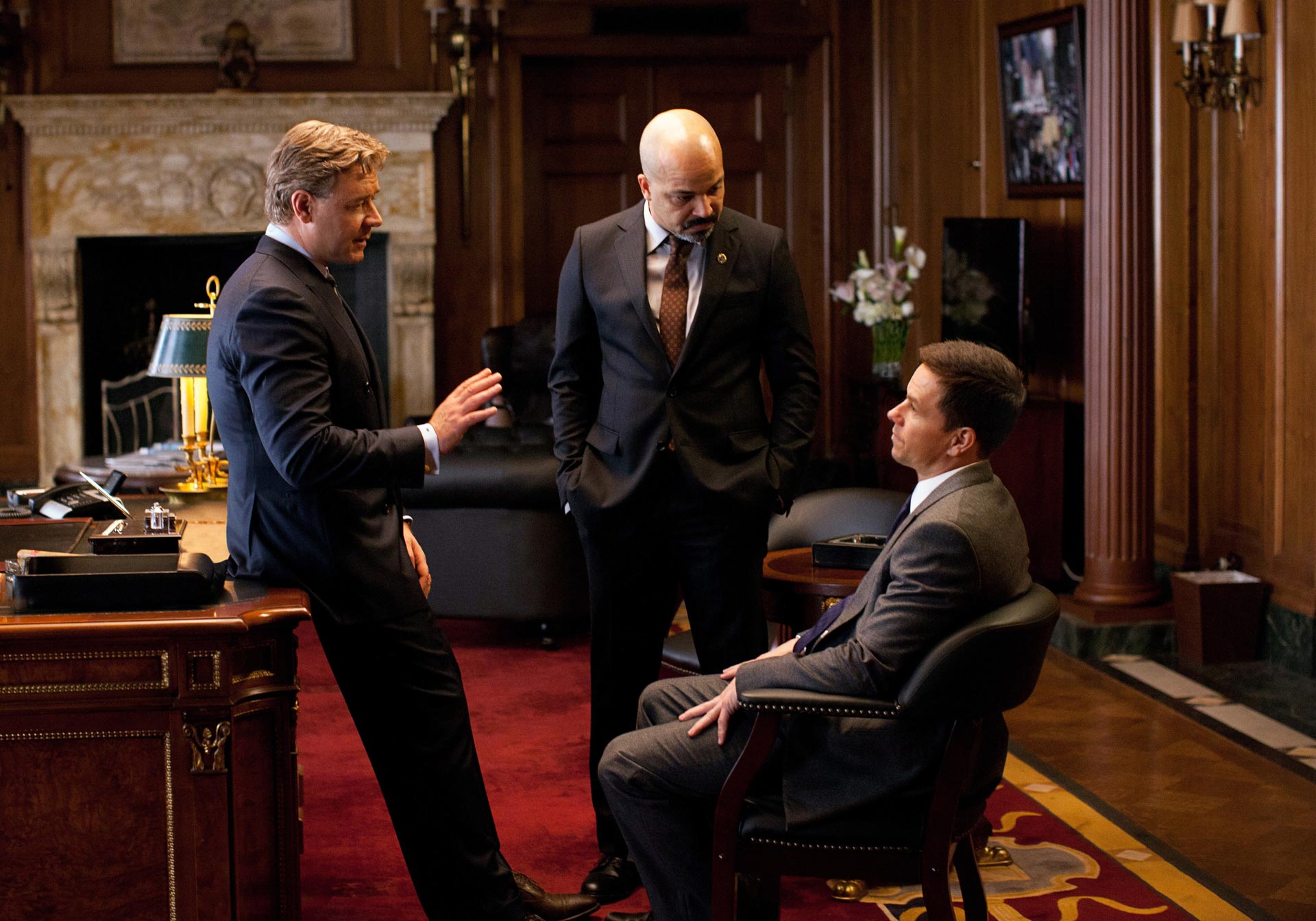
In “Broken City” he plays the mysterious police commissioner Carl Fairbanks who is at the center of a conspiracy involving a corrupt New York Mayor (Russell Crowe) and a private detective with a checkered past (Mark Wahlberg).
Wright chatted about this new role at a press conference in New York.
Can you talk about keeping the motivations of your character so hidden throughout the film?
JEFFREY WRIGHT: I thought the mystery was an important aspect of who he was, as an observer and manipulator. Clearly someone who was a survivor. That was his MO was to let everyone else reveal their cards and keep his hidden. I thought it served his interests and the film as well, the story. There are certain reveals that work because we don’t know a lot about him, we just know that he’s there.

Did you talk to any New York City cops while preparing for your role, and also did they suggest to you the influence of politics to get their job done every day?
WRIGHT: I didn’t talk to any New York cops specifically in preparation for this, but I am friends with a couple cops and former cops, one of whom came to mind a bit. I don’t think the movie is so much an expose, at least I didn’t read it that way. I read it more as a genre film set within a contemporary landscape that has all this richness within it, and as a contemporary Humphrey Bogart story. New York City here could be Chicago, could be Los Angeles, could be Metropolis as I read it. It brings into play larger ideas about corruption that’s not specific to New York, but there’s something else about the confluence of confluence of politics and capitalism. But I read Humphrey Bogart in it, and then getting to know Mark a little better as we worked on this I realized that this guy has the elements of a contemporary Bogart. He has a similar authenticity, the accessibility to audiences, the intensity, all that stuff. It’s very interesting. I tried to do a little bit of my own Claude Rains.
All the main guys in the movie had a lot of layers to them, with the audience changing allegiances as new things are revealed. Did you feel that way about your character in particular?
 WRIGHT: One of the exciting aspects of the film is shifting sands. I don’t think the characters within the story know who to trust and who’s on their side and who’s not until the story evolves. For an audience that’s a good place to be, but as far as my perspective, it didn’t shift any more than it did for the character. I like the idea of being there when Allen asked me to be a part of it. “Yeah, I like everyone, it’s all good.” (laughs)
What kind of statement is the film trying to make about corruption and the nature of modern politics?
WRIGHT: I don’t see it necessarily as a statement movie, but what I like about it is its not only a throwback to Bogart-era films but also films of the ’70s like “Serpico” or “Network,” that genre of filmmaking that was gritty and urban and relevant and political. Even though you were leaving the outside world and stepping into the theater, it didn’t mean you were totally cutting yourself off from the world around you. Storytellers were telling a story that’s connected to reality. It goes back to Shakespeare, “Julius Caesar,” which is the same kind of story about power, corruption and betrayal set in a political landscape. This is rich, fertile ground for storytelling, and unfortunately these types of stories will always have relevance. It always seems like they’re message movies because they connect to something that’s central to human nature: Power, survival, corruption, frailty, fault, hopefully some virtue within that as well.
The screenwriter, Brian Tucker, is an African American in his twenties. Does his perspective bring something unique to the genre?
WRIGHT: I actually spoke to Brian not too long ago about what his intentions were behind the film and he’s really a very insightful cat. He’s talking about ideas of “efficient corruption” at a time of economic uncertainty. The ways power and politics take advantage of that. You’d be better served talking to him about his ideas than me, but one of the things that excites me about this project is it’s very rare that I’m involved with a film directed by someone of color, written by someone of color, and in many ways my character is somewhat subversive because he doesn’t exist that way relative to what an audiences expectations might be of him and his storyline, and he doesn’t exist if that’s not the case, because these two guys are bringing a different perspective than we ordinarily are exposed to on how these characters might interact. It’s really really exciting for me to have been a part of that.
“Broken City” opens everywhere on January 18.