

On day 28 of 30 shooting Sony Pictures’ newest film, Black and Blue, Blackfilm.com watched the only action scene being filmed that day.
Directed by Deon Taylor, Black and Blue follows rookie cop Alicia West (Harris) in New Orleans who accidentally stumbles on some fellow officers murdering a drug dealer, an incident captured by the body cam on her uniform. When they then fail to execute her she escapes and teams up with the one person from her community who is willing to help her (Tyrese Gibson) as she tries to escape both the criminals out for revenge and the police who are desperate to destroy the incriminating footage.
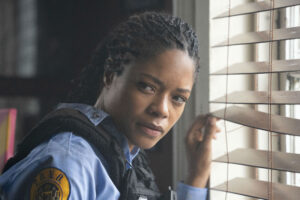
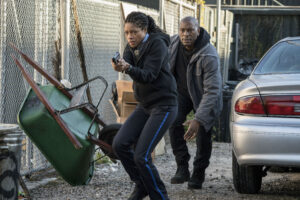
In the scene, Alycia (Naomie Harris) runs between two Louisiana town homes after she is caught with the footage of corrupt narcotics murdering a drug dealer. She intends on showing the recording–captured through her body cam–to the precinct, but must first get through the cat and mouse chase that begins in this moment.
The actors, Beau Knapp (Smitty) and Frank Grillo (Malone), prepare for the scene by going over their lines, pacing around the set, doing jumping jacks and getting the adrenaline up. They have just discovered that Alycia is not truly one of them and will need to reflect that annoyance and frustration.

While both the official cop car and the gold, undercover narcotics getaway are being engined up, Naomie is receiving her blocking under the porch of the town home where she will hide. The whole set is being wet down and Director Deon Taylor sends a few notes to Beau and Frank. He also approves of Naomie’s sprayed face, which makes it appear as if she is sweating from the intense chase. The crew clears the path where the cars will race down the block and stop just in front of the hiding zone, and from there the filming begins.
At the end of filming the scene, Smitty and Malone flee and Alycia crawls out from under the porch and continues running back down the alley. It’s a short, but sweet scene that sets the tone for the challenges that Alycia will face for doing what’s right.
Here’s s what the cast had to say about the film:
Tell us about the characters that you play.

Beau Knapp: I play Smitty, he’s a love interest [laughter]. No, I describe myself as very loyal to my boss (Malone), just trying to survive in New Orleans while making a lot of mistakes.
Frank Grillo: It’s a cat and mouse thing and my character is not unlike that Denzel character in Training Day where he kind of runs the streets until it turns on him. But that’s what we kind of do throughout the whole movie.
Deon Taylor: Frank Grillo represented that weight that I needed on the other side of Naomie. We needed something where we could have a strong, powerful — but at the same time, she’s human, she’s flawed. She doesn’t know it all; she’s not Wonder Woman. So, throughout the course of the film, what Alicia, played by Naomie, is trying to do is find herself as well as be a cop. Frank’s character has been a cop on the force for 20 plus years, he’s a narc, there’s a way that he learns how to patrol the area. And it may not be the right way but that’s what he knows and what happens is, in the film, these two come together with two completely different agendas on how you’re supposed to patrol the area. And that comes off the hills of her seeing him do something he shouldn’t have done, recording it, and in this cat and mouse. And when it comes together, I think the biggest message in the entire film is the change. That’s what the movie is about.
How did you prepare for this role?
Naomie Harris: I was able to draw on a lot of stuff that I did before because when I did Miami Vice, I did lots of undercover work, so I was out with the police and doing raids–I actually did a real drug sting. It was really exciting and terrifying. We got the wrong guy [laughter]. So I did a lot of research with that and then it was a lot of watching cop programs, real, live cop programs. I watched [clips on YouTube] of women cops, following them around and showing their day and that was fascinating to see interviews with them. And also, I find as well, that the biggest thing for me is my imagination. More than even real life stuff. What would it be like if this was my life and I was cop? So, I’m putting myself in that situation.
And how did you navigate through the accent?
Naomie Harris: I wanted to do a New Orleans accent, but none of us are from New Orleans. So since we are all from different places, Deon thought it was better to go with a standard American accent. I’ve heard, since I’ve been here that lots of New Orleans people have been quite offended sometimes because people have tried to do the New Orleans accent and got it very wrong. And since being here, I realized that it’s hard. A really hard accent.
Can you describe your personal relationship with law enforcement?

Deon Taylor: I had a really interesting childhood coming from Chicago/Gary, Indiana area and then moving to Northern California, and then traveling all over the world playing sports. I’ve been affected by police officers in many different ways. From the patrolling, when I was younger, in terms of keeping people in certain areas and having a negative reaction to that in the Chicago area, and with how people police you, vs now, living in a different [area] and seeing how the police act there. You have to be a realist and understand, ok they patrol this way here, and they patrol that way there. What I thought was the most interesting for this movie, and this was also centered around Naomie, when I first took the movie and read the script, I called Erick, the guy at Sony, and said, “hey look, let me tell you why the movie’s incredible and what it represents in terms of black and blue.”

A couple years ago, there was a picture in Time Magazine in Ferguson, the world is on fire, and cops have riot gear and shields. You guys have seen the picture and know what I’m talking about. All cops with shields, white police officers, masks on, everything. At the very end of that line is one black police officer holding the line with a tear right here [points to cheek]. I said, that’s what this movie represents. Because at the end of the day, if you’re a black police officer and you’re trying to do it right and you’re put in these high impact neighborhoods, how do you make a difference? How do the kids see past you just being blue? And that was one of the biggest things that we tried to do in this film when we came off the script to make it become more reality based in terms of how Mouse views Alycia (Naomie Harris) in the movie. What is the conflict there? How does she deal with the day to day? That’s one of the biggest themes in the film — Alycia being from the inner city, coming back to the inner city as a cop and how people look at her and what they say to her. And she has to find out the hard way that people don’t view her as a black female cop. They view her as a cop. She’s trying to make a breakthrough. There are so many different experiences and what we try to actually do is push all of that into one film. The movie takes a complete turn based on the fact that when she’s in trouble, someone from the neighborhood helps her and breaks code. And everything that we’re taught not to do, this character does.
 Tyrese Gibson: I feel like I was born in the belly right there where everybody has had certain cop experiences. When I was in the hood, the only white people we saw was police officers, firefighters and the dudes that came to check the meters in front of your house. And so you just kind of grow up knowing specifically that we don’t f*ck with the police, and they don’t f*ck with us. Period. And then you start seeing why all the homies say that but what’s interesting is that there are two things: the police and that constant kind of friction and tension that’s always there has its history all the way back to the 40s, 50s, 60s, civil rights [era]. It’s so many images of police brutality from back then and you can take a lot of these images from black and white footage and you can relate it to the same image [here].
When Deon is speaking on the shields, you’ve seen those images. So what’s interesting about this movie is that it’s just an analogy, but imagine seeing the movie through the lens of a paraplegic, if the whole movie is about being a quadriplegic, a paraplegic, then you can leave the theater thinking differently based on that experience. So it’s not just a police officer, but it’s a black woman in New Orleans coming off of all these controversies and seeing that she is doing what she is doing in this particular movie and how there’s certain people having to turn the leaf in order to protect her, or try and kill her or whatever the dynamics are. And I think people are going to leave the theater looking at the police experience as an officer through a different lens. And it’s going to also create certain sensitivities for police officers that may not exist right now. So that’s another reason why I took it on. Because I would be lying if I sat here and said that every officer I ever met is bad. I get pulled over all the time for speeding. And they’ll get to the car and be like “oh, Tyrese, what’s going on? Alright. Go ahead. Slow it down, man.”
What are your thoughts about how this film responds to police brutality?

James Moses Black: Lawlessness is really prevalent today. There’s no real protocol with lawlessness. There’s no way of doing the crime, there’s no set way. So if there’s no set way of doing the crime, now, when you go to serve and protect, that image of trying to put something and having a protocol on how to serve and protect is gone. You can say one is breaking the law in America, but it may not be breaking the law in Venezuela. That’s people probably trying to liberate themselves. But they’re doing things against the current law to liberate themselves. And so, when we’re down here and we’re doing this movie right here, there’s a certain way, and this is after Katrina, so people had to have a certain protocol of dealing with lawlessness. So they had to create this thing about how to deal with lawlessness. And then it became, in this movie, that the lawlessness took over and some of us became corrupt.
Some of us became corrupt and still tried to maintain a sense of civility and how to deal with human beings, but a little bit of our soul is corrupt. You know, one of the brilliant books that never really got a lot of play was The Trumpet of Conscience by Dr. Martin Luther King. The questions was, if the light is red, and I’m driving my car, and there’s an emergency, I’ve got to bring my daughter or my son to the hospital, do I run that light? And break the law? Well, you break the law to save a life. So if they stop you, is it now breaking the law or saving a life? And that’s the whole thing to me when people walk into this theater. Alycia is trying to save more lives than her own. She’s becoming a model, not only for people on the force but for the community at the same time. To me, that is the most important part of policing. Not putting somebody in handcuffs, but showing that we are collaborative like this man here [pointing to Deon Taylor], we are collaborative in this sort of thing that we have to police. The police are an important factor in maintaining the law. It says serves serve and protect not serve and kill. And when you think about the movie from my interests, it’s about what does that really mean, serve and protect?
Deon Taylor: Yeah, he’s right on point. All the characters are playing opposite Alycia. I feel like 2019, 2020 is the changing of the earth. The reality is that we are all in a world of confusion. We had to have Alycia get broken in half in the movie. Rock bottom, fall down. That’s where you’re the best. No matter if you can’t pay your bills, getting evicted, your car being repossessed–I’ve had all of that. Holes in your shoes. Damn, I don’t know how I’m going to live tomorrow. Right? If there’s a will, there’s a way. You have to have that happen to you as a person, in order to understand how to rebuild yourself on something real and solid. And that’s very spiritual, but in the film, that’s what we dive and do with Alycia. She comes in spunky like hey I’m a cop. You want change in the neighborhood, here’s how I’m going to change it. And then every blow, it’s like someone is knocking her down.

Naomie Harris: I think that police corruption and brutality is unfortunately a worldwide issue that we have. I think that whenever you have people with power, there’s the potential for it to be abused. So I think that message is needed universally. But also I think that in talking about the fundamental message in being the change: we all like to look out and say oh, I’m not happy about the system, I’m not happy about this, I’m not happy about that, I want life to be different. But ultimately, what Alycia does in the movie, which is so amazing and I have so much admiration for her as a character and I wish I was as strong as she is, [but she] says, no, I’m going to sacrifice, potentially my life, [and] absolutely everything she puts on the line because she says, this is wrong and I want to draw the line here. And I’m going to make sure that I’m the one who is going to make the change. I am the one who is going to make a difference and put this wrong, right. And I think we all need to do that and if we all do that in our small way, that’s how change happens. It’s not necessarily about big, global movements, it’s about all of us saying enough is enough and taking a stand.
 Frank Grillo: It has to start somewhere. When you look at the whole #MeToo movement for instance, there was something that happened that kicked off Me Too. And who would have thought, in a very short amount of time, our culture would change for the better? For the most part, it’s starting to move in a better direction. Now it’s going to take us a while, but it was from one person, one thing. And I think Naomie makes a good point, it’s all of these years, the 20s. The 30s and 40s, we’ve seen the same images of police. And it’s time for that one change to happen. That’s the through line – be the change.
Which scene is your favorite and why?

Deon Taylor: One of my favorite scenes [is] between James and Naomie, where they go to this night club and there’s this big fight. She’s the first one to jump up, she hit her body cam, she runs to the middle of the fight, grabs this guy, throws him up against the wall, putting her elbow into his neck, and what does she do? The guy that got hit ducks out into the crowd, very simple. She hems this guy up and says, “what are you doing trying to stop a fight?” Meanwhile, here comes this guy back through the crowd, with a gun. It’s that quick. Frank comes, grabs that guy with the gun, slams him on the car, arrests him. They go eat right after that. Silence. No conversation. And he says to Naomie’s character, Alycia, the coldest words in the entire film, “he says, you think you’re black? You’re blue” And that was the biggest lesson for her in the opening act of the movie. You can’t get caught off guard with people of your color. Whether you’re white or black, or Latino, or Asian, this is a job. You’re on this side of the fence.
About off campus research
Deon Taylor: When we did our research earlier, we went to all the stations, we learned about the body cam and how they work. We went to one police station and [I asked] one dude, “Where’s your body cam?” And he said, “oh, it’s over there man, push the button for what?” And I said, man, this is crazy. I said, “where do you load the body cams at?” We went to one room, they got the body cams hanging off the wire, one ain’t plugged up. I said, what are y’all doing in here? What is going on? So what the movie represents is the infusion of the body cam.



Loading…