
Tessa Thompson Talks Dear White People And SelmaPosted by Wilson Morales
October 17, 2014

Coming out this week is Justin Simien’s highly anticipated film, Dear White People, which was the Winner of the Special Jury Award for Breakthrough Talent at this year’s Sundance Film Festival.
Simien’s debut feature is a satirical look at campus life and racial politics at a fictional Ivy League college, and stars Tyler James Williams, Tessa Thompson, Teyonah Parris, Brandon P. Bell, Kyle Gallner, Malcolm Barrett, Brittany Curran, Marque Richardson, and Dennis Haysbert.

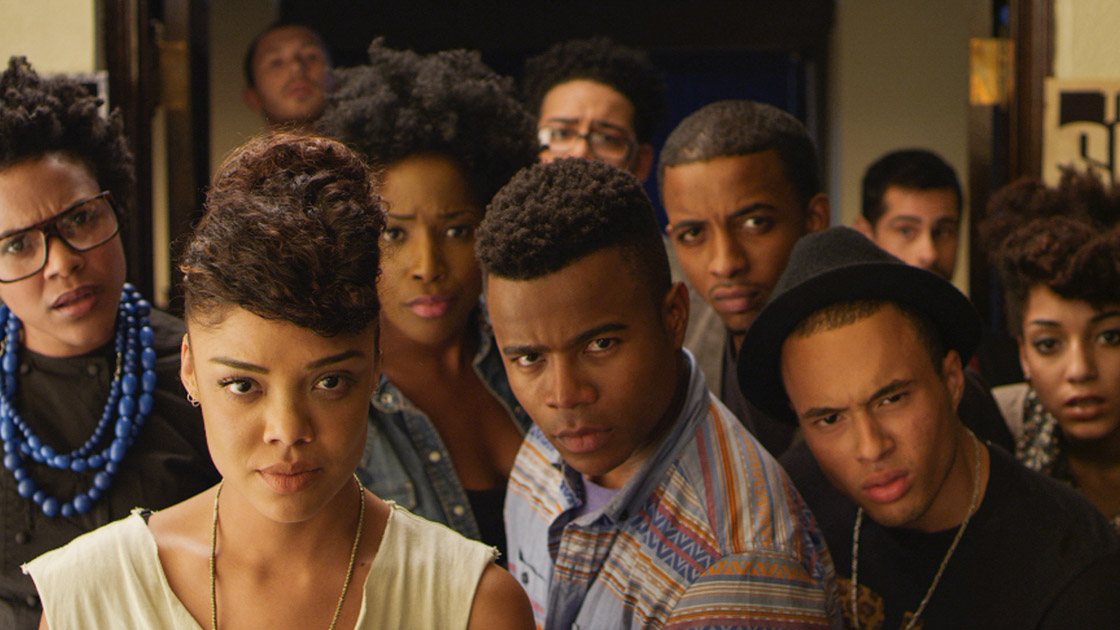
The unexpected election of activist Samantha White (Tessa Thompson) as head of a traditionally black residence hall sets up a college campus culture war that challenges conventional notions of what it means to be black. While Sam leverages her notoriety as host of the provocative and polarizing radio show “Dear White People” to try to prevent the college from diversifying Armstrong Parker House, outgoing head-of-house Troy Fairbanks (Brandon P. Bell), son of the university’s dean (Dennis Haysbert), defies his father’s lofty expectations by applying to join the staff of Pastiche, the college’s influential humor magazine. Lionel Higgins (Tyler James Williams), an Afro-sporting sci-fi geek, is recruited by the otherwise all-white student newspaper to go undercover and write about black culture—a subject he knows little about—while the aggressively assimilated Coco Conners (Teyonah Parris) tries to use the controversy on campus to carve out a career in reality TV.

Leading the charge of this ensemble is Tessa Thompson, best known for the role as Jackie Cook on the television noir Veronica Mars and as Nyla Adrose in Tyler Perry’s For Colored Girls, for which she a 2011 Black Reel Award for Outstanding Breakthrough Performance. The Los Angeles native also had a main role on the BBC series Copper. Thompson will next be seen playing Civil Rights activist Diane Nash in Ava DuVernay’s MLK biopic, Selma.
Blackfilm.com recently spoke to Thompson on her roles in both Dear White People and Selma.
How would you describe Sam White?
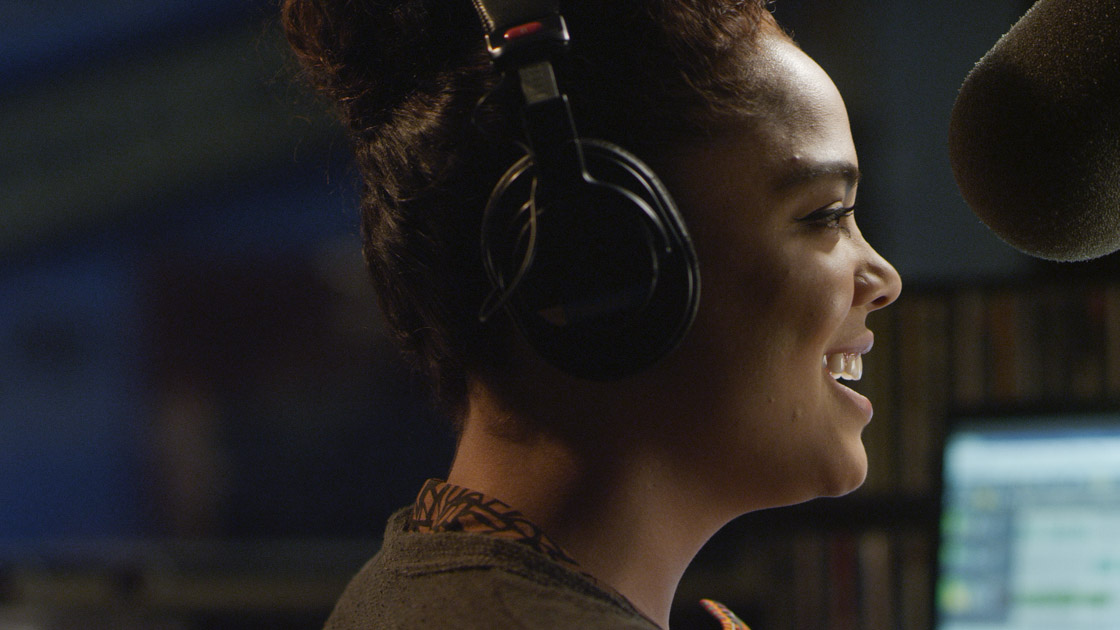
Tessa Thompson: She has this radio show that gives the film its name, Dear White People, and I think she’s someone who interested in making sharp observations about what she sees around her. She’s somebody that’s more than prejudice or racism or inequality upsetting her about America, and I think apathy is the thing that gets to her. She’s become the resident on campus firestarter.
What was the attraction to taking on this role?
TT: I was mostly taken, first and foremost, by the script. I felt it marked the emergence of a new exciting voice. It reminded me of movies that were groundbreaking when they were made, but were also very fresh. That was my first attraction. Also, to play a female character that is not the object of the narrative but the subject of the narrative. To play a person who is enigmatic and filled with contradiction and complexity is a joy for any actor; in particularly for a woman of color. That’s something that doesn’t come along that often.
The title sparks conversion and controversy, so who do you think is the audience for the film?
TT: I think I had a very idea as to who the film is for. I thought it is for the audience who is hungry, the resurgence of blacks; because those are the people who made the film. But what I found when we screened the film at Sundance and subsequently when we screened the film all over the country is the audience is so much whiter than I assumed initially. As much as I assumed the film is about race in America, it’s a film about identity and sometimes your identity comes in conflict with whom you actually are with yourself. I think it’s a universal story. People battle expectation of duty and I think we can all find ourselves in these characters.

Is there any part of the character that you related to?
TT: I felt that I related to Sam in the sense that I went to a very diverse public school for high school and it was my first time in public school actually. I felt like I was being thrown into the fire and it was a really diverse set campus. There was every racial group and every social economic standing, but the campus itself, when it came to lunchtime, was sort of segregated. I think I had some trouble figuring out where I stood and where I fit in. At times, at the time it meant I couldn’t reconcile parts of myself. I felt at times I couldn’t be all the things I was at the same time and that people couldn’t understand or accept.

How was working with the cast and establishing chemistry while shooting in Minneapolis?
TT: I didn’t know anyone before I started working on the film. For some people, there were some strong relationships that were already forged and some of the cast members knew each others. IT really felt like being in college and I dropped out of college and started acting, so I didn’t have that specific experience but we all stayed in the same hotel. It felt like dorms in a way. We felt every waking moment with each other when we were not working and when we were working. We all became really tight and I hadn’t had an experience like that. If ‘Dear White People’ faded into obscurity and didn’t have the attention that it’s having, I would have felt very lucky to have met the people while making the movie. With all the women from the movie, we hang out once a month like a ladies’ day where each woman is in charge of planning. It’s been a real network of support, of friends, and now family.

You’ve worked with numerous directors from your TV projects and films, including Tyler Perry. What did you learn from working with Justin Simien?
TT: Justin is such a big cinephile. He’s just a film geek and it was really nice to work with someone that was that way. The film is so smart because it’s about people crafting identities and we’re sort of borrowing from the filmmakers’ references to create who we are and so the film does that as well. It was really nice to re-discover films that I knew of and to watch some of the ones that were compared to this film. I was really hungry and so I asked a lot of questions and wanted to have a lot of dialog about what we could pull from and what we can build from to create. That was really a joy. I hadn’t had a experience like that. This is something I want to do more of. Right after ‘Dear White People’ I went to do ‘Selma’ with Ava DuVernay. She’s a director that I have been tracking and she and Justin come from a similar background. I feel incredibly grateful to have had the experience to work with these directors. For them, it’s more about than just the movie, it’s creating a movement and that’s a need to a be part of.

Can you talk about jumping from playing Sam White in DWP to Diane Nash in Selma?
TT: Research is what I love about being an actor more than anything. I just love it. I’ve always been a people watcher and then to play that existed in real life is a huge responsibility. The truth is that I didn’t know enough about Diane Nash. I knew of her and heard her name and had a sense of what her story was, but like a lot of people, I had an understanding of the civil rights movement in really broad strokes. I hadn’t really internalized what these leaders were able to do; and these leaders that became leaders were just people and they became heroes by not looking around their surroundings and not be forced into action. The experience of digging deep into Diane Nash, who I think is an unsung hero of the movement, was such a gift and has really heightened my sense of responsibility and if y0u have any kind of platform, you use it. These folks made themselves a platform even in the context of how hard it was at the time, especially as a woman. And to play someone like Sam White, who is not an historical figure, but I took a lot from women like Angela Davis and I think Sam is an iconic character, which I had never played on film before and that was really cool.

Having done these two films, do you have a new perspective as an actress?
TT: To be honest, I didn’t want to do anything after Dear White People unless it was something that spoke to me and then Selma came along. As a business model, I had a special feeling about this movie, and then months later, it wasn’t just the little movie that could at Sundance. A lot of people were so excited to see this film and it got so much buzz in that context and so this was a new business model. I just don’t do anything until I’m like If I don’t make this movie, I’ll be in a deep regret. That was my way of working until Selma came along. When Selma came along, it became clear to me that if I had said yes to any of the things that came previously, I wouldn’t had been opened to that opportunity and it re-conceptualized for me the fact your life is not defined by the things you do, but by the things you don’t do. It just re-instilled in my faith and trusting my instincts about the kind of work that I want to do. I think that’s what I learned. I love making movies and making content that are interesting and of wide variety.