
EVERYDAY SUNSHINE: The Return of FishboneAn Interview with directors Chris Metzler and Lev Anderson
by Wilson Morales
June 18, 2010
EVERYDAY SUNSHINE will open on October 7, 2011 at the ReRun Theater in Brooklyn, NY, and on October 21, 2011 at the Laemmle Sunset 5 in Los Angeles, CA

Long before there were bands like Living Color or No Doubt, there was this punk funk band called Fishbone.
Formed by John Norwood Fisher, Phillip “Fish” Fisher, Angelo Moore, Kendall Jones, “Dirty” Walter A. Kibby III, and Christopher Dowd, the band went through peaks and valleys for nearly 30 years with changes in the lineup.
Premiering at the Los Angeles Film Festival on June 19 is their tale in ‘Everyday Sunshine: The Story of Fishbone.’
Directed by Chris Metzler and Lev Anderson, the film is narrated by actor Lawrence Fishburne, with appearances by Flea, Ice-T, Perry Farrell, Gwen Stefani, and Branford Marsalis.
‘Everyday Sunshine‘ traces the band’s past and present, while providing a comprehensive view of the historical and cultural forces that gave rise to a legendary Black Punk Rock, Funk, Ska, Metal, Reggae, and R&B band from Los Angeles that continues to defy conventional categories and expectations.

Blackfilm.com caught up with both directors Metzler and Anderson as they speak about their work in bringing the tale of this unique band to the big screen.
What was the attraction of telling the story of Fishbone?
Lev Anderson: Both Chris and I were interested in those people that lived on the outside. Guys that have fallen in this no man’s land of crossing genre’s and not being in any one place at one time. They are phenomenal musicians and we figured it would a fun project.
Chris Metzler: I had never seen them in concert. I was just kind of aware of how ubiquitous they were. I had a chance to see Fishbone in college but skipped out on the concert. Two decades later I met Lev, and we started talking about the project. He gave me the story and I thought it was fascinating. The thing that really captured it for me was it was six African American guys that grew up in South Central LA who fell in love with rock n’ roll. Through their love of rock they didn’t really fit in with their own community, and they just decided to make art and music that captured their own personality.
Where you a fan from the beginning or later on after they achieved mainstream success?
LA: Yes, I was a fan. My father was an ecliptic music geek and he took me to see Fishbone when I was 10 years old. I was a fan since then and I’ve always loved their music despite changes in the lineup. I was actually surprised a few years ago when we decided to the project that they were still playing because they sort of dropped off the radar. I saw that they were playing in San Francisco and Chris and I went to their show and we decided to go for it.
CM: By now I’ve heard every song many times! I quickly became a fan of the band when I went and saw them in San Francisco where I lived. One rainy Sunday night Fishbone rolled into town and I walked in and saw three-hours of the greatest live performance I’ve ever seen and was in love with them from that moment on.

How receptive were they when you approached them about the project?
CM: Fishbone has been approached many times to do a documentary on their lives. They were a little skeptical at first because either fans or documentary filmmakers had started films that had never come to fruition. So I loaned them out a documentary I did called ‘Plagues and Pleasures on the Salton Sea’ which is this offbeat environmental comedy narrated by John Waters. After Norwood and Angelo saw the film they thought it was so weird and trippy, and they had to realize that the sensibilities I had and the sensibilities of their music were so similar and came at it full-force.
LA: They didn’t know who we were. I actually done an interview for college radio with Norwood years ago, but of course, he wouldn’t remember that.

Every filmmaker faces some sort of challenges. What was it on this film?
LA: For me, this is my first film and I had to keep the energy up and even if you are doing an interview for two or three hours, you have to stay engaged on everything because the people you are talking to are really feeding off you as well. It’s a conversation and it’s not them just answering questions. Plus, you have to work you butt off with a limited budget to tell a story in a high quality way that will appeal to people who have never heard of Fishbone. We are trying to tell a story that shows how unique they are, and show the universal issues that they grappled with.
CM: Each film has its own challenges and the two main things for the Fishbone documentary was… I don’t know how many people have been on the road with a band or as part of a band, but I can tell you it’s a lot of wear-and-tear tedium. You’re traveling 800 miles a day between these different cities, and me & Lev were working on a pretty limited DIY budget. You would wake up in the morning and drive for 8-to-10 hours, set up shop, film, watch the concert, etc, then start driving again. It’s a 24-7 schedule, so that was the biggest challenge. Second of all, Fishbone is an eclectic group of diverse personalities. You’ve got 6 original members all with their own approaches to things. While Angelo and Norwood were the remaining original members of the band. The rest of the guys weren’t sure they wanted to revisit the history of the band now that they weren’t a part of it. After getting a chance to talk to them and letting them know what our vision of the film was the attitude was, “let’s do it, and let’s do it right.” Challenges make the film difficult to make but in the end make it a rewarding experience and hopefully a better film.

How tough was the editing process?
CM: That’s a good question! We have three hard drives in our office, each 4-terabytes full. That’s 12-terabytes of film, about a thousand hours of archival footage that we dug up. That’s not the stuff we shot, that’s stuff people have been shooting of the band for the last 30 years. In a 100-minute movie a good chunk of that is present day stuff and interviews, so about a thousand hours of footage were left on the hard drives! (laughs).
LA: It’s really hard. This is a band with almost thirty years of history. There’s a lot of stuff that we had to cut out that we didn’t want to cut out just to make it. We didn’t to make an epic film. That’s what DVD extras. We focused on stuff that helped tell the story and provide character arc for the guys in the band and everything they went through, especially Angelo and Norwood. We had to leave some things out, including some fun interviews and such, but those are decisions you have to make.
Why do you think Fishbone fell off that radar?
LA: People who always say that if you can predict who will be the biggest rock stars, then you will be rich. It’s hard to say that for a band, especially for a band as talented as Fishbone is obviously. In the film, Questlove talks about how uncompromising and relentless they are in what they do. Those guys will stick by their music. They have that much integrity. At times, they tried to appeal to a wider audience and it doesn’t always work for them. Sometimes people just can’t handle it. It’s just too heavy for folks. I think they can live with that. I’m glad they keep making music they way they want. That’s a hard thing to do now with the way the music industry is.
CM: There’s no one reason you can point out that they didn’t achieve the same level of mainstream success as their peers. I think you can’t ignore the factor of race, you have these 6 black guys playing metal and rock n’ roll music that’s associated with white culture. Also, they made such different sorts of music to the point you couldn’t really describe what they were doing. When you want to be a commercial success large companies and conglomerates want to typecast you and say this is the sort of music they do. Fishbone said, “we’re going to make the sort of music we want.” It’s very interesting and great music. The things that made it difficult were race, interpersonal struggles in the band, and then of course them wanting to make the music they wanted to make.
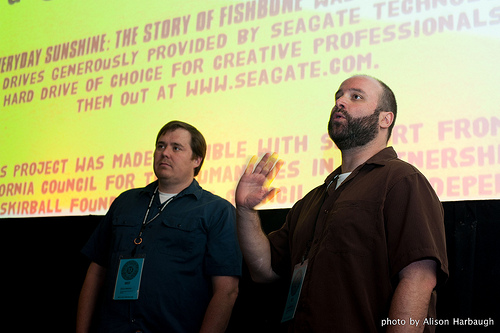
Where did you find the artists that appreciated them and how easy was it to get them on camera to talk about them?
CM: That was probably the easiest thing to do in the film was to find other musical peers and people that influenced them to talk in the film. The ones that influenced, like George Clinton, to people who were their peers like Red Hot Chili Peppers and Brandford Marsalis, to bands like No Doubt and the Black Eyed Peas. They thought Fishbone rocked and made them want to be a band. It was easy to get them to participate, they just said “sign me up”. It was a little difficult getting through to some of them just because they’re musical celebrities, but once they heard about it there was no denying they wanted to be a part of it.
What’s you favorite song by them?
LA: It’s hard for me because I love a lot of their music. I really love ‘The Warmth of Your Breath’ because it tells you what Fishbone is about. I like ‘Monkey Dick’ and I like some of their softer pop tunes.
CM: (laughs) I have to say ‘Bonin’ in the Boneyard.’ It’s a terrific song and captures the musical eclecticism that Fishbone does. It’s just a fun song you want to sing and dance to, and it’s a little bit raunchy which I think pushes the edge a little bit.
They’re still performing with a new band, what keeps them going?
CM: The thing that keeps Angelo and Norwood going, the two original members, is they pursue and work for their art. They never wanted to be anything else other than musicians. Them being able to express themselves and find a group of people that appreciate it is something they’re so enthusiastic for. If there was one person in the crowd or a thousand people, Angelo and Norwood would be out there doing it because that’s what makes them happy in life.
LA: A lot of it has to do with how dedicated the fanbase is for Fishbone. If I saw a Fishbone album coming out, I would be excited to get it. It was always a nice and fresh experience for me. They feed from the reactions they get from crowds. They have a legacy in black music that they realize is important; and even if they have to struggle to make end’s meat, they carry on for the rest of us.
Do you think their music is relevant today? Do people get it? They came in the middle of when rap was just starting, and now rap is in the forefront. Do you think society can get an all-black alternative punk rock band?
CM: Taking in what the top selling albums are and what’s on MTV that basically the world we live in now is the world Fishbone helped create. Bands like Black Eyed Peas and Outkast show the musical eclecticism that Fishbone pioneered. The world is ready for it. Unfortunately to me Fishbone’s music is still ahead of it’s time, but I think some people will listen to it and say “Fishbone’s time is now!”