
WALL STREET: MONEY NEVER SLEEPSAn Interview with Michael Douglas
By Max Evry
September 22, 2010

Michael Douglas, who is currently waging a very public battle with cancer and whose son Cameron was imprisoned earlier this year, makes a triumphant comeback in Wall Street: Money Never Sleeps. The film is a sequel to 1987’s Wall Street, and returns Douglas to the role of financial shark Gordon Gekko that won him an Academy Award over two decades ago. It also marks the return of director Oliver Stone, as well as a hilarious cameo by Charlie Sheen.
Douglas recently sat down in New York, where the film takes place, to discuss how he faced the challenges of the role and his new challenges in life.
Your situation has taken precedence over everything. What’s your reaction been since going public a week ago with this?
Michael Douglas: Well it didn’t cost Fox a lot of money, there’s not a lot of marketing dollars involved here. Unfortunate timing situation, this is never a great time situation. I’m fine, very proud of the picture. My doctor’s are optimistic, I’m optimistic, obviously a combination of radiation every day and chemo limits a full day. Everybody did a fantastic job. Life goes on. This is just another chapter. I’ve had a pretty good run of it. This is a pretty bad year, and it’s gonna be topped off with a really good movie.

What was your experience shooting in New York this time out?
MD: I thought New York looked beautiful. After looking at it, and acknowledging [cinematographer] Rodrigo Prieto, who was Oliver’s call, I think the first time I saw the picture I was thinking, “Wow, this is sexy! This is a beautiful, seductive, gorgeous-looking city.” If you’re have this witches’ brew, then this is an awfully nice cauldron to have it in.
Have you met Michael Milken or any of the people you modeled Gordon Gekko after?
MD: I met Michael Milken for the first time with Oliver Stone at the Drexel-Bernham offices in Los Angeles, we were doing homework. They were giving us a tour, and Michael was a little nervous, and then Oliver said, “Can you show me the shredding machines?” (laughs) Michael then excused himself, said, “Excuse me.”
How much weight do you put on the experiences and opinions of people in investment banking you meet in your research?
MD: Everybody’s always an expert if you’re doing a picture in their area. That’s the one area where Oliver, in terms of the verisimilitude on Money Never Sleeps, was making us all crazy as we began shooting in terms of getting into the detail and everything else. I think he gets a particular enjoyment out of satisfying that 70 people who possibly understand the entirety of the script. That’s all accurate. It is a phenomenon. It’s a wonderful opening. The first picture did well, but the kind of life that this has taken on is a unique phenomenon between the movie and the world and where it’s at today.

What do you think Gordon Gekko was like as a teenager?
MD: I don’t know. I think he found out he was Jewish when he was 13. (laughs)
What are some fun guilty pleasures helping you get through this hard time?
MD: One of the guilty pleasures was I didn’t have to do the junket today. (laughs) I guess I’m taking it a day at a time. Trying to do my homework, keep up with the program, and rest. I don’t have anything to do, thank goodness. Couldn’t have picked a better time. Tennis has never been better. College football just started. Got a Monday night game comin’ up with the Jets. Sports looks really good. To top it off we got a picture that’s rockin’. What’s not to like?
You had a really amazing scene in the film with Carey Mulligan that was raw, about a father and daughter relationship. You have a famous dad, what is something he taught you that’s made a difference in your career?
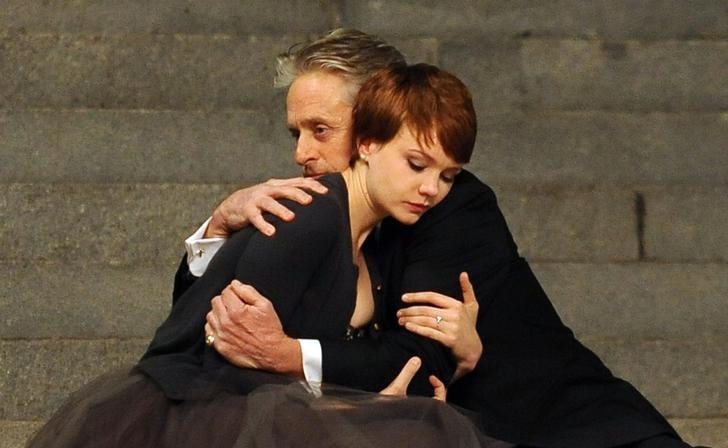
MD: Watching the way they conducted themselves. We’re very fortunate in that this is a business where as kids you can go visit your mom and dad on the set where they work. You get to see at an early age what your mother or father do. I think its kind of a big advantage when you got a little older for how you conduct yourself, ‘cause you were able to see how they conducted themselves when you were growing up. Seeing people with their own kind of insecurities and understanding that. I think the disadvantage is that I don’t ever get any credit because it’s assumed because your old man was a success that you got an opening into the business.
When you were invited to be a part of this movie the second time around was it an instant “yes”? What was it like stepping back into Gekko’s shoes?
MD: It was always about, “does the idea sound good?” Yeah, the idea is good but you got to have a script. First time around we had a script, but it wasn’t until the second time around with Allan Loeb that Oliver committed. Really felt there was nobody else if we were going to go do this again. I liked the idea but did it make sense? Yeah it made sense. This time around was fun because there was more of an arc to go. We were a little concerned with the preconception of Gordon and the power thing. If you strip that all away will people be interested at all? On the other hand it was nice to be able to have an arc… and to see how soulful Oliver’s gotten in his old age. (laughs)
What motivates you in life?
MD: A good part. (laughs) Just quality, quality wherever you can find it… and a little financial security doesn’t hurt. (laughs)
Gordon Gekko is such an iconic figure. Why do you think that is and is it the role for which you are the most proud?
MD: It’s probably the one I get the most recognized with. It was a beautifully written role. I’ve had enough pictures where I’ve done every single scene, carried the picture like Charlie Sheen did in the first one, and Shia does admirably in this picture. But this is a very well written character where they talk about you before you come in. It’s what you dream about. I was fortunate enough, with a lot of good healthy pushing and prodding by Oliver to have a good part and deliver.
What advice do you have for the younger generation who will have to pay for the actions committed by characters like Gekko?
MD: Keep your day job. (laughs) I thought you were going to be asking about your great grandchildren ‘cause that’s who’s going to be paying for it.
There was one scene in this movie where you’re talking about your son. Your performance is remarkable. Did any of that resonate with the recent events of your life?
MD: That was all written before Cameron went off the deep end. That was an integral part of the script. Again, it shows you how much Allan Loeb and Oliver were in sync with that situation, a man who lost a son, and a daughter who couldn’t deal with it.
Wall Street: Money Never Sleeps opens everywhere this Friday, September 24th.