
Your HighnessAn Interview with James Franco and Danny McBride
by Wilson Morales
April 7, 2011

Coming out this week is the comedy film, ‘Your Highness,’ which reunites Academy Award nominee James Franco and Danny McBride.
The two actors previously appeared together in the 2008 comedy ‘Pineapple Express.’
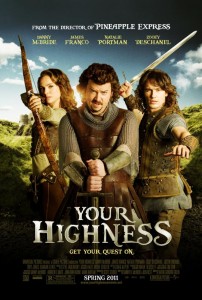
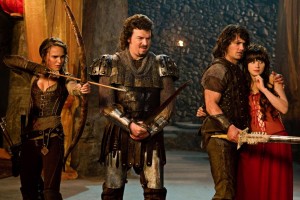
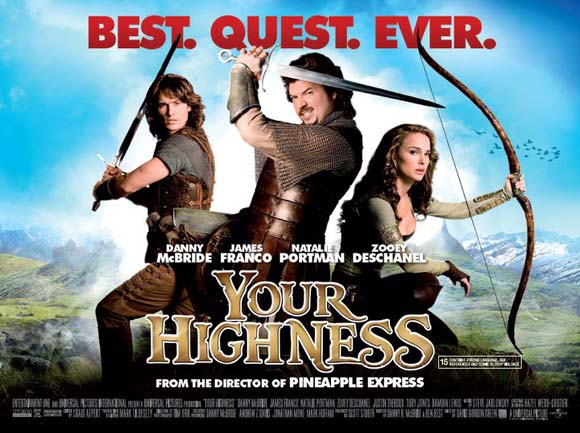
In ‘Your Highness,’ which is directed by David Gordon Green and co-stars Natalie Portman, Franco and McBride team up for an epic comedy adventure set in a fantastical world. As two princes on a daring mission to save their land, they must rescue the heir apparent’s fiancée (played by Zooey Deschanel) before their kingdom is destroyed.
At a recent press conference held in Los Angeles, both actors spoke about working together.
 Which scene was the hardest for cracking up and that you almost didn’t get through?
Danny McBride: You know, surprisingly the scene that I couldn’t get through was this scene I had to do with Natalie where we’re sitting at this table in this tavern and I have to confront her about stealing this compass. The way David Gordon Green directs, he’s literally right out of frame of the camera and he stands there and he makes you say the most ridiculous things and you can’t really hesitate. You have to just keep going through with it. In the scene, he’s just like, “Call her a bully and a whore.” So I started just doing it without thinking about it and as soon as I looked at Natalie and the word “whore” came out, it just felt horrible and I couldn’t get through it. I had to just keep doing it over and over. That weirdly was the hardest thing for me to get through.
James Franco: I think we had a hard time with the wise wizard too because we were acting with a puppet and we were short on time that day, so it was actually causing problems.
DM: We couldn’t finish it.
JF: So that was a scene that was hard to get through.
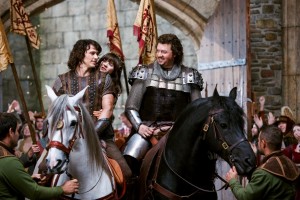
In your historical research, did you find that the mullet was a common hairstyle in medieval times?
DM: Well, historical accuracies were very important to us in this film. We really wanted to make this an educational film and show kids that people back in the Middle Ages, when there were two moons, acted just like people do now. We really kind of were modeling that haircut off Mel Gibson in Lethal Weapon. That was what we were kind of going for with that haircut.
So it was the 1480s?
DM: Yes, yes, they rocked the Mel Gibson Lethal Weapon haircut back then.
Was there any wizard weed involved in the writing?
DM: You know, I don’t tend to partake in much wizard weed when I work on scripts. It’s such a hard process and if you want to do it good, it seems like if you do partake in a lot of that, people don’t tend to really want to watch the things that you come up with when you’ve done that. With this film, it was really important for David and I when we were coming up with the idea that we only thought the comedy would work if the movie itself was approached as a serious fantasy film and that’s where we would find the comedy so to us when it came time to cast the film, even with the craftsmen we pulled onto the film, the guy who designed the weapons designed the weapons for Braveheart and Apocalypto. Our production designer worked with Danny Boyle and the person who designed the armor had designed the armor for Kingdom of Heaven so we really just approached the movie as if it were a serious epic fantasy and we just found the comedy in the fact that the more serious we took the movie, the more the comedy seemed to work. In the writing of it, we thought of it as a comedy second and as an adventure movie first and then we really tried to find that humor on the set.
Was there a lot of improv?
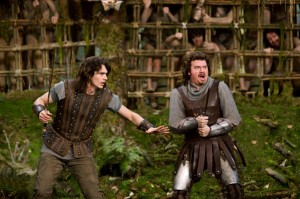
DM: There was a ton. I’ve worked with David a few times before and even the way we worked on Pineapple or even the stuff we’ve done on Eastbound, we always tend to do one or two takes that are what’s on the page. Then from there, David just gets in there and we just start pushing it. It’s not always even just to find jokes. We’ll just improv just so that everyone in the scene is on their toes and you find that reaction that maybe you wouldn’t have gotten when the actor knows exactly what’s coming next, so improv’ing I think is essential to what we do and there’s a ton of it in here, right James?
JF: Yeah. And like Danny’s saying, when you have a movie where you improvise during every scene, it’s not just about finding funny lines. Like Danny was saying, it does something to the actors because you’re more aware. You don’t know what’s coming next so you don’t get lulled into a way of doing the scene the same way one time after another. So you’re much more aware and it does something to the behavior. It makes it more immediate and makes it more alive and then David won’t have you just improvise different lines. He’ll have you say it in very weird ways, like say it like a robot or say it like you’re taking a big dump.
DM: That was a direction he gave to Charles Dance at one point. It was very funny to see his reaction.
JF: Yeah, I don’t know if he liked that kind of – –
DM: He was just kinda like, “What have I signed up for?”
What was it like working with the guy who played Courtney?
DM: Courtney was played by Rasmus Hardiker and it was one of those deals with him where we had been auditioning all these guys for Courtney and as soon as we saw him, before he even came in the room, you just kind of knew. This is our guy. He was sitting in the waiting room and out of all these people, you could identify that that was going to be our guy. He’s comedically just brilliant. He’s fast on his toes and he just killed that role. He was a lot of fun to work with.
When you’re dealing with raunchy humor, was there anything you were surprised you got away with?
DM: Well, the fact that we made this movie was very surprising to us in the first place. David and I the whole time never really were convinced that someone would make this movie. To us, it was just this wild idea, this crazy movie that we wished Hollywood would take more chances and make crazier things and to us, that’s what this was. It was an opportunity to make a film that we liked. That just seemed so specific for what we kind of wanted to see that we were surprised that someone was going to let us do that. There’s tons of things that I can’t believe are in there. It’s the first Minotaur erection that has ever been filmed before.
JF: Ever. If you think about it, it’s the first time ever.
DM: Yeah, a lot of people have tried and have not been able to accomplish it, but we did it.
Did you grow up playing Dungeons &Dragons and did that inspire Simon? What movies did you watch for research?
DM: David Green and myself went to film school together. I was a freshman and he was in his second year of film school and we both lived in the same dorm. I met him the first week I was going to school there. When you go to film school, you’ve got all these guys who are trying to show everyone how smart they are. When they talk about movies, they’re talking about all these pretentious arty films because they think that that’s the kind of movies you have to like if you’re going to film school. One of the things that David and I instantly clicked on was that we appreciate those films, but at the same time we appreciated movies like Beastmaster and Krull and Dragonslayer, these fun movies that capture your imagination when you’re a kid. So it was awesome to be able to actually try to make one of those movies and it just gave me a very good excuse to my wife of why I needed to be watching Krull on repeat all the time, because I really couldn’t have gotten away with it unless I was getting paid for it so it was a selfish reason to make this film.
JF: The first film I ever saw in a movie theater when I was very young was The Dark Crystal and I’d see that repeatedly in the theater. Then The Neverending Story and the original Clash of the Titans also, we’d watch that on my friends’ VCR. They’re a little hokey now but still have a lot of charm.
 Have you ever cleaned up your act to be the hero for a woman?
DM: Well, despite how I may come across on screen, my act is pretty clean. I tend to play it clean. I got married last October so I have cleaned my act up.
Even just being more polite?
DM: Yeah, I was born in the South and was raised to respect ladies and to be a gentleman so that’s something that’s always been important to me.
How challenging was it to pitch this script?
DM: You know, the first day we came in and pitched it, we pitched it as “This is Krull meets Barry Lyndon” and the executives were like, “Never pitch this movie like that ever again.” But to us, that is what it was. We wanted to take it, approach it as a serious drama but at the same time have that fun that we had with a movie like Krull. That was always the concept. That was what was interesting about taking on this project is can you make a legitimate fantasy/adventure movie like this and still find a way to find comedy in it without making it a spoof. I think that’s what interested me and Green from the beginning was this’ll be something interesting to try.
James, the level of your prolific work has been so well known, they even spoofed it on SNL.
JF: Not very well though. That guy didn’t look like me at all.
How do you feel about the public perception of your prolific work?
JF: Well, it’s hard. It’s out of my hands really. I really went to school for myself. Sometimes I forget that it’s actually not a public act. I’m there just to learn and better myself. That part of my life is not a performance but in some ways it kind of has become material for public discussion to the point where The New York Times is interviewing my teachers. But I don’t mind. I’m proud of everything I’m doing. So I don’t know, it’s just that part of my life is a performance and I perform as a job and part of it’s kind of not, but what can you do? I can’t control the attention.
You’re directing films, acting in 3 or more a year and we keep hearing your name attached to things.
JF: Well, there’s also this phenomenon where people do like to announce movies that they think I’m doing that I’m not. I mean, somebody just doesn’t have the time to do all the movies that people claim that I’m going to do or I have acquired the rights to a lot of books that I love and I think it helps the writers to sell their books if they announce my attachment. But it doesn’t mean that I’m going to make the movies in the next year or two or three.

Can you talk about Natalie Portman and how she fit into the group?
DM: Well, David had been in talks with Natalie about another project and once we started to get some movement on Your Highness, it looked like that was what was going to be next. In his conversations with Natalie, she brought up this project and was saying that she was dying to do a comedy and really wanted a chance to work with us and we were thrilled by that because having actors like James and Natalie, to us that’s what separates this movie. It’s not a movie that’s just filled with your typical comedians. It’s cast with a lot of prestigious actors and that to us is what made this movie unique and fun. I honestly was really embarrassed to hand Natalie the script for the first time. I was like, “Should I just go through and take out all this dirty stuff? I’m nervous to show her this.” David’s like, “No, we’ve got to let her know what she’s in for.” She was a total champ. The stuff that I thought would make her blush, that’s the stuff that she thought was funny and totally embraced it. On the set, she never shied away from that stuff. She could definitely hang with the boys. She wasn’t intimidated by any of the foul stuff going on.
JF: No, she wasn’t. She embraced it.
You’ve been in serious epics. Did any of that experience help you with this?
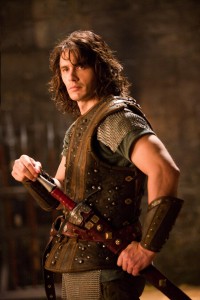
JF: It’s interesting. Somebody earlier today said we might have ruined this genre for anyone that wants to treat it seriously, because it really is hard to make an earnest fantasy film. Until Lord of the Rings and maybe the Harry Potter series, there haven’t been too many of these films that have been embraced by an older audience. Usually they’re thought of as kids’ films. It is hard to just put on all that gear and I think people think of heroes in a different way now. Because this had a comedic element to it, it’s like you can get away with that. So actually, I tried to play the character pretty earnestly. Because it’s a comedy, we can get away with a lot of the cheesiness that maybe can hurt a film that’s completely earnest. Because we get away with it, then you can actually address some of the real feelings and real dynamics between brothers and jealousy and feelings. That’s kind of the secret of bromances. You can talk about relationships between guys and brothers because it’s a comedy. If it was not a comedy, it would probably just be boring or cheesy.
Or kinky.
JF: Yeah, kinky. You go the kinky route, it could work.
What kind of training did you do for swordplay?
JF: Well, Danny was the writer so he conveniently wrote his character as someone that was very bad at using swords so he didn’t have to train at all. I trained a bit but I had done literally nine months of training seven days a week for Tristan & Isolde because I was a young actor that didn’t know that was insane. I didn’t get to use much of it in that film so I got to use it in this movie.
Between Fred Simmons, Kenny Powers and this character, how do you modulate your comic archetype?
DM: With all these films, everything from – – when we did Foot Fist Way, that was a really independent film and we shot it for 70 grand and we shot it in like 17 days. We didn’t have a lot of time but with that, Jody and I hadn’t been writing things like that before that movie. I think we started approaching the story in figuring out that if we could change who the protagonist is and try to get the audience to align with someone who isn’t typically who you align with in films, it opened up all these different comedic possibilities for where the story could go. With Foot Fist, I think we were just starting to scratch the surface with that and we wanted to do more with it but we had just blown our load on this independent film. That’s why we set up Eastbound & Down so we could have a way to explore that architecture in a story of let’s take this sort of convenient story and this almost clichéd story about an underdog, but let’s put the audience with someone who they are not used to following in this story. That was kind of the design between those things. When it came time to approach this with the fantasy, it was one of those deals where it’s like how do we find our stamp? How do we find our way here? Following your typical hero on a fantasy quest, it just felt like the only way we’re going to be able to find comedy then is if we make the fantasy silly, if we make the action silly. So for us, once again it was just like shifting that lens of who you typically follow in these sort of films and trying to find someone that’s a little bit more unexpected. It just allows you to hit some of those clichéd moments with a new perspective. To us, that’s kind of comedically what was interesting about it and what separated it from other films that are in this genre. I think it’s just a fine balance. I always come from a place of story so you’ve got to just kind of find those layers of how exactly you’re going to get an audience to root for someone that is so morally corrupt or makes these bad choices. So for each character, it’s kind of a different thing. With Fred Simmons, he’s dealing with adultery and loss and betrayal, so it’s like alright, how do you have a guy do this but still find redemption? With Eastbound it’s the same way. You just try to figure out what their wound is and how you can get an audience to get behind that wound and in this film, it was based on sibling rivalry. It was based on someone who felt like he was living in the shadow so it’s just a matter of figuring out how can you play around with that and how can you get someone to identify with this person that normally they wouldn’t identify with?
Oz is one you’re actually attached to, right?
JF: Yes, yes.
What do you like about taking that on?
JF: I love the idea of working with Sam again. I think it’s going to be – – Sam is a master of combining classic Hollywood character types and storylines and ideas and then matching that with innovative technology. So I really think he’s going to build an incredible world, but a world where we have room to play characters and have fun.
Is there an end to Franco on General Hospital?
JF: No, there’s going to be a lot more awesome groundbreaking stuff. Truly.



Loading…