
Beware The GonzoAn Interview with Zoë Kravitz and Ezra Miller
By Wilson Morales
September 9, 2011
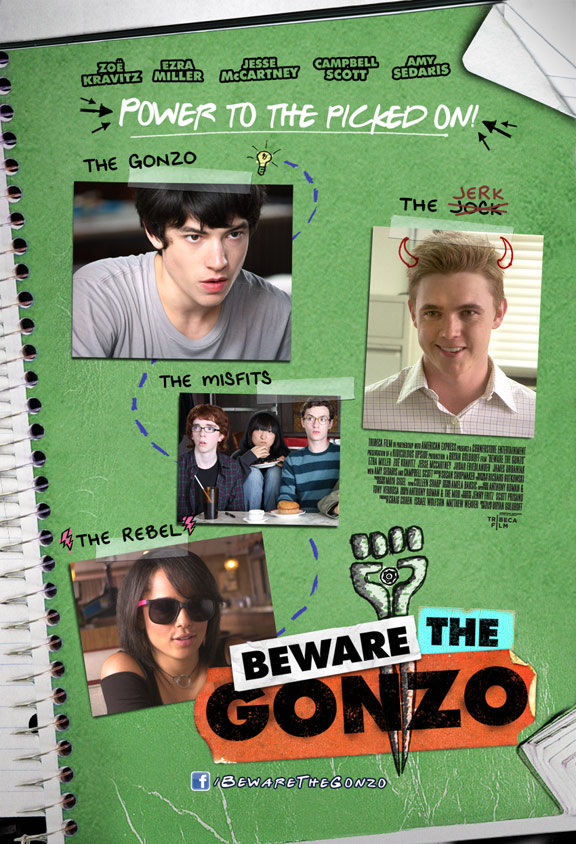
Currently on VOD and now in theaters is the independent comedy film, ‘Beware The Gonzo,’ which stars Ezra Miller, Zoe Kravitz, Jesse McCartney, Amy Sedaris, Campbell Scott, and Judah Friedlander.
Eddie “Gonzo” Gilman (Ezra Miller) is starting a revolution in BEWARE THE GONZO. When the wild-eyed rebel journalist is ousted from his prep school’s newspaper by its über-popular editor Gavin Riley (Jesse McCartney), Gonzo decides to become the voice of the oppressed by starting an underground paper with the help from a beautiful outsider (Zoë Kravitz). Not afraid to question authority and infuriate the school’s principal and staff, they give a voice to all the misfits victimized by Gavin and the rest of in-crowd. But the more Gonzo uncovers about the injustices in his school, the more he learns that the truth comes with consequences in this fresh teen-angst comedy.
In speaking with Blackfilm.com, both Miller and Kravitz talked about their roles in the film and working with the rest of the cast.

How would you describe Eddie and Evie?
MILLER: Eddie is a cocky kid who is obsessed with Hunter S. Thompson to the extent that he changes his first name to Gonzo after Thompson’s invented style of journalism. He starts a paper in his school and becomes this big, self-righteous ego endeavor for him but something real and empowering for other people. He fails to see that and takes the whole thing too far in a personal initiative, and pretty much betrays everyone, messes everything up, and then it’s a classic road to redemption deal.
KRAVITZ: Evie has a reputation as the school slut, bad girl type thing. She teams up with Ezra’s character because she has this hatred for Gavin Reilly because he’s the reason she has this reputation. You discover she’s the beautiful, soft girl who’s been destroyed by the scary rumor mill of high school.

What makes this different from the other teen underdog movies we’ve seen before?
MILLER: All films are different, of course, but I think this proudly follows in a lot of the traditions of the teen film in terms of narrative structure, thematic emphasis. It’s just a movie with a real end-of-the-day purpose of empowering young kids to do what they want but in a way that’s smart and realistic.
KRAVITZ: I agree.
Was there any point in your life where you felt like an outcast?
KRAVITZ: I still feel like an outcast. Actors get special treatment, but it’s one of those industries where it’s acceptable to be categorized like you are in high school. You’re the bad boy, you’re the pretty girl, which creates people that feel like outcasts.
MILLER: In the end you end up feeling much more like an outcast ’cause of misunderstanding. Everyone feels like an outcast because we’re all weird. The fact that we have any sort of definitions of normality when the reality is everyone’s an outcast. Everyone is exempt from this ridiculous feeling of how people should be.
Was there any trait within the characters that you saw in yourselves?
MILLER: I’m pretty arrogant and self righteous.
KRAVITZ: Just the whole idea of Evie having to claim her own identity being perceived as something she’s not. It’s something I’ve always had to deal with.
MILLER: I identify back to when I was the age of the character or even a bit younger. An unrealistic drive towards whole, fully formed, black and white ideals and substantial action when in fact the lessons in this film are about being realistic and true to the actual nature of what you’re doing, especially if you’re trying to activate some sort of social change because it’s so complex and you’re talking about people. As a young man I was naïve to those realities and in that naivety sort of self righteous, which is certainly the story of Gonzo.
Was there anything you added to the character to make it feel more authentic?
MILLER: In theory a lot of film or acting is an attempt to authenticate in some form or another the story. I’m also interested in the chance to heighten, exaggerate, or make cartoonish a character, and this is true of Gonzo journalism, sometimes that’s truer to the way it feels when you experience the story. Efforts to authenticate and elaborate and make a fun movie.

How was working with the rest of the ensemble like Jesse, Amy?
KRAVITZ: Everyone was so kind. There was no egos or weird actor stuff. It was a joy to work with everyone.
MILLER: Everyone came in really happy and hungry to work. The energy of a set emanates from the top down, and our director was like a baby in the biggest toy store in the world. Bryan was like jubilee, just singing the praises of the experience and the honor, and that’s very contagious. People are very aware of the opportunity to gather a mass of people and make a piece of art.
Each of you have gone on to do other films. Since you shot this early in your careers was there anything you were able to carry over into the other films?
 KRAVITZ: No, but I feel like everything you do makes you hungry to go on to the next film and make that as good if not better.
MILLER: On a set there are so many things going on that you are an actor just standing in the middle of, not helping with. The more you know about filmmaking the easier your job becomes as an actor. Every film you do is a huge experience.
What are your next projects?
MILLER: I just finished “The Perks of Being a Wallflower” and I have two other films coming out around now or the next two months or so. “Wallflower” comes out in the spring, and my band is releasing an album.
KRAVITZ: I am still going around festivals with a film I did called “Yelling At The Sky” which is coming out in November, and then maybe the next “X-Men” whenever that happens.