
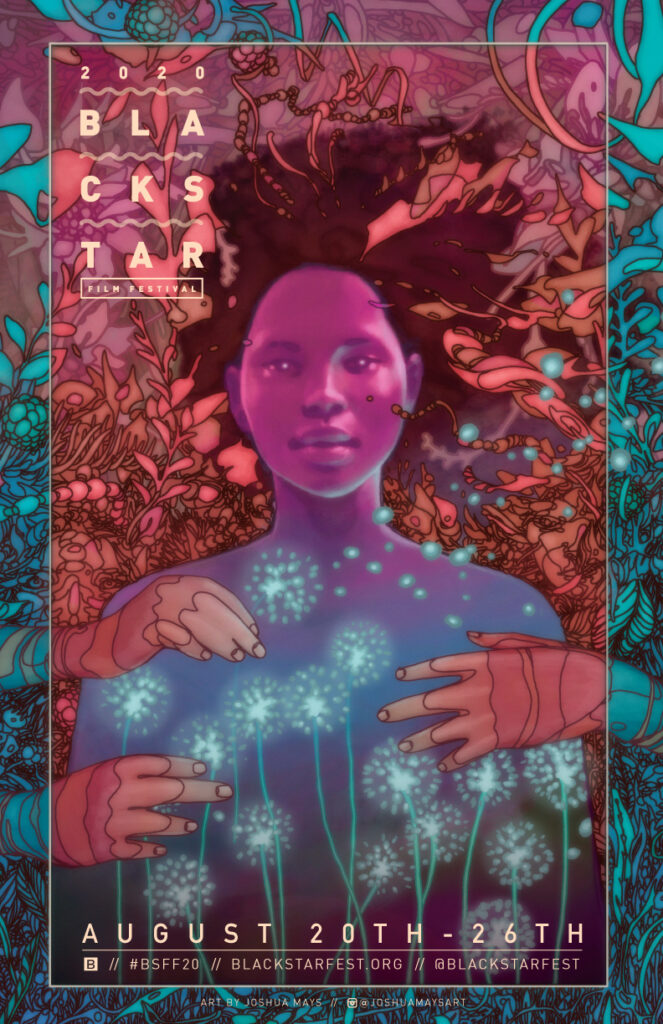
BlackStar Film Festival, the world’s premier celebration of Black, Brown, and Indigenous film and video artists, is pleased to announce that the ninth edition of their annual festival will take place August 20-26, 2020 and will be presented entirely online.
This year’s BlackStar Film Festival lineup includes more than 80 films, including 24 world premieres and representing over 20 countries. Ticketed attendees will be able to view all the films through a single online portal, which is available at watch.blackstarfest.org and through apps available for Apple TV and Roku. Tickets are available on the festival’s website, with day passes starting at $5 and a full festival pass available for $100, which is priced to include a donation to BlackStar.
This year also features three live drive-in screenings in the parking lot in front of Philadelphia’s Mann Center for the Performing Arts in West Fairmount Park. These screenings are presented with Lyft and in partnership with the Philadelphia Department of Parks and Recreation, as part of their new Philly Drive-In Movie Nights initiative. Tickets to the drive-in screenings are free on a first-come, first-served basis.
“I am incredibly proud of our team and the work they have done to meet the challenges of this moment and present our festival this year,” says BlackStar Artistic Director & CEO Maori Karmael Holmes. “The format might be different, but our nearly decade-long mission of centering and celebrating the voices of Black, Brown, and Indigenous people from around the world is not. We look forward to sharing these incredible films and the immense talents behind them.”
Last year’s festival, which drew nearly 10,000 attendees, saw the Best Feature Narrative Award go to Selah and The Spades, directed by Tayarisha Poe, and the Best Feature Documentary Award to The Infiltrators, directed by Cristina Ibarra & Alex Rivera. BlackStar’s 2019 edition also hosted a discussion between Spike Lee and #MeToo founder Tarana Burke commemorating the 30th anniversary of Lee’s Do The Right Thing, as well as the festival premiere of Solange Knowles’ film When I Get Home. The full slate of films, parties and events will be announced in the coming weeks. For more overall information on the festival and its programs, visit blackstarfest.org.
Among the World Premieres are:
Unapologetic, a feature documentary by Ashley O’Shay, that takes a deep look into the Movement for Black Lives in Chicago, providing an intimate peek into the personal and political battles that transform the city.
Tayler Montague’s debut short In Sudden Darkness, about a working-class family trying to stay afloat in the midst of a city-wide blackout.
The short documentary You Hide Me, made in 1970 but banned widely uponcompletion. Ghanian filmmaker Nii Kwate Owoo examines the colonization of African Art in the British Museum, London, gaining unprecedented access into the museum’s secret underground vaults.
Shantrelle Patrice Lewis’ debut feature Daughters Of, which examines the immediate and critical importance of self-care and healing for Black women.
Raishad Hardnett, Lauren M. Schneiderman & Cassie Owens’ Legendary: 30 Years of Philly Ballroom, an inside look into the effort to preserve Philadelphia’s ballroom scene,a Black and Latinx LGBTQ safe-space that has endured for 30 years.
Other highlights include:
Martina Lee’s Black Boy Joy, a short about two generations of Black men, living within the same household, juggling the demands of raising a young son with autism while adapting to their new normal after the death of a loved one
Channing Godfrey Peoples’ feature narrative Miss Juneteenth, about a former beauty queen and single mom preparing her rebellious teenage daughter for the “Miss Juneteenth” pageant.
Coded Bias, a feature documentary from director Shalini Kantayya that follows MIT Media Lab researcher, Joy Buolamwini and the fallout from her startling discovery that facial recognition does not see dark-skinned faces accurately.
Ekwa Msangi’s Farewell Amor, a feature narrative about an Angolan immigrant whose wife and teen daughter are finally able to join him in the U.S., after 17 years apart.
Nationtime – Gary, a feature documentary by William Greaves about the National Black Political Convention of 1972 in Gary, Indiana.
A Day With Jerusa from Brazilian filmmaker Viviane Ferreira, following a young medium and her 77-year-old neighbor as they travel through time and realities common to their ancestry.
Amy Aniobi’s HONEYMOON, telling the story of a newlywed couple on their first night together––made all the more awkward, romantic and honest, because they only just met.
Loira Limbal’s feature documentary Through The Night, presenting the stories of two working mothers and a child care provider, whose lives intersect at a 24-hour daycare center.
Michèle Stephenson’s Stateless, a feature documentary following the campaign of electoral hopeful Rosa Iris and revealing the depths of racial hatred and institutionalized oppression that divide Haiti and the Dominican Republic.
maɬni – towards the ocean, towards the shore, directed by Sky Hopinka. The documentary follows two characters, speaking mostly in chinuk wawa, as they contemplate the afterlife, rebirth, and the place in-between.
I ran from it and was still in it, an experimental film from Darol Olu Kae offering an intimate portrait of familial loss and separation.
Down a Dark Stairwell, a documentary from Chinese-American Filmmaker Ursula Liang. The film looks at the complicated fight for accountability and justice after a Chinese-American police officer kills an unarmed, innocent black man in a dark stairwell of a NYC public housing project.
Zeshawn Ali’sTwo Gods, about a Muslim casket maker and ritual body washer in Newark who takes two young men under his wing and teaches them how to live better lives.
Right Near the Beach, Gibrey Allen’s feature narrative looking at the murder of a prominent Jamaican and the public uproar caused by rumors about the secret life he may have lived.
ROCÍO, a feature documentary from Mexican-American filmmaker Dario Guerrero. The film profiles an undocumented mother of three who, after a sudden cancer diagnosis, must choose between seeking treatment in her native Mexico or awaiting certain death in the US.
About BlackStar Film Festival
The BlackStar Film Festival is an annual celebration of the visual and storytelling traditions of the African diaspora and global communities of color — showcasing films by Black, Brown, and Indigenous people from around the world.



Loading…