
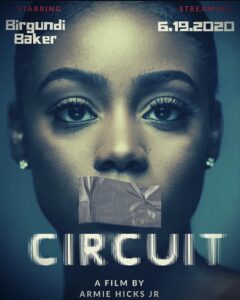
 Currently streaming on YouTube, Film Shortage, and Vimeo is Circuit, a short film written and directed by Armie Hicks Jr. and co-written by Sade Sellers. Produced by Lauren Herrel, Lisa Mazzotta, Sophia Kapri, Kristoper Wile, Armie Hicks Jr., and executive produced by Thomas Martin.
The film stars Birgundi Baker (The Chi), Xander Bailey, Shopia McDowell, Mariama Diallo, Roy Abramsohn, and Pedro Isaac Chairez.
A young teens romantic expectations are dashed when she finds herself the victim of sex trafficking.
Director Armie Hicks Jr. spoke to Blackfim.com about Circuit.
What was the plot & purpose of this film?
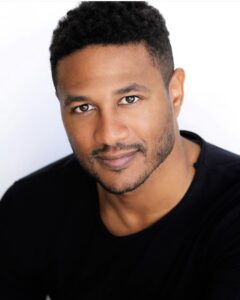 Armie Hicks Jr.: We wanted to have a call to action, we really wanted people to watch this film and be moved and to want to go out and actively do something. I know a lot of times we make films with the idea to entertain but this was really a piece designed to bring awareness and to force people to want to go out and hopefully change and try to abolish sex trafficking.
In terms of the plot, we did various interviews with girls from different walks of life who had been through this. We heard stories of all the different ways they were involved in trafficking, whether they were sold by their parents into it, or whether they were enticed with romantic expectations. So we wanted to make an amalgamation of all these girls and their stories and put them all into one character. The writing process between me and my writing partner Sade Sellers was seeing the most authentic way we can go about accomplishing that.
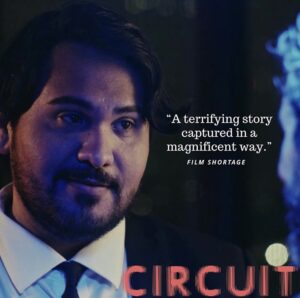 With all the research and data collected to create this, it could’ve very well been a full length film. What made you opt for a short?
Armie Hicks Jr.: We wanted this to be a piece that was a call to action. The short has an open ended and not-so-happy ending. And to wrap things up in a nice bow and have a hero kind of takes away and gives it that fantasy element. So in a short we felt that we could have a more message based visual vs. an entertainment visual. We wanted the viewer to see the information, see the stats and ask themselves what they can do to help vs. watching while eating popcorn and then going back to your bubble.
How important was it for the cinematography to match the authenticity of the acting and the story?
Armie Hicks Jr.: We wanted cinematography-wise, and through the visuals and through the sound, to enhance what the story was saying. We put a lot of emphasis on the scope. A lot of films are shot in widescreen and they want you to get as much information as possible on what’s going on outside of the scene, but what we wanted to do was the opposite of that. We wanted to pull you into Blondie’s character and how trapped she felt. So we chose to go with the original academy ratio which is a lot smaller. And with that we decided on very specific compositions on how we chose to frame the actors in their different stages of hope and grief. We were very meticulous in our shot list in going through and making sure that we didn’t distract and take away by trying to be too fancy and doing too much. We wanted to strike that balance of putting the viewer into the lead character, Blondie’s shoes.
 Did you know who you wanted to cast ahead of time?
Armie Hicks Jr.: When I was writing this, I knew that I wanted Birgundi Baker to be the lead. We’re both from the same hometown. I’ve known her and her family for a while and she is a phenomenal actress. She’s one of the leads on The Chi. She had the look and I think the range to pull off what I wanted. This is a mature piece, with a lot of mature elements. These girls are playing 14-16 year olds so we didn’t want to cast too young and then they not be able to handle the maturity and then we didn’t want to cast too old and then not have the look. So Birgundi was the perfect combination. From there our producer and casting director Lauren Herrel, had an extensive casting call and search and we saw numerous actors. For the pimps, we really wanted to go against type; we got a lot of the guys you’re used to seeing in movies—the Russian guy with a thick accent, guys with tattoos all over their faces, big brawny guys. We wanted to go against that in terms of our antagonist because we feel like this issue can happen to anyone and it can happen anywhere and you don’t really know who the perps are. I think we found a very solid and well-rounded group who did a phenomenal job with their performances.
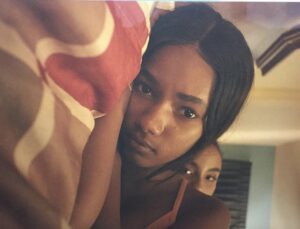 Was it intentional to cast a dark skin leading actress?
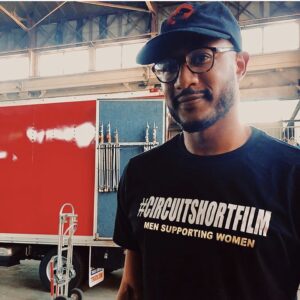
Armie Hicks Jr.: Absolutely. Part of my personal mission has been to be the change that I want to see in Hollywood. I’m an actor first and the roles that I’ve had have always been limited to me so that’s how I became a filmmaker. I thought it was important to create roles for myself and others. In one of my other short films I intentionally cast a dark skin leading actress and as I kept evolving it became my goal to continue doing that. Circuit has a female co-writer, three female producers, and had we not had a scheduling conflict we would’ve had a female cinematographer, and camera crew. Claudia Castello, shout out to her, she edited Black Panther, Creed, and Fruitvale Station, she was our editor. I wanted to be supporting women in jobs that traditionally not only go to men, but white men.
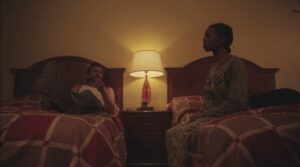 While the visuals told their own story, the writing/dialogue did the same. What was that process of ironing out the perfect dialogue (albeit brief) to drive the point home like?
Armie Hicks Jr.: The original script I had was about these two guys who were gangsters and their boss asks them to do an errand. They go pick up this car and there’s a girl in the trunk and then they set off to free her from him. It’s a way different story from what it ended up being. And I was workshopping that script and worked on it for a long time thinking it was great. I sent it to my friend Sade Sellers and she was like, Armie you are telling this story from your male POV and I don’t think that it’s hitting home the way you want it to. It’s good and it’s written well but it just seems like it’s yet another action movie. It’s not really saying or doing anything beyond that. So she helped point me in the right direction and eventually we became co-writers and we completely flipped the script on its head and started telling the story from the perspective of the girl that was found in the trunk. And from there we gave her her own story and she became Blondie.
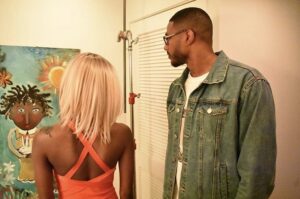 There was a pivotal moment in the film where Blondie (played by Birgundi Baker) stops and stares at an art piece hanging on the wall. What was the intention behind that scene?
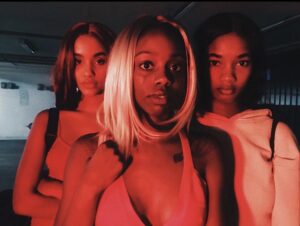
Armie Hicks Jr.: The intention for that was her seeing the loss of her innocence, the childhood that was stripped away and she’s not getting to have. It serves as a reminder of home, a reminder of hope that you can get out of this; you can escape, which is what we see in the following scene. Blondie serves as the hope, Red (played by Sophia McDowell) serves as kind of in-between; she’s been in the system for a while and is more accepting of it. Jade (played by Mariama Diallo) is fully indoctrinated, there’s no hope, no escape. We also wanted to show the hierarchy and the different ways the girls have compartmentalized or sought to cope with their situation.
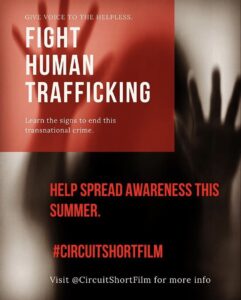 What did you set out to accomplish with this film?
Armie Hicks Jr.: My sister is a doctor and she travels to India, Costa Rica, Africa and she’s gone to all these places. She actually helps restore the lives of women who’ve been rescued. And she’s been doing that for a while. She’s my older sister and I just thought that was very heroic. And it was during a conversation we had that she said I would be surprised how often this happens in America. And I didn’t believe it at first because you watch movies like Taken and assume that it’s a foreign issue. Because how is this happening in America and we don’t hear about it. In my research I found that the majority of victims are African American women and it clicked to me—oh, that’s why we’re not hearing about it more—because it’s black and brown girls. There’s no amber alerts for them, no press, there’s no news coverage for them. So what I wanted to accomplish was to get the ball rolling in the media about sex trafficking. And I know there’s a lot of groups that are out there working towards this and I don’t want to seem like I’m the first one or a trailblazer or anything like that. But I’m a filmmaker and that’s my way to help. We partnered with Journey Out, a non-profit from Los Angeles and they’re doing a great job; they actually have boots on the ground and if Circuit can reach an even different audience and pair the two together, now they have a bigger outreach. We set out to save lives, that’s what we wanted to do.
The film mentions that Blondie met the man that turned out to be a pimp online. How easy is it to get recruited via social media?
Armie Hicks Jr.: Very easily. We spoke to a girl who was living in the streets, was homeless and she had a cellphone and was on Facebook chatting with this guy on the other side of the country and they were exchanging information and love and pictures and he offered to fly her out to come live with him. He buys her the ticket, she flies out and as soon as she arrives he immediately takes her to a hotel, takes her phone, her ID, locks her in this room and within 20-minutes guys are showing up. And that’s how quickly through social media she was recruited. This is a silent plague.
 How long did it take to complete this film?
Armie Hicks Jr.: It was probably a year and a half to two-year process from where I started with the original script to now. It’s been a very long process but I’m very proud of the film and everything we’ve accomplished.
The film release date fell on Juneteenth. Was that on purpose?
Armie Hicks Jr.: We were in festivals and had some festival releases and we were slowly building and gaining momentum and then COVID hit. And a lot of festivals were cancelled or going virtual and so we put it online for mass consumption and we thought that we could self-distribute it that way. So in looking at dates I thought Juneteenth would be a good date because it’s so significant in terms of slavery and black people and how with this film people call sex trafficking– sex slavery. So I thought the two coincided very well.


Loading…