
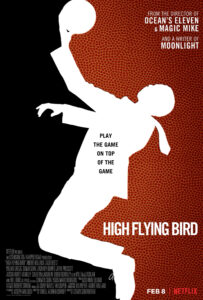
Currently streaming on Netflix is Oscar winner Steven Soderbergh’s NBA drama High Flying Bird, written by Oscar-winner Tarell Alvin McCraney (Moonlight) and starring André Holland, Zazie Beetz, Melvin Gregg, Sonja Sohn, Zachary Quinto, Kyle MacLachlan and Bill Duke, plus appearances from NBA athletes Reggie Jackson, Karl-Anthony Towns and Donovan Mitchell.
In the midst of a pro basketball lockout, sports agent Ray Burke (André Holland) finds himself caught in the face-off between the league and the players. His career is on the line, but Ray is playing for higher stakes. With only 72 hours to pull off a daring plan, he outmaneuvers all the power-players as he uncovers a loophole that could change the game forever. The outcome raises questions of who owns the game – and who ought to.
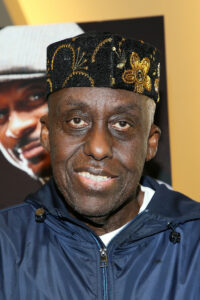
For veteran actor, director, producer, and writer Bill Duke, who best known for a vast collection of films in front and behind the screen that includes Car Wash, Commando, Predator, Bird on a Wire, Menace II Society, Deep Cover, A Rage in Harlem, Exit Wounds, Payback, X-Men: The Last Stand and more recently Mandy, this is his second collaboration with Soderbergh. In 1999, he appeared in an uncredited role in The Limey, which starred Terence Stamp.
Blackfilm.com recently spoke with Duke regarding his role in High Flying Bird, working with Soderbergh again, and working with Andre Holland.
This is your second time working with Steven Soderbergh, so was this a role that they reached out to you for?
Bill Duke: Yes. I had worked with Steven on The Limey many years ago so I was grateful to have a second time working with him. He’s brilliant.
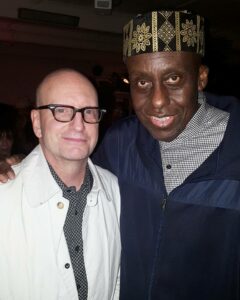
Having said that, what has changed in terms of his directing technique?
Bill Duke: Not a lot. He has always been a person who has been a supporter of actors. In other words, when you get the role, you feel safe with him because he’s supporting you in what you’re doing, he allows you to have your own creativity, and he’s respectful in what you do and understands and trusts you. Also, he’s very specific in terms of directing, whether you are sitting, standing or moving, He gives you the freedom to do what’s organic to your character, but he works his magic in terms of where he wants you to be for the shot. It’s a combination of both.
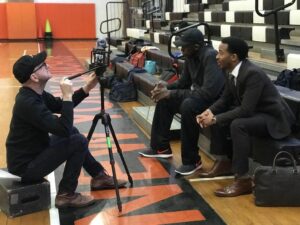
As a director yourself, how was the experience when was filming you with an iPhone?
Bill Duke: It’s hard to express in words. I’ve never been in a film where it was shot with an iPhone. One of the amazing things of when he did the dolly shot, they wheeled him around in a wheelchair. It was a new experience but it was incredible. They used a lot of available light. There wasn’t a big lighting available crew. It was very, very educational.
What more can you say about your character Spence besides that he’s a basketball coach?

Bill Duke: Spence is old school. Spence comes form the Harlem Globetrotter days where you played the game for passion and he understands the business of it. He understands of how it was taken over from us and he also understands how do you deal with it in a pragmatic, realistic way; not just passion, but how do change things. That’s what he’s trying to teach the kids. I understand that you’re angry and upset but that doesn’t mean that your passion will change. What is your strategy? He’s old school in that way.
In essence, would you say he’s more about teaching the kids how to love the game before politics and money come into effect?

Bill Duke: That’s totally correct. It’s the balance. It’s a business. If you get injured in one game, your career could end. We understand the business part of it, but at the same time, you have to keep the passion for it. For example, if you tried to drive down the middle of the court while against the Detroit Pistons from the 80s, when they had Dennis Rodman and Bill Liambeer. You wouldn’t survive because they didn’t want you to score points. The game is a lot safe than it used to be. It’s a game of passion and it’s a game of business. I love the passion of it.
Did you ever play the sport?
Bill Duke: Did you ever see Charles Barkley play golf? He has the worst swing in the game and that’s how I am in basketball. I wasn’t good on the court.
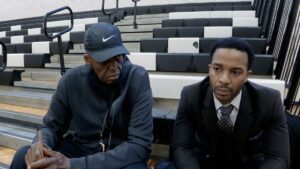
How was working with Andre Holland?
Bill Duke: First of all, he’s a brilliant actor, but what’s most impressive about him is that he’s not acting. He’s surrenders to the character 1000%. You’re not talking to the actor, you’re talking to the character. He’s allowed to possess him actually through the entire thing. That gives the other actors something to deal with. It’s not just lines. You’re emotionally engrossed in the process and the scene and Steven lets you do it. He lets you live it. It was a great experience.

Do you have to be a sports fan to understand the film?
Bill Duke: No. I think a lot of people will get it because it applies to more than sports. What do you own? What belongs to you? You’re working your whole life and basically paying bills. It applies to everything. Everyone has to make choices in terms of what they want to do with their lives and how important is the work and the passion.
What goes into saying yes to the projects that you do?
Bill Duke: Story. It’s a compelling story. I love great writing. Steven always has great projects that make you think and feel and at the same time laugh. It’s great working with great writers and directors because you’re getting paid for something you love and want to do.

In 2018, we had a record number of films of color directed and starring Black talent released in theaters. Do see a shift changing in Hollywood?
Bill Duke: I love the progress that’s being made. I want to see more. I want to see a larger percentage of films that deal with those topics made, but I congratulate the fact that there is more diversity in terms of women, people of color and different ethnicities telling their stories from their point of view. It’s very important that we give a voice to the voiceless in terms of media; because media is a global phenom and it portrays you dependent upon what controls you have and the writers are doing great work. I think it’s important, not just Hollywood, but globally how we are perceived.

In terms of directing, when you we see behind the screen again?
Bill Duke: Well, I’m working on a couple of projects now, developing from documentaries to feature films. With the business side of things, you have to protect your investors. Where is the audience and what percent of that has to be sold to make the profits, but also the story. Why do I care about the characters? It’s really structured in terms of the character arc and the story arc of the film. To really get to understand what you want to say and how you want to say it, by no means is it an easy process. It talks time time, energy and also craft.



Loading…