

Now streaming on Netflix is director Martin Scorsese’s The Irishman, which stars Robert De Niro, Al Pacino, Joe Pesci, Jesse Plemons, Anna Paquin, Harvey Keitel, Stephen Graham, Bobby Cannavale, Jake Hoffman, Jack Huston, Kathrine Narducci, Ray Romano, and Domenick Lombardozzi.
Based on the novel I Heard You Paint Houses by Charles Brandt, THE IRISHMAN, an epic saga of organized crime in post-war America told through the eyes of World War II veteran Frank “The Irishman” Sheeran (Robert De Niro), a hustler and hitman who worked alongside some of the most notorious figures of the 20th century. He’s reputed to have carried out more than 25 murders. Spanning decades, the film chronicles one of the greatest unsolved mysteries in American history, the disappearance of legendary union boss Jimmy Hoffa (played by Al Pacino), and offers a monumental journey through the hidden corridors of organized crime: its inner workings, rivalries and connections to mainstream politics. Joe Pesci portrays Pennsylvania Mafia boss Russell Bufalino, who may have had a hand in the disappearance of Jimmy Hoffa.

During the New York Film Festival, where the film had its World Premiere, Blackfilm,com spoke with Bobby Cannavale about his role, working with Scorsese and working opposite these great actors. Cannavale was the lead for Scorsese’s produced HBO series ‘Vinyl.’
How would you best describe your role as Felix “Skinny Razor” DiTullio?

Bobby Cannavale: He is an extremely trustworthy person in a not very trustworthy world. That gives him a lot of currency because many things can happen in front of him and he’s airtight. And so people like that I think in that world is very valuable. That’s what he that’s what his role is in this journey that Frank has. He’s the guy who shows him the ropes and brings him into the world. He’s an example of what of how valuable being a trustworthy person is. He lived a long life. There’s not that much you can find out about him in research, They’ve been things written about him. But there’s not a lot you can find, which is a testament to his sort of steel trap.
How long did it take when you read the script before you decided to how you were going to play this character?

Bobby Cannavale: Well, with Marty’s process, I was lucky because I’d gotten to work with him a couple of times. So I was “in” with him. I did a reading of this script six years ago with those guys, and I played all the other parts in this reading. Joe (Pesci) and and Bob (De Niro) and Al (Pacino) played their parts and then I played everybody else. Funny enough, when Marty asked me to be in it, and I didn’t know who he was going to ask me to play, I was hoping it will be Tony Pro, even though I knew was a long shot because the whole gag on him is that he’s small. I was trying to campaign for that role. I just liked that role lot and it would give me a chance to work with Al again. After thinking about it for a while, he was just like, “I don’t think I can make it work, you’re too tall.” Then he offered me the role of Skinny Razor and I talked to him about it.

We had a conversation before I really did any work on my own. We talked about just what I was telling you about, about how this guy really represents like, the front door to the world. If you can get past him, and he trusts you, then you’re in and that was very important for him to be able to and for me to convey in those scenes. When he’s eating the steak, and he meets Bob’s character for the first time he really wanted to get a sense that like this guy was the entryway into this world. That conversation happened early with Marty.
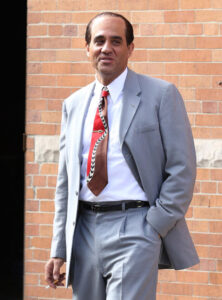
Were you part of the de-aging digital process or was it just you in makeup?
Bobby Cannavale: So the cameras really only work to de-age to age we had to be in prosthetics. So I had to go to LA and get a cast made of my head, just so that I could be bald. I’d be in that chair for two and a half hours every day. These guys got to come in late and just put a couple reflectors on them and be done. But it was prosthetics for us. It was more practical.
What is that feeling to be part of this cast with a lot of heavyweights?

Bobby Cannavale: It’s truly a great honor. I can’t underestimate or undersell that notion really. It’s everything. It’s those guys. It’s their movie. You’re just happy to be asked and I’m really just very happy with the results. I’m going to be in this movie forever. There’s a certain sadness about the movie particularly in the last hour as it’s starting to really slow down as these guys are getting older. I get a very sad feeling watching the movie because I’m not going to see all these cats together in a movie again. It took this long for them to all be together in a movie. Joe doesn’t even act anymore. Marty obviously is going to keep making movies, but who knows if you’ll make another one with Bob. It feels in the end because they all die. I’m really grateful to be in the movie just to just give some support in the film. As a fan of his work, these movies are populated with those characters and so I’m I’m happy to play my part in it and I’ve gotten a real great opportunity to be the guy in his work as well. So I’ve had both and but this one feels really special because of how great these guys are.
What is it you’re getting with him each time you working with Martin Scorsese?

Bobby Cannavale: I’m getting like an incredibly collaborative experience. It’s something that the first time I worked with him I did not expect. I just thought he would be like, “Stand here, do this.” I don’t know what I expected but I didn’t expect it to be so collaborative. He just brings you into the world. He lets you rehearse, you go to his house. He makes you feel like an equal. That’s a really unusual thing for a guy that’s that successful. It just puts you at ease and it makes you feel special. Those are pretty heavy hitters I was with every day, and I was never really nervous. I felt like part of the family. That’s a really special quality that he has. His sets are notoriously quiet. He insists on them being very quiet.

So when he’s directing actors, there’s 100 crew members that are just standing still. Nobody’s working. Nobody’s doing anything because he is right here with you and you feel like you’re the only person in the room when he’s talking to you. That’s a special quality that not everybody knows that I have. I’ve worked with eccentric directors who don’t know how to talk to actors and still make good movies. But Marty has this very, very familial, very warm and he loves actors so much and he makes you feel confident. By the confidence that he showing in you and and it’s a it’s an incredible quality, particularly for somebody who’s got as much going on as he does. The guy’s got like a million things going on his head. He’s preserving films and he’s making documentaries and he’s thinking about a million different things and yet you’re the only person in the world when he’s talking to you. That is really unique.
What goes into saying yes to the project you take?

Bobby Cannavale: I’m lucky I do good. I do. I do stay very busy. I always wanted to work on stage. That was always the thing that I wanted to do more than anything, and I still really only want to work on stage. I work on stage once twice a year here in New York. I’ve done that for many years. That was always my first love, and everything else really is just decisions. If Woody Allen calls, or back then, then I go, if Spike Lee calls I’m going to go, and the same when Marty calls. So those are really easy decisions to make. And in TV, it’s really funny because I’ve done a lot of TV but the truth is the things I didn’t expect to be big deals really ended up giving me access into better roles like “Will and Grace.” When I did “Will and Grace” I hadn’t done much really. I done “The Station Agent” and that film was a big break for me, but it was a tiny little movie that got me “Will and Grace,” and then I won an award for that. I didn’t see that coming at all and it gave me another step up into that world. So I started getting offered interesting roles in television.

I don’t really map anything out. I just know that I can work in all of the different mediums. I just try to space it out and make it work with my life. It’s really that simple. I don’t overthink it, to be honest. But I’ve been very lucky because I’ve had really great people to work with from Marty to Tom McCarthy to Sam Esmail, auteurs who make the things that they write. I’ve been very lucky to work with people like that. I think that working in the theater for a long time, maybe brings something extra to the table for people who make their own work. Maybe they find value in that. I hope that they do, but I really just follow my gut.
What is your favorite film of his?
 Bobby Cannavale: I like them all, man. I really do. I guess I keep coming back to Raging Bull just because I’ve seen it so many times. And because it made a mark on me at such a young age. I was young when that movie came out. I was like 11 or something. I saw it on VHS and not in the movie theater obviously. It was one of those movies that like I would get my ass kicked if they found out that I had a copy of that on VHS. I would watch it when mom wasn’t home. I would put it on late at night. I would fucking hide the video cassette, and I ran that thing to death. It was so artful and I never seen such an artful movie before it treated the guy like a real hero, almost like a saint and it put all these ideas in my head. How can somebody be portrayed be so nasty in one hand, yet be so exalted on the other hand, and I remember being very confused by the complications of that character and it just changed my life that movie.

Where do we see you next?
Bobby Cannavale: Motherless Brooklyn is out now. I’m doing the play “Madea” at the Brooklyn Academy of Music with my wife (Rose Bryne) in January. That’s a modern adaptation. I’ve got a comedy with Melissa McCarthy called Superintelligence that opens in January as well.



Loading…