
 Author, screenwriter, and director Felicia Pride is on a steady climb to becoming a household name in the film industry. Known as a writer on Ava DuVernay’s Queen Sugar, a 2016 Film Independent Screenwriting Fellow, and a NBC Writers on the Verge graduate, Felicia has continued to climb the industry latter having sold her first drama pilot to NBC’s Universal Cable Productions. Currently, she is developing the feature Deeper with Universal Pictures and Will Packer Productions, and she is the co-writer and executive producer of the film ‘Really Love’ produced by MARCO and originally set to debut at SXSW 2020, and screening her newest short film tender.
Felicia Pride’s road to becoming a successful writer has been anything but conventional, and was often met with many roadblocks and crossroads as she had to constantly combat the pursuit of her dreams vs. her reality.
What drew you to become a writer?
I think you do have to be called to this. I think the calling is what keeps you going – through the ups and downs, rejections, and financial uncertainty. I believe that writers at their core are called to this work. For me, I wasn’t really one of those people who said at 10 years old I was going to be a writer. I often make a joke that when I was 5 years old I wrote my first book, but to be honest it was teachers I had in high school and college who noticed my writing and encouraged me to minor in English. Ultimately, I didn’t know any writers so the idea of being a writer was very foreign to me and didn’t make sense. I decided to stick with a business degree instead, so I can get a job in business.
I ended up working at Panasonic in New Jersey after college working in marketing. I’m grateful for the degree I earned because to this day I still use it for projects and I think differently about projects in the way. But, it was there, while working in marketing, I was creatively bored at that position so I starting looking for places online to write. I stumbled across this internship at a good Black owned community newspaper in Staten Island that essentially, that publisher would publish our work. So when I got that first print newspaper mailed to my house with my name “by: Felicia Pride” on the Mary J. Blige review, I felt very “seen” in that moment and I felt like this is it! That feeling of voice and purpose, and writing about a musician that was very close to me – it all just came together.
From there, I started freelance writing and eventually went back to school to study writing in Emerson College for my Master degree, but I was still nervous because I didn’t know what that career path looked like. So, I would always look for ways to be more practical and I did that for a long time, sort of fighting the writing purpose, desire, and dream with this need to be practical.
How was it transitioning from writing for publications to writing scripts/ screenplays?
 I did a stopover in book writing first – I wrote six books. Books were hard for me to write and took a lot out of me. I think I was looking for a form that felt more feasible – a different type of difficulty. So I said to myself I want to write a screenplay. That screenplay is what became Really Love today and is premiering at SXSW. That was a 10-year journey to get that film made in terms of many things. I was also self-teaching myself screenwriting at that time, but I fell in love. It mixed, in my opinion the economics of journalism, in terms of the tightness that you have to be in – you don’t have huge word counts, and then the imagination of fiction. The two worlds came together so nicely in screenwriting.
It wasn’t until I was running a consultancy where I was doing a lot of marketing work around social justice projects. I enjoyed the work but I wasn’t creating again and it got to a point where I was burnt out. So I said to myself that I really wanted to be writing again. I was pouring all my energy into running a consultancy in the service of other creatives, but I wanted to be creating again. So my mentor encouraged me move to LA, which was five years ago, and that was the turning point for me where I said I am going to give my professional writing career another shot! When I first got out here I got a job working in film distribution and was on track to be a VP, but then I got laid off. That was God’s way of reminding me that I said I wanted to come out to LA to write and create. After I got laid off, I got myself together and became very serious about my writing and how to craft a professional career as a film and TV writer.
So, how did you transition from being unemployed to becoming a Film Independent Screenwriting Lab Fellow and NBC’s Writers on the Verge graduate?
Whew, there’s a lot to that and it involves two sides. On the practical side, I had to reprioritize writing in my life. Writing had to be the most important thing—more important than paying my bills. What I mean by that is I had to write first every day. I had to do a psychological shift around writing. I started talking on these odd jobs which gave me just enough money to pay my bills, but it gave me the flexibility I needed to write. Because what I also needed to do was create a portfolio of my work with writing samples that could be used for potential jobs – feature writing samples and TV writing samples alike. I needed to have that together so when an opportunity presented itself I would be ready. So I got into a bunch of classes, joined a two writers groups, got a career coach who helped me navigate the business, and I got very serious. I also had to remind people that I was a writer. The perception of me was that I was an executive in distribution, so people had truly forgot that I was writer because I forgot that I was a writer. I had to reposition myself publicly as a writer. Then I started applying to programs, networking to branch out, and get my work in front of people.
On the flip side of that, I had to let go of the fears that I had around being a fulltime writer and the first feelings when it didn’t work out. I had to let go of the ego and rekindle my love for the work and reestablish a healthy relationship with the work. That was the spiritual work I had to do in conjunction with the practical.
What was turning point for you when truly felt “seen” as a screenwriter?
 Getting into the industry Writers on the Verge program was definitely a turning point for me because writing films is challenging. Films take so long to get made and I was also trying to get into TV, so getting into that program validated for me personally that there is something here. Also, to be in a program with some incredible peers who take the work as seriously as you do and to have network executives take your work seriously as well. Not to mention, three-fourths of the way into the program my father passed away. He was one of my biggest cheerleaders and knew how badly I wanted to be writing again, so I had the solace that he knew I was back on track. That was a tough year for me but I told myself I was going to turn things around. By the end of 2018 I sold a pilot, I sold a film, and got staffed. One thing I love that has come out of me rekindling my relationship with the work is that every day I get better, and people can’t take that from you.
What is your favorite writing style?
Definitely television–I love it! TV is my thing. Features would be next. Features are just a different beast. Feature writing is a more solitary writing experience. TV is a more collaborative writing experience Also sometimes what I learned through the Really Love project is that film is a director’s medium. That’s also why I started to write for TV. I realized there are certain projects that I am going to have to tell the story start to finish. I’m currently working on an indie feature that takes place in Baltimore and is inspired by my mother, my niece, and my sister—no one else can direct that, so I told myself I needed to get my skills up. But TV is definitely my favorite style of writing. I love the expansiveness of storytelling in TV and you have more room to do things.
In working on television shows, many are familiar with you working with Ava DuVernay on Queen Sugar. What has your experience been since working on this show?
 It’s been amazing. This is my second season on the show and Ava is such a creative force, who loves black people and that in itself is rare in Hollywood. You know what I mean? So, God knew the room to put me in because it is a room that I can bring my full black female self into, then to be a part of nuanced conversations about blackness, and then be a part of telling stories about black people that show us in our full humanity. Learning from our show runner Anthony Sparks as well, who is amazing in so many ways as a leader and a writer. Overall, to learn in a safe environment has been one of the biggest blessings.
Your latest project – the short film tender, why did you decide to tell this story?
 Tender is my way of the getting my feet wet in directing. I wanted to tell a story that was contained, affordable, and producible. It started from this scene I had from a pilot, actually the pilot that got me staffed on Queen Sugar, between these two women and I really liked these two characters. So then I thought what if I turn this scene into a short? And that’s where the story was born.
I’m proud of this short – it’s an imperfect baby. I’m really proud of the fact that, for the first time in my artistic career, I have been a part of the vision from start to finish. I’m approaching my 20th year of writing, off and on, but even with books – I didn’t get to choose the book cover, what the aesthetic was, or even be a part of that conversation. It was such a gratifying experience to be able to thinking about what the credit font was going to look like. I also worked with some incredible actors. I love the collaborative process that came out of directing tender. Working with my wonderful DP (cinematographer), Ludovica Isidori who was amazing and we had a really wonderful relationship with my editor. Pretty much all the departments, with the exception of one or two, were women and mainly women of color. Overall, it was a beautiful and I’m really proud of what we did together.
What do you want your viewers to take away from tender once we experience the film and absorb the story? What are you hoping that we grasp?
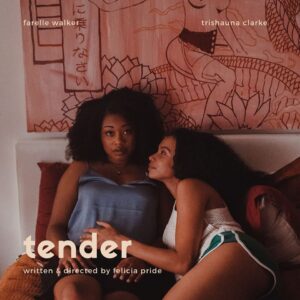 Ultimately what I’m saying is the power of female intimacy and the breast of what that could look like. It can look physical, it can look emotional, or spiritual even. I’m really exploring those themes with the sort of tagline that is ‘finding intimacy in unlikely places’. What happens when we truly open ourselves to being vulnerable with someone and what does that look like?
What can we look forward to seeing from you in the future?
I recently sold a film to universal with Will Packer Productions that I’m producing. It’s an erotic romance called Deeper. So I’m actively working on that right now as we are in the early stages, but I’m really excited about it.
Although writing wasn’t always a dream of yours you grew into it and have been able to adapt and change the kind of writer you have been throughout your career. What advice do you have someone who says they want to be a writer?
Quick plug— I run a service called the Create Daily (www.createdaily.com), which is a free service that I’ve been running since 2012, and it’s geared towards underrepresented creators. Every week I send out a list of opportunities and people, who are on the list for 7 years, have told me that email is still that little kick in the pants. It’s a form of little encouragement to keep going and I think that’s probably the biggest advice I would tell writers, particularly writers who feel called to do this work. I feel like my biggest regret was when I stop writing. So to that I say keep writing. Even if you have a job, or you have two jobs, if things aren’t happening for you –keep writing because it’s ultimately all about the work. It’s about telling these stories. Now, of course there’s the business aspect of getting these stories out and that’s a much longer conversation. But overall, keep writing is what I say and do not stop.
What advice would give on how to best navigate the business side as a writer/ creative?
You’ve got to focus on the business. I am grateful for my business degree and the fact that I ran a business, because I am able to bring that savvy with me in dealing with the business side. Getting a lawyer is key, that’s for sure. I literally have had experiences with downloading a contract online and then that comes back to bite you. Get a good lawyer because you need to protect your intellectual property and that’s all you kind of have, right? Your IP, write year, a your copyright. You must study the business. I read the trades every day. I have a seed that I pulled together and I read it every night before I go to bed. I want to know who the players are, who’s selling what, and who’s doing what. Or going to panels and informational sessions—there is so much access to resources these days where you kind of have no excuse to not understand foundationally about how the business works. Also, there is being able to connect with mentors and people who have done it before you to get into the more nuanced aspect of things. Please make sure you get yourself a therapist because this business is nutty and you need to stay grounded and sane. I go to hot yoga, I go hiking, I pray, I meditate, and I go to therapy, so that this business don’t make me go crazy or lose myself.


Loading…