

Kirill Mikhanovsky used his personal experience as a transport driver to write and direct a freewheeling comedy based in Milwaukee. The Russian immigrant moved to Milwaukee and took a series of odd jobs including driving a medical vehicle. He eventually graduated from NYU’s prestigious Tisch Graduate Film program and the Sundance Institute Screenwriter’s Lab. Mikhanovsky has made several award winning films including his first feature Sonhos De Peixe and Inhale Exhale. “Give Me Liberty” is set in a day in the life of Vic (Chris Galust) a second generation medical transport driver who is late to pick up passengers due to a road block after a neighborhood protest.

Things get more complicated when he must take care of his grandfather and shuttle a group of elderly Russians to a funeral. This delay upsets his passenger Tracy (Lauren ‘Lolo’ Spencer) who makes her acting debut in a lead role. The model and advocate was diagnosed with ALS at 14. Now in her early 30’s, Spencer is a marketing manager and disability rights advocate who has a popular Instagram account. Lolo has also gained popularity while modeling adaptive clothing and giving advice to the disabled community. She is currently featured in a Zappos Adaptive campaign. Director Benh Zeitlin (Beasts of the Southern Wild) and Ryan Zacarias serve as an executive producers on the film. George Rush (Sorry To Bother You) and playwright Alice Austen ( Jimmy Salvador, Emilie) are producers on the movie. “Give Me Liberty” screened to packed houses at the Sundance Film Festival and Cannes Film Festival. BlackFilm spoke with the director, Lauren Spencer and writer/producer Alice Austen about their latest collaboration.
BlackFilm: You have a similar background to the main character of the film. Can you talk about how you came up with the concept for this story? How did you get everyone together to collaborate?

Kirill Mikhanovsky: I did that job at some point in my life in the late 90’s. 1999 I believe…in 1998 it marked me the deepest. It was really was one of the hardest jobs that I’ve ever done in my life for many reasons. It went down for nine months. In retrospect it was also one of the most important jobs that I ever had while in college…It was a truly formative experience for me, as a human and as a director. So I knew this job first hand. I understood what it was like to drive around the city. And what it was like to be responsible for the lives and safety, of the people I helped get to where they needed to be. There was a lot of drama there. I would always be late. I didn’t know the city very well. My English was not up to speed. I was that well-meaning screw up. It was my personal discovery of Milwaukee, my personal discovery of America. Milwaukee is a very complex city. It’s one of the most segregated places in the country. It’s very spread. Many people who came from my generation, who came from Russia have no idea about Milwaukee. I had the privilege of learning about Milwaukee through that job…I happened to be in Milwaukee and had the fortune of being introduced to Alice Austin who was with Steppenwolf and other theaters.
She had written thirty or more plays and two novels. I had the fortune at being at the reading of one of Alice’s plays. I approached Alice. We began to work on a script. One thing lead to another we decided to make a smaller film in Milwaukee, which we found to be utterly fascinating as a city. As a surviving city, it is a struggling city, the backbone of America. Despite all of it’s economic difficulties it is still fighting for the American dream. As a starting point, I suggested to use those stories that I lived through, while being on the job as a driver… What we ended up doing is a complete shift. It’s not really my life, only biography by no stretch of the imagination. Nor would I call Chris my alter ego, if I were to call him my alter ego, then everyone else is my alter ego, including the character of Tracy. I think probably the same would go for Alice, because we love our characters. We wrote incredible characters and we love all of them—but also impossible. One of the most impossible characters of course was that of Tracy—impossible to cast. And through Alice’s extensive connections in the Chicago theater world, we got introduced to a casting agent in Los Angeles. That happened to be Gayle Williamson. We had a very specific idea of who we wanted for the character of Tracy. We knew roughly the age, how the character would be and we knew we wanted an African-American to play that role. It was very important to us. So we had the picture of Tracy only of course we thought. How are we going to find this amazing human being? Believe it or not that was the first human being who was introduced to us. The moment we talked to Lolo we knew she was the one. My god, who would have thought that one of the most difficult characters to cast, if not the most difficult. And certainly the most important one in the movie would be the first person we would meet. It’s really an incredible blessing.
BlackFilm: I know that you are singing the praises of Lolo’s talent. I saw that talent when I was watching the movie. Lolo, how did you prepare to act in the film? This is your first role. You’re known as a model and an influencer. You’ve been very outspoken for other people with disabilities in the community. This is your first acting role and leading role in a film.

Lolo Spencer: It was a journey a little bit because the pressure of a lead role and it being my first role was definitely there. I’m just one of those people that like to execute at the highest degree that I possible can give. The pressure was definitely there. Given the fact that me, Alice and Kirill were able to talk on Skype for two years before we even went into production. And constantly, regularly talking about the character. I really just wanted to figure out where were the similarities between myself and Tracy- to start there because would be the easier things in my brain to tackle. Because I could relate to those moments or those character traits. And then the things that weren’t as similar or maybe I had grown out of those are the things that I needed to remind myself and tap back into of – okay Lola at 32 now is not going to respond in the same situation in the back of a van, as Tracy did.

Tracy is younger than me. I had to think, okay well when I was younger. I probably would have went off on a driver just like that…Because this film was very touch and go. I didn’t know when I had to go. So I did my best to prepare. I took an acting class for a month. Literally the very last acting class a few days later we were on the plane to Milwaukee to shoot…. The very first day of shooting was the toughest day.
When you’re thrown into a situation, it’s flight or fight. I just went in there and did my best. I knew Kirill is trying to tell me to give this kind of emotion. I’m just going to have to pull it from somewhere…
Director Kirill Mikhanovsky On Working with Non-Actors.

That is what we set out to do before we wrote a single line. We committed to that idea. This is the thing that made the film what it is but what slowed us down in financing it. I don’t want to call Lolo a “ non professional actor.” What she did is top of the craft. I have a hard time calling her a non-professional… This is the first role for her. What is valuable about non-actors is they bring with them is their life baggage. Their life experience, they bring it to the screen. In this respect, Lolo was prepared. Lolo is a true survivor. She’s tough as nails but she is also vulnerable in certain ways…
Lolo Spencer on the Importance of her Portrayal

It was incredibly important that I was able to portray the authenticity and the emotional arc in every dynamic that Tracy goes through in the film. Because I have my background as a content creator on Youtube. I’m always blessed to hear other people’s stories and understand other people’s feelings— and what they go through with having a disability. Disability is such a large spectrum, in how people go about their lives, as people with disabilities. It’s all very different, just like in other groups. I think society believes you’ve got a disability all of you guys feel this way about your lives. That’s not necessarily the case. They think we’re these angelic people. Oh, you can’t touch the people with disabilities… People are going through everyday life, like everyone else is, we’re all human. So I really wanted to be sure that I portrayed that part, the humanity within Tracy…to where like Kirill said when you see Tracy, you forget that she has a disability… In everything I do I want to represent people with disabilities and represent authentically what our lifestyles are in every spectrum. Whether it is the drama or some flashy stuff that I do in my personal time.
Kirill Mikhanovsky on Finding Lauren ‘Lolo’ Spencer For The Lead Role

Lolo is not giving herself enough credit… I remember Alice and I was looking at Lolo when we had just met with you. We were studying your photos… Lolo is beautiful. Lauren is beautiful… She’s not just a pretty face… If you just take your time and look into her eyes you see a lot of depth there. There is a lot of depth that can’t be bought and can’t be taught. It can’t be learned. It can only be accumulated and earned—through certain experiences that are all unique. Lauren Spencer is incredible because of the hardships that she has had. Because of what she had to survive—that is what Lolo brought to the screen.
Alice Austen on Working with Kirill Mikhanovsky and Filming in Milwaukee

Kirill and I both lived here and both have roots here. Kirill grew up in Moscow. He moved here when he was 19 or 20. We both love the city. For us it was non-negotiable for us to make a film in Milwaukee. Because Milwaukee is a character and a city in the movie as we rightly point out. It was to us—the heart of the American Dream. It was a city that used to have a lot of factories that have since closed. It’s struggling to reinvent itself. It is a segregated city. No one in the city is interesting, because we did a lot of street casting. One of our questions was what do you like about Milwaukee? What do you hate about Milwaukee? Invariably, everyone said we hate the segregation. It was critical for us to make this film in Milwaukee. But the crux was at the time, we were devoted to making the film in Milwaukee, but nobody was devoted to us making the film here. No one outside of Milwaukee was interested in us making the film here. Because there are no tax incentives here, so we really struggled to make the film here. Ultimately we got some people to support us in small ways. But it was an incredible battle to do the film here.
Kirill Mikhanovsky on Writing The Script and Working with Benh Zeitlin

For me as a director, the city, the location is always the main character of each film I do. Milwaukee was cast first, more than anything else. The story was inspired by Milwaukee. By taking it anywhere else we would have been betrayed the genesis of this story. Casting the location or the city is just as important as casting the lead or any other actor…. We stuck to our guns for 3 ½ years before we got to make it….A local billionaire offered us full budget to make it in Detroit. We turned it down. We were asked to shoot in Los Angeles to move it anywhere, St. Louis to Chicago…People were wondering why are you so loyal to this place. We were loyal to the idea…Milwaukee is the main character and this is how it came about…

We didn’t know what we were in for; we thought it would take us a year and a half to get it made. Lolo was with us for two years… At one point everyone around started to doubt if it was going to happen at all. That’s when in October 2017; we turned to each other Alice and I. We understood, hell or high water money or no money we’re making it in a few months. Because if we don’t we will never make it. I’m so happy that we made that decision…As far as screenwriting; we went through a few iterations of the script… A number of important people in the industry read it and fell in love with it. They found it very exciting. One of them was Ben Zeitlin of “The Beasts of The Southern Wild.” He read the script and got on board as an executive producer. He wanted to help us get it off the ground. He wanted us to run out and shoot a film. He was so excited. Even though he was neck deep in preparation for his own film. That’s when all the trouble began. We wouldn’t find anyone else to finance this wild adventure. As time went by Alice and I kept reworking the script, just to keep it fresh and exciting…
On Bruce Springsteen Giving Permission To Use “Born In The USA” Song In The Film
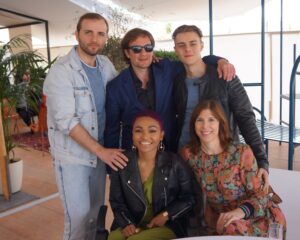
Alice Austen: We had a very interesting moment in the film, in the talent show when the young man sings “Born In The USA.” There is that point as a producer where you have to go out and get music rights. We were told that’s never going to happen. In 35 years that song has never been licensed. Bruce Springsteen has been offered a lot by many and has never licensed it. We reached out and started a dialogue. It was a really wonderful exchange. In the course of the correspondence, we reiterated the fact that the use of the song isn’t political. That was one of the things that he had objected to over the years. There is this young man who is in working in this place with people with severe disabilities. He’s from a blue color family in a town where a lot of factories have closed. He wants to work and it gives him human dignity to be able to work. He loves Harley Davidson, The Greenbay Packers and Mr. Springsteen. Soon enough the correspondence led to—well can you please send a screener. Then he approved the use of the song. It was a magical moment for us because it was right before Sundance.

Kirill Mikhanovsky: It was one of those “yes” moments, because certain songs are part of the film. It’s almost impossible to take them out. When a confirmation on that scale comes along, It’s just so heartwarming and inspiring.
On The Meaning of “Give Me Liberty”
Alice Austen: We had packed audiences at Sundance. Everyone would come up to us at Sundance and say everyone needs to see this film, because it’s a healing film…To us that was a sign that we had something very special on our hands.

Kirill Mikhanovsky: There was a clear dichotomy that it was a huge hit with the audiences. The audiences really connected to the material—to the characters. People would say, every American needs to see it today. At the same time almost all mid-level executives of distribution companies would say it’s a really lovely film. We don’t know how to market it.
Alice Austen: Lolo and I talked about this openly. To me that was a euphemism for we don’t know how to market a film with a lead actress who is a disabled Black woman in a wheelchair. If we had a famous White actress with a following in a wheelchair and she pretends to have a disability we might have had a big deal out of Sundance. For me that was infuriating, we believe Lolo’s performance was so singular. It should go all the way and she should be in contention for awards for her performance. Indeed she was recognized as having given one of the strongest performances at Sundance. Together with people like Adam Driver, Riley Keogh and very well known actors. That’s not an accident. It’s because she does—kudos from us to Music Box films. They were bold enough to acquire this film. They typically distribute international films. They fell in love with the film… The title was interesting. We were writing the script and believe that the title is important… There is someone we connected to who is a mechanic and a North African immigrant. He walked into the coffee shop where we were working. He was wearing a “Give Me Liberty” t-shirt with the Statue of Liberty. And we looked at each other and we were like, that’s it…that’s the title.
Kirill Mikhanovsky: The funny thing is it sounds so right—after all the conversations about America. Milwaukee in the context of America. Milwaukee struggling and the American dream, the immigrants, segregation and how to make this world a better place. “Give Me Liberty” struck the chord immediately, we wrote that yellow shirt into the script…
On Getting a Standing Ovation at the Cannes Film Festival
Alice Austen: We had I think the longest standing ovation at the festival…we were told, they’ll love it. It’s such a great beautiful film. It was an over 10 minute standing ovation. None of us expected it. It was really unbelievable.
Kirill Mikhanovsky: Someone asked me what were you thinking of while this was going on? I felt it was a great question to ask, because as far as I recall I was thinking nothing. You kind of float, it was like a wave…It’s as close to meditation as a real moment can come…I thought we would get 30 seconds and people would just go…
Lolo Spencer: It was definitely unexpected. People clap and they start talking about the film. They start running up to you asking questions. I think we were all preparing for that. When the audience wouldn’t stop clapping for a couple of minutes. I was like are they gonna stop? I didn’t know what was going on either. I was like this was incredible. You hear so much about the rumors that Cannes is really tough. They don’t just use any films in their festival. The French are very serious about their films. So, for us to have gotten a standing ovation, it was like oh my gosh. We beat everybody in my head…This is incredible.
Kirill Mikhanovsky On Shooting the Movie on Kodak Film Stock
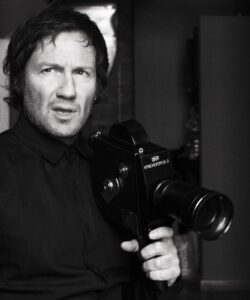
Alice Austen: We were really determined to shoot on film. Even though film wasn’t budgeted. We had a digital camera and we also had an ARRI camera. Some of it is shot digitally. We also brought film in every time I thought there was enough money to scramble— to order some more film so we could shoot. We shot some of that on an old Russian camera Kirill had that is a wind up camera.
Kirill Mikhanovsky: It was like a Russian version of the Bolex, where you have to wind it every 25-30 seconds. Interestingly that camera is not perfect. It flashes light. Sometimes the film got stuck in the sprocket holes…it had a funny blur to it. But those parts end up making sense. Because of the driving and the rattling of the van… We used that film to convey the impressions of the main character. If it’s his memory or him falling asleep and dreaming with the film…I can’t imagine my life as it is without celluloid, without that sensation. My dream is to continue doing it on film. It was our ideology from the get go. It really mattered to us to do the film in the old Milwaukee, still struggling with the medium that is also still classic, ritualistic and profoundly cinematic. It was a very important choice.
‘Give Me Liberty’ is now playing in theaters in NY at IFC Center and in L.A. The film is a Music Box Films release.



Loading…