
Luke Cage Showrunner Cheo Hodari Coker and Mike Colter Talk Season OnePosted by Wilson Morales
September 27, 2016

Coming out this week on September 30 from Netflix and Marvel Entertainment is “Luke Cage,” the third series in Marvel’s four-series package at Netflix after “Jessica Jones” and “Marvel’s Daredevil.” The last series will be “Iron Fist,” with all four leading into a “Defenders” mini-series.
After a sabotaged experiment leaves him with super strength and unbreakable skin, Luke Cage becomes a fugitive trying to rebuild his life in modern day Harlem, New York City. But he is soon pulled out of the shadows and must fight a battle for the heart of his city–forcing him to confront a past he had tried to bury.

Mike Colter, who was first introduced in “Jessica Jones,“ plays Cage and leads a cast that also includes Simone Missick as Misty Knight, Frank Whaley as Rafael Scarfe, Mahershala Ali as Cottonmouth, Theo Rossi as Shades, Alfre Woodard as Mariah Dillard, and the return of Rosario Dawson as Claire Temple.
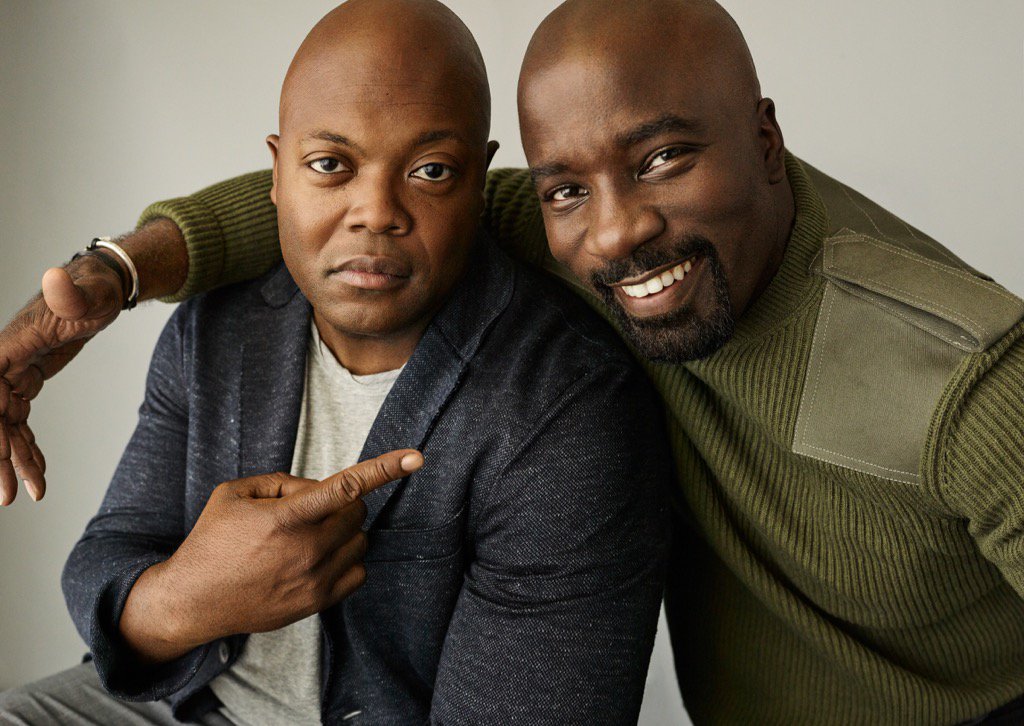
This past summer while at San Diego Comic Con, Blackfilm.com was among the few journalists who spoke with Coker and Colter on bringing this character from the comic books to the Marvel Cinematic Universe.
How do you view Luke Cage? What’s your take on this guy?

Cheo Hodari Coker: He’s a complicated man who no one understands but his woman, but in this case, Reva happens to be dead. He basically deals with that. He deals with the fact that he has very few people that he can talk to. He never wanted this prowesss. He didn’t ask for them and now that he has them, he doesn’t necessarily want the spotlight and the heat that comes from being different. When things happen that he could have prevented from happening and there are consequences from that, he feels its his responsibility to come out from the shadows and to be a hero. Part of the first season is how does one accept the mantle of being a hero?

There’s that pivotal line in the first episode where he says, “I’m not for hire but I have to.” Just we are playing with the fact that Power Man is a hero for hire, but first for season one, let’s look at what does it mean to be a hero. What are the sacrifices that come from that? How does one get to the point where you come to accept who you are?
Mike Colter: He’s a guy that’s been thrust into a place that he doesn’t really want to be in. He’s a guy that’s been endowed with abilities as they say and to him, he doesn’t see it as a positive. He’s reluctant to embrace it. He’s a humble guy and doesn’t want parts of it. Ultimately, it’s something that he will have to deal with. It’s perfect for me, because I don’t really like the spotlight either. With him, it feels like a glove.
Is it a challenge to write the plot to coincide with what fans know from the comic books?

Cheo Hodari Coker: Not really. Daredevil is haunted by Frank Miller from the standpoint that the Frank Miller run on ‘Daredevil’ is so insurmountable that the only thing you can do is match it, which the show has. Brian Michael Bendis’ run on ‘Alias,’ in terms of what he did on ‘Jessica Jones,’ is that comic and the level of them, and the maturity and deep themes of them translate perfectly in the series. With Luke Cage, as I grew up the tones of the Power Man and Iron Fist was never really heavy. Every single issue had Cottonmouth and Big Ben and all these different people. I thought it was a disadvantage but it turned out to be a great advantage for our show because it really allowed us to explore these characters that hadn’t been in 30 to 40 years. It gave us an opportunity to reinterpret them. We can do it in such a way that definitely respected the spirit of the comics, the original comics from the 70s and all the different versions but at the same time, with the show, it existed in its own space. I think what happens because they are so different, people will go back to the comics and experience that richness one way and they will also give our show its own sense of whatever it is.
There’s a great nod to the classic look of what audience remember from the comic books. Can you talk about the fun of doing that?

Cheo Hodari Coker: I’m assuming that you are referring to the origin episode. Charles Murray wrote that episode is also an executive producer on the show with me. Not only is he a brilliant writer/ director, he’s also the geek bar none. That was the episode where he was like, “Cheo, I’m writing that episode.” Charles is a big dude and I was like, “The episode is all yours.” For the life of me, I could not incorporate the tiara in an organic way and once he figured that out, it was great.

Mike Colter: I’m not a geek in the sense that I didn’t grow up reading Luke Cage, but because I have playing him for a while now and absorbing other people’s energy, I can only imagine to watch it happen and say to yourself, “Oh my God, that’s the scene!” It’s like a slow orgasm that builds. I felt that the longest episode of the series. I’m not kidding you. With all the costume and the makeup and the setups and the flashback sequences, it just took a long time to film that. Once that was done, I felt that we could finish the series now. The episode felt like a series itself. I think it was a 13 day shoot. We did the reveal at 1am in Queens by someone’s backyard. You’re cold and outside and you say to yourself, “Are we finally going to do this?” It was a great experience and one of my favorite episodes to do.
The show really leans into race in a fascinating way that hasn’t been done in the Marvel universe that you can only do with a story like Luke Cage. In the first episode, what stands out is the use of the N word. Was there any difficulty in getting that past Marvel? Did they put up a fight at all in having the Marvel Cinematic Universe all of a sudden use that language?

Cheo Hodari Coker: Well, they had some trepidation. I’m not gonna front. But my whole thing was that, in using that word, I didn’t want it to be comfortable. I wanted every single time that it’s heard for people to think about it. But I also really wanted the show to live on its own terms, from the standpoint of, this is what it’s like when you eavesdrop on black people talking to each other. That word will come up, at times, in certain ways, so I wanted to explore the context with which it was used. Cottonmouth uses the word differently. In Episode 2, as Luke pushes forward to becoming a hero, the word is referred to in the very beginning of the episode, and at the end, and the history of Crispus Attucks. I wanted people to think about it in a way that they hadn’t thought about it before. And at the same time, every blaxploitation movie from Shaft to Hell Up in Harlem to Black Caesar deals with power and deals with these issues, so it needed to feel like that, too. When all else fails, if everyone gets mad, they can blame me.
Mike Colter: We talked about it, early on. I remember talking to Cheo about it and I was adamant that Luke was not a person that used that language. He was not a person that used that word because he was bigger than that. First and foremost, he’s a superhero, but we’ve got to define this superhero in a bigger sense than just his powers. He needs to be someone we can aspire to be, and I felt like, if he was the kind of guy that used that language all the time, like someone on the street corner who didn’t respect themself or the people around them, then he had lost what he had given up. So, that was a high requirement. In this day and age, even as a Black man, if you don’t want to use that word or you choose to not use that word, you’re walking a path on your own because it’s so accepted. Whereas for Luke, he wanted to be better than that. From the books he’s read like the James Baldwin books, he’s trying to work on himself. He’s trying to change his path. So, when he does use it, it resonates because it’s out of frustration. He can’t deal with this issue right now. He’s going through so much. He has to deal with this guy, this person right now. At this point, he wants to unleash and retaliate with the same venom and hatred. Sometimes you don’t know the effect of words until you hear it used on you. That frustration just came out. It works in that moment. He uses it because of a certain reason.

Cheo Hodari Coker: That was the thing. I always get question, “What makes Luke Cage different than any other character?” Well, he’s black. Let’s face it, there aren’t a lot of black superheroes. So, in dealing with a black superhero, you’re going to deal with ugly history and the beauty of history. Yes, he’s going to have different responsibilities and different issues that, say, Captain America wouldn’t have to deal with. But then again, he’s going to deal with certain things that every superhero has to do. At the same time that he has superhuman abilities, but we want to also emphasize the human the frailty of personality and temptations and everything else that comes with being a person. That’s one thing about the show. Everybody from the villains to our heroes have these moments of doubt, have these moments of reflection and clarity. That was really one of the main things we really tried to do.

Mike, what’s it like taking this character from a different showrunner than you originated him with? From Jessica Jones to Luke Cage?
Mike Colter: Yeah, it’s interesting. I look at it from the standpoint as like being directed by a different director, every episode. As an actor, there’s something that different people bring to the interpretation. The showrunner for Cage is obviously a black man, and the Jessica Jones showrunner was a white female. Jessica Jones was told by the point of view of Jessica, so Luke Cage existed in her point of view. It’s her viewpoint how we experience him and how he interacts with her. So, we’re doing this from the leadership of a black male, who is now the showrunner examining this character. It’s the same character, we’re just turning up the volume on certain colors and certain flavors. He’s in Harlem now. We all act differently in certain places. We don’t want to admit it, but when we go home we’re different where we grew up than we are with our family, and than we are with the guys that we went to college with or our fraternity brothers. People just exist differently. It’s small, subtle things, but we do this because we’re different people and different colors come out. That’s all there is to it.

Cheo Hodari Coker: Also, I thank (Jessica Jones showrunner) Melissa (Rosenberg), every single day, for casting Mike. She cast the perfect Luke Cage. What’s great about Mike is not just that he literally looks like the character, as he was drawn, but at the same time, he also has the sensitivity. That was the one thing. Yes, we’re going to have the brawn and grit of Luke Cage, but I also thought it was important that we have somebody that could embody the sensitivity of conversation and personality. Even though my approach is slightly different, the Luke Cage of Jessica Jones is no stranger to the Luke Cage of Marvel’s Luke Cage. It’s really a continuation, to a certain extent. It’s just got a little different flavor, but it’s still the same suit.

Can you talk about the music in the show? From D-Nice, Faith and others, can you talk about bringing those artist to Harlem?
Cheo Hodari Coker: I was lucky enough to open up my phone book and my Facebook feed. These are people that I have known from my days as a hip hop journalist. I’ve known D-Nice, I’ve known Faith, Raphael Saadiq, Ali Shaheed Muhammad and Method Man and other people for over 20 years. It was cool to build this world and at the same time as them to be a part of it and have it fit together. The music fits really well and we also introduced all these different acts. The chance to use Nina Simone in episode 6 and Mahalia Jackson. I just went through my mom’s record collection. It was great. It was fun.