
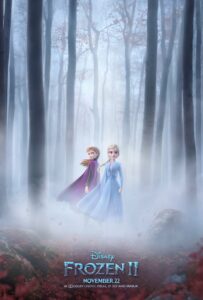
On a tour of Disney Animation Studios in preparation for Frozen 2, we got a chance to speak with three of the visual development team for the film. These are the people that work on the costumes and hair and makeup for the characters, as well as looking at how the visuals line up with the story. Visual development artists Brittney Lee and Griselda Sastrawinata-Lemay spoke to us about designing the outfits for Anna and Elsa, the look of characters we haven’t seen yet, and more to look forward to in Frozen 2.
What do you two specifically do for the visual development team?

GRISELDA SASTRAWINATA-LEMAY: We are the costume designers, and then there are character designers and environment designers. We do costumes and hair and visual appearance for this movie.
So, thinking about the hair. This is a movie that involves water, and different weather events, and ice, and snow, and more. How did you start to figure out what the hair on Anna and Elsa would look like, wet and dry?

BRITTNEY LEE: That’s the hardest part! Well, we did have the foundation to build on, this being a sequel. That was one area where we were able to save time. But we tried modifying and updating hairstyles from the first movie, and on Elsa, we were trying to update her braid to get more play in the wind. And it ultimately didn’t work because it was too close to the braid that we know, but not close enough. So it looked like a mistake. And we knew that, so we knew the audience would feel that. So we decided to go with her original braid, but there’s an extensive amount of testing that’s done, putting them through their paces. There’s something called a “rollercoaster test,” and that’s more for the short hair characters like Kristoff. You basically have their face in front of you, and it looks like are locked in a camera right on them as they go through a rollercoaster. And that’s meant to show you where the gaps are in their hairstyles and where we need to finesse more. So there’s a lot of testing from a lot of people, and I think we’re mainly there, specifically for the elements, to give direction in how to shape things in an appealing way, and how to maintain the character.

GRISELDA SASTRAWINATA-LEMAY: I remember for Anna and for… every character, really, when hair gets wet, it’s not just wet. It’s beautifully wet. It’s parted in a nice way. It’s not like when we go into a pool and go down and up [in the water] and it’s just all straight down. Everything is beautifully art directed.
This movie takes place three years later. Was there any maturing of the designs of the characters to make them appear older?
GRISELDA SASTRAWINATA-LEMAY: For Anna, it’s the hair. Putting her hair down makes her feel more grown-up, and the costuming for her is about squaring off a lot of the rounded curves. That makes her feel older.

BRITTNEY LEE: Yeah, I think that there was still an overall effort to make sure that the elements looked mature enough for both girls. It was a bigger task for Anna since Elsa was always the older sister and she needed to look older always. Anna was the playful younger sister, and she got the brunt of being aged-up
We see the new outfits that the characters in the film are wearing, and how they’ve changed. How did you settle on the color palette of the film, and where did the inspiration come from?

GRISELDA SASTRAWINATA-LEMAY: Mike Giaimo [prodcution designer] had already designed the logo when I started designing Anna, and Lisa [Keene, co-production designer] already had a color palette of what the forest would be. We’re taking that into consideration and then, standing next to Elsa, what are the colors that would look good in the environment and pop when Anna and she are in the same scene.
I can imagine there are a lot of questions to ask about the fashion of the two women, but there’s Kristoff, and characters we haven’t really met yet like Lieutenant Matthias. What was the design of these characters and how they fit into the world?
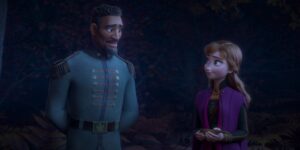
BRITTNEY LEE: Well Kristoff, he was mainly concerned with maintaining [the status quo]. So he’s a mountain man, and we’re going into this forest where he should feel very much at home. So we didn’t have to do so much updating for him as much as we were making him fit in the world and fit with the girls. So he kept mainly the same silhouette and he updated materials and details so that he has the iconography of Arendelle in his sash, so he fits in with Anna and Arendelle. So now he is of two worlds.

GRISELDA SASTRAWINATA-LEMAY: Matthias, we’re basing on the Arendelle guard from the first movie, so we used the same greens and similar cuts, though he is of a higher rank and has a slightly different uniform.
We see a little bit of a crowd scene in the footage that we saw today. What is your role in designing outfits for random bystanders in a movie like this?
GRISELDA SASTRAWINATA-LEMAY: For the crowd, Michael [Woodside, animation supervisor] wants the crowd to feel like art directed also with color. So the crowd has a season color for this movie. Like you know, even in real life, in winter we have certain colors, in fall certain colors, in summer… and it’s the same thing in Arendelle. In Arendelle it’s colors that are more of the autumn color, but not as saturated as the girls. Because we want the ladies to pop out more, though they all share the same color palette.
You spoke earlier about the design of Elsa. For the musical numbers, how much does movement and especially choreography factor into the way that you design some of these costumes.

BRITTNEY LEE: It’s major. I mean, for the outfits that they needed to be in for the forest, it was mandated basically from the beginning that they be in pants because we knew that they would be going through all kinds of paces. And you know, modesty-wise it was important. But as far as “Into the Unknown” was concerned, we knew that nightgown needed to move, so we provided some extra material so we could get some lyrical secondary motion to it. So she’s got a sheer on top that hopefully serves that purpose. But we were really conscious of it in the dark sea. So, we didn’t know how much time Elsa was spending underwater, but we knew she was going underwater.

And we wanted something that would feel magical and sort of ethereal and floating around her, and so we had to look at a lot of musical footage and a lot of dancewear to get the right cut of the dress so that she wouldn’t feel restricted underwater. We didn’t want her to feel tangled in her dress, but we wanted her to move in a way that was flattering and exciting. So that was a big one, but movement overall for both of them is something that we’re conscious of and constantly thinking about. Elsa usually has capes, and that’s something that we can get extra movement and drama for choreography out of. But it’s always one of the checkmarks that we want to hit.
Do either of the two of you do work with the non-human characters in the film? Or is it mostly just the humans?

BRITTNEY LEE: We’ve done a little bit of work with Olaf, and a little bit of work with Sven. For Olaf, he was designed by Bill Schwab early on so basically at this point it’s just extra details that go on him at any given point in time, and so you don’t want to add too much to Olaf. Olaf works as is, so anything we do is very, very secondary. And Sven, he’s got a harness, and that’s always needed to fit well with Kristoff. And so that’s almost something we designed as an accessory to Kristoff. They worked together and… they were a couples costume! Before Anna and Kristoff! [Laughter]
What’s the biggest challenge of designing looks for Frozen 2 compared to some of the other films that the two of you have worked on?

GRISELDA SASTRAWINATA-LEMAY: Well, time is always a challenge. And for me, the attention to details is something that’s always fun and challenging at the same time. Because this technology for Frozen 2 has advanced so much, you can do so many things that we could do before. For example, embroidery we are making it as if we are making real embroidery. And then when Elsa and Anna move you can see the threads shining differently. It’s pretty wild, pretty amazing.

BRITTNEY LEE: Yeah I think the fact that this movie is a sequel is challenging in and of itself. We gained some stuff from that, we hit the ground running so to speak. But there is also a lot of pressure to make sure that it is up to par with the first movie. And we are also breaking rules from the first movie, and how do we manage that as far as narrative is concerned. Making sure that Elsa in the forest, the hemline is above the ground for walking. And that breaks her, it broke her immediately and so we say that, so trying to bring in and re-introduce details on her that feel like her and work on a silhouette so short.

I know that Anna and Elsa’s mother becomes a bigger character in this movie. How did you redesign her from the brief appearance in the first movie to the way she looks in this film?
BRITTNEY LEE: You know it’s funny, in the first film she was designed very quickly for the sequence she was in, which came very late. So we always had the girls first, and facially she was always related to the girls. So the costume for her in the first movie came together really quickly, but it was one of the production designers, Mike Giaimo’s favorites from the first movie. So it was nice that we could use it again and show it again. But it has been totally reworked as far as materials are concerned, and just general properties. So it feels softer and feels more approachable than it did in the first film. Because you see her sitting in bed with these two little girls, and it looks like something you can sit in bed and feel comfortable with and not restricted. So that was a big concern, making sure that it could feel loved and lived in.


Loading…