
A story of first love between Maren (Taylor Russell), a young woman learning how to survive on the margins of society, and Lee (Timothée Chalamet), an intense and disenfranchised drifter, as they meet and join together for a thousand-mile odyssey which takes them through the back roads, hidden passages and trap doors of Ronald Reagan’s America. But despite their best efforts, all roads lead back to their terrifying pasts and to a final stand that will determine whether their love can survive their otherness.
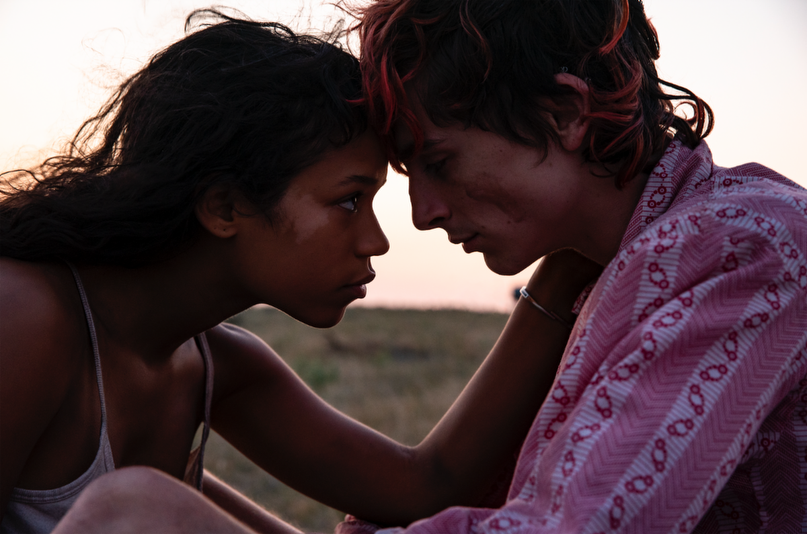
The film, directed by Luca Guadagnino (“Call Me By Your Name”), is based off of Camille DeAngelis’ novel “Bones and All” which was published in March of 2015. Along with Russell (“Waves”) and Chalamet (“Call Me By Your Name”), the cast includes André Holland (“Moonlight”), Michael Stuhlbarg (“A Serious Man”), and Chloë Sevigny (“We Are Who We Are”).
Director’s Statement
“There is something about the disenfranchised, there is something about people living at the margins of society that I am drawn toward and touched by. All my movies are about outcasts, and the characters in “Bones and All” resonated with me. In that regard, it’s also interesting to me to tackle texture-wise the mid-West in the 80s. The idea of the traveler, the one who roams, the wanderer in this kind of modern setting felt very American to me and seemed to me to be a good place to start making movies in the USA.
The heart of the movie is tender and affectionate to its characters. I’m interested in their emotional journeys and what is going to happen to them – where is the possibility inside the impossibility for these characters? No, I don’t think the movie is transgressive, but perhaps we’ve moved so far into post modernism that to tell this story in a classical way may feel transgressive.
I am asking my audience to join this journey; it’s about discovery. Who are these people? Why do they behave as they do? What are they learning? And in so what do we learn about ourselves?
I come from a Catholic country and we have the metaphor of cannibalism every day of our lives – the Body of Christ in the metaphor of the thin (eucharistic) wafer. At the same time we are still animals – part reason and part instinct. Part of our drive is social and part is ancestral. It is the ultimate way in which a human being can annihilate another human being, but that’s not what the movie is about. The movie wants to be, for me, more of a meditation on who I am and how I can overcome what I feel, if it is something I cannot control in myself. And lastly, when will I be able to find myself in the gaze of the other?”