
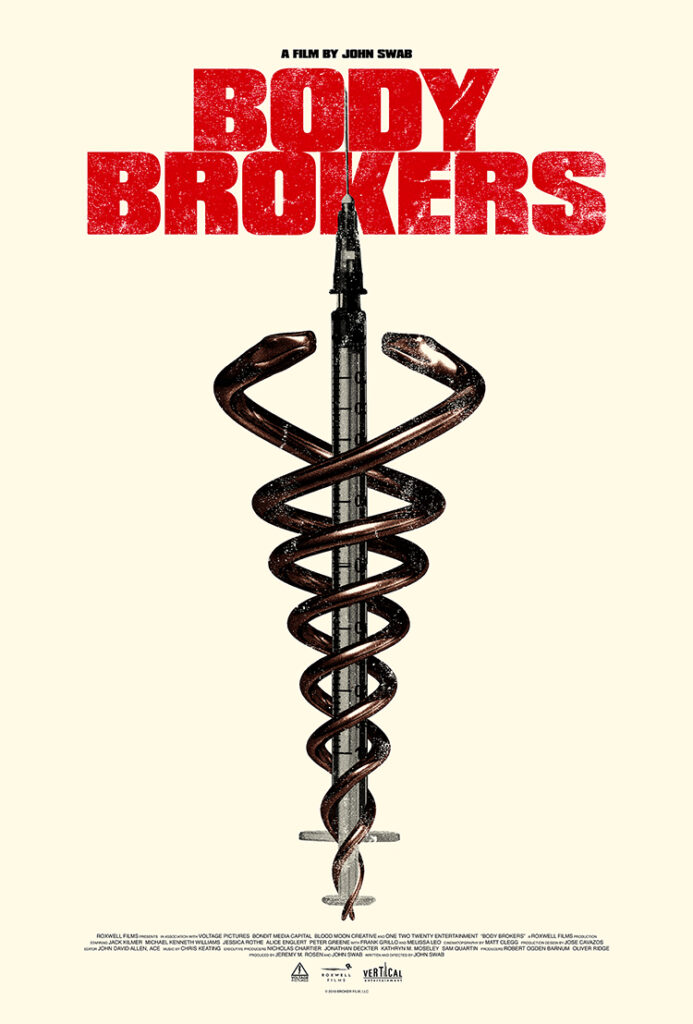
Michael K. Williams – ‘Body Brokers’ Interview – Blackfilm.com correspondent Ellen Wanjiru speaks with Michael K. Williams about his new film ‘Body Brokers,’ based on the true story of the multi-billion dollar insurance scandal within the substance abuse treatment industry.
BODY BROKERS is directed and written by John Swab (Run with the Hunted, Let Me Make You a Martyr) and stars Frank Grillo (The Purge franchise, Captain America franchise, The Grey), Melissa Leo (Prisoners, The Fighter, Frozen River), Jack Kilmer (The Nice Guys, Palo Alto), Michael K. Williams (12 Years a Slave, “Boardwalk Empire,” “The Wire”), Jessica Rothe (Happy Death Day franchise), and Alice Englert (Beautiful Creatures, Ginger & Rosa).
Vertical Entertainment will release the crime thriller BODY BROKERS in theaters and on Digital and On Demand on February 19, 2021. Pre-Order Link: https://bit.ly/BodyBrokersFilm. Read the Michael K. Williams – ‘Body Brokers’ Interview below!
SYNOPSIS: Utah (Kilmer) and Opal (Englert) are junkies living on the streets of rural Ohio until a seemingly chance encounter with the enigmatic Wood (Williams) brings them to Los Angeles for drug treatment. Utah appears to find sobriety with the help of treatment center therapist, Dr. White (Melissa Leo), and tech turned love interest, May (Rothe). They soon learn that drug treatment is but a cover for a predatory business, enlisting addicts to recruit other addicts. Utah is no exception. Wood and his drug treatment mogul partner, Vin (Grillo), take Utah under their wing, introducing him to the good life, though Utah’s addiction remains his biggest obstacle.
Michael K. Williams ‘Body Brokers’ Interview
Ellen: How did this script find you and was it an immediate, “Yes, I’m doing this” or was it a decision that took time to make for you?
Michael K. Williams: The script came to me through director John Swab. He and I have a mutual friend in common, well in my mind I’m really good friends with Melissa Leo. *laughter* Melissa and John Swab are a team of sorts and they’d worked with Michael Pitt. I was always on their radar so when this came about, they reached out to me. And when I read the script, it was a definite yes.
Ellen: The film pulls back the curtain on an insanely flawed and fraudulent system. What was your level of awareness prior to getting the script?
Michael K. Williams: I was completely ignorant to this situation. I was also taken back by the level of kicking people when they’re down and taking advantage of vulnerable people. The story of Body Brokers is, for me, the poster child. When you said it pulled the curtain back, it resembled another situation that takes advantage of the vulnerable and that is the “for-profit prisons” that we have in this country. When did when stop calling it the “correctional facility” and start calling it jail and prison? How did recovery centers start caring more about filling the beds than the people who are actually in the beds? How did we get to that place? It’s capitalism. So that really threw me. I was completely ignorant to that.
Ellen: When the rest of the world gets to watch this, I feel like a large percentage will be just as blown away by that realization. But when you think about capitalism, it’s kind of like – “Oh, that’s why.” So while it’s a big surprise, it’s also how this country operates. *laughter*
Michael K. Williams: *laughter* It really shouldn’t be a big surprise.
Ellen: Isn’t that crazy though, that realization.
Michael K. Williams: It’s messed up but, that’s who we are. That’s our underbelly. It’s refreshing that John took the time to tell this story.
Ellen: You play Wood – a somewhat mysterious and layered character; and as a body broker he’s part of the problem, instead of the solution. Can you talk a bit about Woods inner turmoil and why he was so drawn to Utah (Jack Kilmer) beyond the purpose that he served?
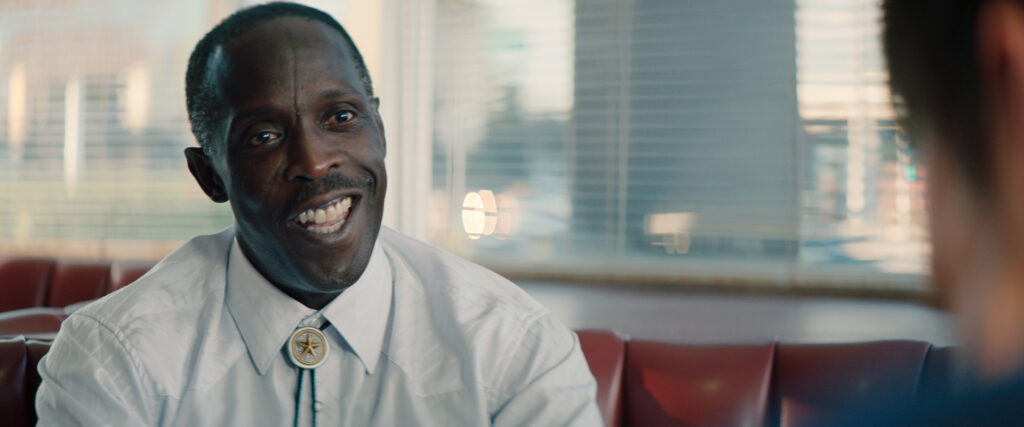
Michael K. Williams: You know to me Wood is a perfect example of what an addict looks like while in recovery. A lot of times in my past I’ve looked at narratives that dealt with addiction or recovery and those storylines have always focused on what the drugs did to the person and what the person did while they were on drugs. A lot of times we don’t really look at the recovery process. It’s to my knowledge that drugs are not the problem, drugs are a symptom of the problem. When a person puts down the drink or the drug and they get sober, that’s when the real work begins.

There’s a lot of character defects that still exist in the addict’s mind even when they put the drugs down. You have people in recovery that still do really despicable things because they haven’t done the work yet. As they say, recovery is an inside job. So, Wood is the perfect opportunity to show that version of what a person in recovery could look like. He’s pretty much sober, but he’s sold drugs, he’s body brokered people, his moral compass is still off. Putting down the drug doesn’t mean that your moral compass automatically goes to balance. You got to put some work in to reach a place in life where something like that would not sit right with you. Wood is not there yet, so it was a great opportunity to show that aspect of recovery.
Ellen: I struggled for a second to love Wood based on how he was living. But then there were moments where it looked like Wood wasn’t thrilled about what he had to do. He became relatable.
What level of relatability did you come into this role with, in order to connect to Wood?
Michael K. Williams: I really struggled because his moral compass, in my opinion, was way off; but, Wood is the epitome of a capitalist. Don’t hate the player hate the game. He’s pretty much black and white. When he asks Utah, “Are you sure you’re ready to leave the program because I don’t f*ck with fiends. You mess up once, I don’t know you.” That’s who Wood is. When I first started to really love him was probably the same moment when you started to love him, when he became complicated. We see him lose it and he stomps that doctor out for belittling and talking down to him. That’s when he became relatable to me. I knew what that felt like. When he had to make a decision to kill or not kill Utah. Then, we see these two men in the car have that conversation and his genuine concern for Utah was one addict helping another. He still didn’t leave that part of the program of recovery. He just didn’t take the time to work on his own defects. He could rationalize selling drugs and body brokering people but, he really believed that he was doing a good thing by turning Utah on to this lifestyle and caring for this young man.
And in the car when Utah (in response to Wood stomping out the doctor) says, “People like that have been talking down to me all my life.” Wood’s response is, “What did I do to deserve to find you?” That was, in my opinion, when Wood was at his most honest. Where he wasn’t rationalizing. I didn’t see big homie/little homie. I didn’t see black or white. I didn’t see a capitalist. I saw two addicts helping each other. Which is what it really is about. It was in those moments that I believe he became really relatable to me.
Ellen: The scene when Wood apologizes to Utah for bringing Opal (Alice Englert) into the “game,” was unexpected. I didn’t think Wood would apologize so, to your point, that makes sense.

Michael K. Williams: There comes a point where I believe that you can’t rationalize a selfish or poor decision that may have hurt other people or hurt myself. I’m not going to act like in my entire life I haven’t done that, I’m not on a moral high horse here. That was Wood’s version, and I’ve had my version. Given my past, dare I say we’ve all done some version of things that we’re not proud of, but I believe that there comes a point in every person’s life where that bullshit doesn’t work anymore. I believe that happened in that moment. Wood didn’t just apologize for Opal, but he apologized for sniffing coke in front of Utah.
Ellen: How about that.
Michael K. Williams: Yeah, those apologizes came from the same place, in my opinion.
Ellen: My perception of Wood prior to that scene was that he was towing the line and wouldn’t do anything “bad” in front of Utah. I think that’s what humanized Wood for me.
Michael K. Williams: Yes, I couldn’t agree more.
Ellen: This film is essentially blowing the proverbial lid off of the pot. What was the energy and chemistry among the cast knowing the impact this could have once it got released?
Michael K. Williams: Most of my scenes are with Jack and dare I say, we had a little Training Day kind of vibe going on. Most of my connection was with him. We hung out off set and got something to eat. We filmed a lot of our scenes in the city of Tulsa, Oklahoma and so I took him to Black Wall Street and there was this brother named Rico Wright who has an art gallery on the corner of Greenwood Ave and Pine. I would go in there and play chess with the homie. I took Jack there and we bought a bunch of food there and brought it back and ate. He’s a decent young man, me and him really vibed.
John Swab, that’s his city. He was born and raised in Tulsa, Oklahoma. He was the first person who took me to Black Wall Street and took me to an area where our ancestors lived, where their homes were burned down. The only proof that there were homes previously there were the staircases. Everything else was burned down or bombed. So, John showed me all of that and I went and showed it all to Jack to share the experience.
Ellen: I thought the chemistry between you and Jack Kilmer was absolutely incredible. It felt like you guys had known each other for years, like you were homies from back in the day.

Michael K. Williams: That’s my little brother. You meet people in this business and there’s so many personalities. It’s refreshing to meet people where what you see is what you get. Sometimes, we sit down, and I only say two words with him. He’s a decent young man. There’s an effortless vulnerability that’s all right in his eyes. You know the saying that all skin-folk ain’t kin-folk. He had that vibe, man. I could take him to any of my neighborhoods in Brooklyn and not worry about him for one minute.
Ellen: I would’ve loved to see Wood’s response to what happens to Utah at the end. In my mind, I’m thinking that there was a special connection between those two and for it to end the way that it did was heartbreaking. Did you ever think of that in terms of how it ended?
Michael K. Williams: Um, that’s a very good question. Wow. That is so painful that my mind never went there. I glanced at it and I wrapped it up and compartmentalized that somewhere in the back of my brain. That’s an extremely painful question. Because the answer is extremely painful.
Ellen: I understand.
Michael K. Williams: That really hurt. I’m sorry.
Ellen: I get it, it hurt watching it. Thank you for allowing me to ask that question. So how do you think this film will be received?
Michael K. Williams: I don’t know. I believe people are going to initially say what you and I said at the beginning of this conversation. Like, “Holy shit I didn’t see that coming.” I think that would probably be the main response that people are going to have about this film.
Ellen: I think so, too. I can’t wait to have conversations once the film comes out. I thought you were incredible in it. You have this ability to be so diverse in the characters that you play. You make it relatable. Thank you for your creative genius.
Michael K. Williams: Thank You.
Letitia Wright and Michael K. Williams Set to Star in Born Studios’ ‘Surrounded’
Michael K. Williams – ‘Body Brokers’ Interview – Blackfilm.com correspondent Ellen Wanjiru speaks Michael K. Michael K. Williams – ‘Body Brokers’ Interview – Blackfilm.com correspondent Ellen Wanjiru speaks Michael K. Michael K. Williams – ‘Body Brokers’ Interview – Blackfilm.com correspondent Ellen Wanjiru speaks Michael K.



Loading…