

Coming out this week from Warner Bros. Pictures is director Edward Norton’s upcoming thriller Motherless Brooklyn, starring Norton, Bruce Willis, Gugu Mbatha-Raw, Bobby Cannavale, Cherry Jones, Michael Kenneth Williams, Leslie Mann, Ethan Suplee, Dallas Roberts, Josh Pais, Robert Ray Wisdom, Fisher Stevens, with Alec Baldwin and Willem Dafoe.
An adaptation of the Jonathan Lethem detective novel and set against the backdrop of 1950s New York, “Motherless Brooklyn” follows New York private detective Lionel Essrog (Edward Norton), who has Tourette syndrome and a flawless memory for details. While his tics make social connection difficult, Lionel’s memory is an undoubted asset to his boss, Frank Minna (Bruce Willis). But when one of Frank’s missions goes awry, Lionel is left to piece together the mystery of his mentor’s final job. What he encounters is a deep, shadowy network of corruption and crime, stemming from the poor neighborhoods of Brooklyn and jazz joints of Harlem to the upper echelons of City Hall.

Along the way, he’s increasingly drawn to impassioned community activist Laura (Gugu Mbatha-Raw) whose work advocating for poor tenants may be leading her into the dangerous orbit of terrifyingly ruthless Moses Randolph (Alec Baldwin), a city planner hellbent on modernization at any cost.
For Mbatha-Raw, last seen on Julia Hart’s Fast Color and Adewale Akinnuoye-Agbaje’s Farming, the film offered her the opportunity to return to New York and actually visit Harlem for the first time and work with actor Norton, who’s coming back to the director’s chair since 2000’s Keeping the Faith.

How long does it take after you start reading the script, and then picture yourself playing that role?
Gugu Mbatha-Raw: I always read it for the first time visualizing myself. With a good, intriguing role I think you transpose yourself into it the first time and sometimes it works. Sometimes it doesn’t. Having met Edward after reading the script, and talking more about the world and for me, and sounds really superficial, but getting into the costumes, doing the first fittings, getting that feel of, of how the character might walk or move or dress and the accent and all of those. It’s a layered process really. I think that sort of gets more three dimensional as you go.
How would you best describe your character Laura?

Gugu Mbatha-Raw: She’s a real pioneer for her time. For me, it was so refreshing to see that she wasn’t just the femme fatale. She was so much more than that. She’s an educated woman. She’s underestimated. People think she’s a secretary, but she’s a trained lawyer. She grew up in Harlem. She’s an activist for her community in Brooklyn against racial discrimination and housing. She’s not the jazz singer. She’s not the cliche. That to me was really refreshing. So often when we see women depicted in 1950s period movies, they’re either the sultry sort of singer in the nightclub or the 50s housewife, and she was none of those things. She managed to escape that and be so much more progressive than we often see women depicted of that period. There must there were women like and for me, it was just refreshing because they don’t always get time on screen.
When you do a period piece, do you do any research in terms of the racial discrimination, the black woman in that era, or even the music scene? How much did you go into it? Or was it something that you and Edward discuss?

Gugu Mbatha-Raw: Yeah, absolutely. For me, the research is some really exciting way to prepare and my character Laura is not in the novel. I knew that up front. She’s the creation that Edward brought into the film having transferred the novel from the 90s to to the 50s. In a way, there was a freedom there that I wasn’t having to go back to the book. The book wasn’t really a source for me for Laura. I’d never been to Harlem before researching this film, even though I’ve been to New York so many times. I’m always in a hotel suite for a few days or working. I called up my friend, Denise Burse. She’s an actress who played the older version of me in Black Mirror’s San Junipero. I remember when we work together briefly, she said, “Oh, you have to come to Harlem and come visit me” and I’m like, “Okay, Denise. I’m doing research and you have to give me a tour.” She’s lived there for so many years. So it was really nice to be able to have a really intimate tour from her perspective of living there and go to some really iconic sites. There’s also the music. I’ve always been a fan of jazz. I grew up playing the saxophone. I love Miles Davis.

Knowing that there was going to be that side of it and that was something that really came alive in the shooting of it. On the page you don’t know how it’s going to sound obviously. I listened to a lot of Billie Holiday in my trailer, a lot of 1950s jazz. Then really, just working with Edward on our vision for her as this intelligent woman of her time. Also talking with the costume designer about how she would express herself through clothes as a college educated girl. That was really interesting, putting on the costumes, the silhouette, the girdle, the pointy bra, the 50s accoutrements that actually really make you feel and move differently. Then the script itself is so dense. Just to read it. It’s 140 pages long, and there was so much there. There was so much to get your teeth into in terms of the atmosphere of the city and everything. There’s New York itself. It’s constantly keeping you present.

How was it working with Ed as a director and as well as an actor because this was not the first time you’ve done this.
Gugu Mbatha-Raw: Yeah, the first time I ever work an actor also working as the director was with Tom Hanks in Larry Crowne and more recently with Adewale Akinnuoye-Agbaje in Farming. It’s always a bonus because as a director and as an actor, they speak your language. They understand what it feels and things don’t get lost in translation, depending on people’s skills in directing. Edward always felt like a kindred spirit. Somebody who is appreciative of theater and the craft and very articulate. To have a really articulate director who’s also an actor at the helm, it only helps and makes the process more immediate and intimate.
At any given point being that your character is not in the book, did you and Ed discusses where she and his character would go? Was there any romance involved?
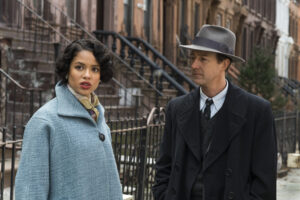
Gugu Mbatha-Raw: It’s deeply romantic. There are some moments there like the scene in the jazz bar. They only met that afternoon, and she’s not just a love interest. She’s got her own agenda. She thinks that he’s a journalist who’s going to shed some light on her cause in his his paper. Not that she’s using him, but I think there is an element that it’s not just a romance for romance sake. I think that they definitely have a connection, but I liked the fact that it wasn’t sentimentalize. It’s not at the expense of their greater cause and I think maybe in the future. Where the film ends up you hope that there’s a future for them. I like the fact that it wasn’t a cliched romantic story. There’s elements of romance, but there’s also the bigger picture.
Is there anything you’re picking up from your latest director as far as his or her technique that you can take to your next project?

Gugu Mbatha-Raw: Always. It’s sort of via osmosis. You learn from everyone and it’s not just the director. You learn from every department in it, and other actors. It’s just getting to marinate in all of these different ways of working and I don’t know how many things I consciously bring to the next project because everything so specific. I definitely learned so much from Edward in terms of his focus and his preparation. He had so much to deal with in this film in wearing so many hats and having so much responsibility in being in front and behind the camera to tell such an epic story. It was really breathtaking sometimes just to behold how how he was switching gears. I’m sure it was such a huge challenge for him, but to know what’s possible as an actor, and what inspired me is how you continue to push yourself as an artist because everyone knows Edward Norton is a great actor. He is personally pushing himself as an artist to be able to add all these other dimensions to his skills. So that was inspiring.

What are we going to see you next?
Gugu Mbatha-Raw: Next year Misbehavior comes out where I play Miss Grenada. Motherless Brooklyn is slightly conflicting on the same day as The Morning Show for Apple, which is coming out also on November 1. Farming comes out on October 25th. Those are the three things coming out in the next month and Misbehavior hopefully next year.
Between the films and TV work you do, what goes into saying yes to any of these projects?

Gugu Mbatha-Raw: I always look for a good script, and really good writing. Specifically on this and The Morning Show, the writing was really sophisticated and intelligent and had something to say about the current culture. I’m always interested also in the message. Why do we need to say this now? What is the conversation around the film and the cast? Who am I going to be working with? Who am I going to be learning from? This incredible cast of Alec Baldwin, Willem Defoe, Edward obviously, Sherry Jones are an amazing cast of actors and similarly for The Morning Show. To just watch, let alone being a scene with any of them, I know I’m going to grow. I’d never done anything in the 50s I’d never done anything with detective genre. Is it going to keep me interested? I don’t like to feel like I’m repeating myself. Is it is it going to challenge me? That’s what I look for.



Loading…