

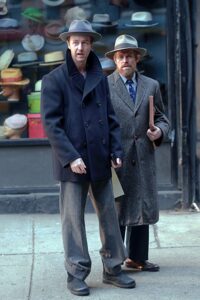
Coming out this week from Warner Bros. Pictures is director Edward Norton’s upcoming thriller Motherless Brooklyn, starring Norton, Bruce Willis, Gugu Mbatha-Raw, Bobby Cannavale, Cherry Jones, Michael Kenneth Williams, Leslie Mann, Ethan Suplee, Dallas Roberts, Josh Pais, Robert Ray Wisdom, Fisher Stevens, with Alec Baldwin and Willem Dafoe.
An adaptation of the Jonathan Lethem detective novel and set against the backdrop of 1950s New York, “Motherless Brooklyn” follows New York private detective Lionel Essrog (Edward Norton), who has Tourette syndrome and a flawless memory for details. While his tics make social connection difficult, Lionel’s memory is an undoubted asset to his boss, Frank Minna (Bruce Willis). But when one of Frank’s missions goes awry, Lionel is left to piece together the mystery of his mentor’s final job. What he encounters is a deep, shadowy network of corruption and crime, stemming from the poor neighborhoods of Brooklyn and jazz joints of Harlem to the upper echelons of City Hall.

Along the way, he’s increasingly drawn to impassioned community activist Laura (Gugu Mbatha-Raw) whose work advocating for poor tenants may be leading her into the dangerous orbit of terrifyingly ruthless Moses Randolph (Alec Baldwin), a city planner hellbent on modernization at any cost.
For Dafoe, he’s having another stellar year playing strong characters. Because the film is has a film noir feel to it, it’s hard to explain what his role is. But after receiving two back-to-back Academy Award nominations in the last two years, including one for Best Actor for Eternity’s Gate last year, it’s assumed he has another great role in this film as well as The Lighthouse, which is also out in theaters.
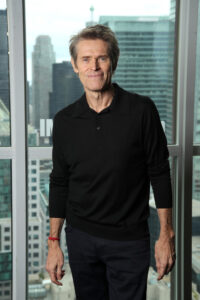
Blackfilm.com caught up with Dafoe during the New York Film Festival where Motherless Brooklyn was the Closing Night film and spoke with him about his involvement in this film and The Lighthouse.
When do you envision yourself as a character in this film? Is it the first or second after you read the script?
Willem Dafoe: It probably doesn’t happen until you’re doing this. You read the script, you try to imagine the world and you try to imagine what your function is in that world, where you fit into that world and then you try to inhabit it. So, those speeches that you have, those scenes you have, you have some sort of anticipation of what has to be accomplished or what you have to understand and you do whatever it takes to reach an understanding that you say, “I have a relationship to this.” You create a relationship to the things that you’re saying so they mean something to you so you have a personal stake. And in that shift, that’s where the character is born.
Then it really sticks when you do the scene because then you’re with the partner and you’re entering the world. That sends you to a place that you can’t plan and you probably don’t want to plan. So it starts with, you start to form an idea, then you think, “Wow, I’ve got to prepare to show up to be there.” And then in the doing it, you really find out who the character is because I think characters revealed through action. In this case, I have all these big speeches that are quite complicated. I like them very much, not only for the information they impart, but also they’re written nicely. There’s real character and I knew I had to do them fast and clear. That that was that was where I started, really with that with the text. I also like very much that the character he’s not he’s a character that when you first see him he appears to be completely other than he is not just a mysterious character but who you think he is changes a lot.

How would you best describe your character?
Willem Dafoe: It’s tough because in one part of the movie, he’s one thing and then in another part of movie, he’s another thing so the I would say he’s someone that’s been marginalized, but has the key to a central riddle in the movie.
Did you read the book before?
Willem Dafoe: Not before doing it because they were so different that I didn’t want to be pulled to feel an obligation. I had plenty on the plate, plenty to deal with. Edward transposed it in such a big leap and got Jonathan Lethem is a generous and smart guy to let him do that I think. I didn’t want to be tied to the book.
How was it working with Edward as an actor and a director?
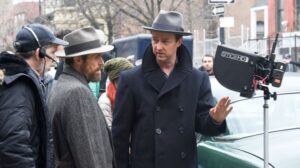
Willem Dafoe: As far as the material, you just you just accept it for what it is. That’s kind of why you don’t read the book because then you don’t have split allegiance. And you read the script and you say, “I’m done with this.” This talks about things that resonate with me. It’s interesting and as entertainment it’s not a little puzzle that you got to work your way through. So that’s all good. And then as an actor and director and writer, it’s nice because you get behind one vision.

You don’t have any issues of trust or understanding because it’s all there. And not only is it all there, but he’s toe to toe with you. He’s not standing outside. He’s in the mix. It cuts out a couple of degrees of removal, which isn’t always great, but in this case, it worked very well. I think he was quite heroic in his ability to be so many places at one time. I think he was able to accomplish that because it’s about people. You get people that inspire you and people you know that will watch your back and people that get what you’re trying to do. He’s very good at cultivating relationships. A lot of these people had deep personal relationships with him, working wise. So you went on that set. it was Edward’s show but not in an egotistical way but in a way that was just very complete. You could go to the source. If you had a question you knew who to go to.
You also have The Lighthouse in theaters as well. How was working on that film?

Willem Dafoe: Fantastic. Robert Eggers is a really gifted guy. In fact, I saw The Witch. I saw the film under the best circumstances because I’d heard nothing about it. I had been away working overseas and heard nothing about it. I just went in cold and saw the movie said, “Wow. Whoever made this film has got something.” So I called up my representatives and said, “Track this guy down, and see if he wants to meet me.” We met and we got along fabulously and said “let’s work together.” This is the fruit of that seed. I didn’t work with him on it. It’s like he was just doing this project. I didn’t develop it with him. He just arrived one day and said “Look, here’s the script. I want you to do it. The other guy is going to be Robert Pattinson. We’re going to do it on location. It’s going to be nasty weather and do you want to do it?” It was like that, very direct.
Can you talk about the chemistry between you and Pattison?
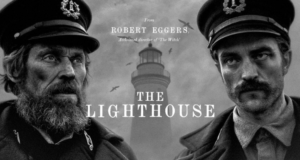
Willem Dafoe: You play the scenes. It’s well constructed. The chemistry is no chemistry because these guys are at each other’s throats. But the actions are very clear. The characters are very well drawn. They don’t really meet. They’re two guys stuck with each other and they’re trying to figure out Strip away people’s identity and things get pretty nasty; and both of them gets stripped away.
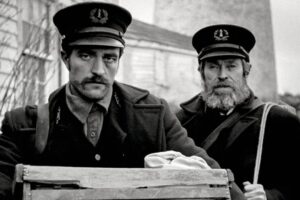
It was a pressure cooker. situation. But Rob Pattinson really is very committed actor. He’s got a very different way of working than I do, but it suited his character. His character is kind of more psychological. Mine is more mythological. His his is more like prose. My character speaks more poetically. They’re very different. But at some point they also get mixed up because they’re desperate to find a way to survive in this terrible situation.
In the last few years, your level of work has exceeded more than what you’ve done in the past. When you get back to back nominations, that’s not an easy feat. What’s changed? Did you change teams? Are you getting the best roles coming at you right now?

Willem Dafoe: Everybody will tell you this, and t I mean it from my heart but I’m not thinking about that. I think about it once it’s a possibility, and I will try to facilitate that by promoting the movies and it helps the movies. It’s nice to get that recognition. It is important to me, but what has changed? Everything’s changed and nothing’s changed. For many years, I had a theatre company. I still do theater, but not day to day. So for a lot of my career, I was always limited about how much I could be away and what I could do and sometimes I had turned down things or not be available for things because I had this theater company. That’s ended. I still do theater, but I feel I had more flexibility in the things that I could do. As I get older, I feel like less pigeonholed. I feel like there’s more possibilities coming from different places.
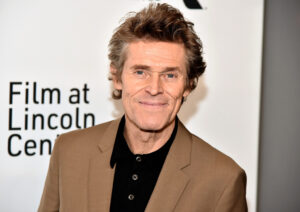
But when you look at Florida Project, At Eternity’s Gate, and The Lighthouse, those are all true to what I’ve always done and that is sought out strong directors and I planted seeds and with with each one of those directors, it’s not just like, an agent submission came in and we did something. These are people that a relationship was cultivated. I’ve been around long enough and I’m old enough that I planted a lot of seeds and they are seeds planted in earnest and with patience. So sometimes those things come bearing fruit. And in these cases, for me anyway, without connecting the dots too much, I think that’s what’s happening. Now’s a good period and I’m happy for it. I just still love to perform and it gets more mysterious and more interesting the older I get.
What’s coming up next?
Willem Dafoe: I did a movie for Disney Plus called Togo. That’s an adventure film about a dog sled run. I have a cameo in Wes Anderson’s film.
What goes into saying yes to the projects you take?

Willem Dafoe: People places and things to do. People are important because you can have the most beautiful script but if the people don’t connect with it, or don’t know how to you know bring it alive, then what’s the use. If it’s done with the wrong motivation. You’ll want to shoot some place that is rooted. That gives you an adventure where you learn something and you can apply that life experience to the heart of what you’re doing so it lives. Then with things to do. You don’t know what a character is until you really get there,, but you can say, “Do I want to do these things? Do these things resonate with me?” When I’m telling those stories, and Motherless Brooklyn, some of that stuff is new to me. It puts me on a track about thinking about things that excite me because it sends me to a new understanding or new thinking that makes me feel more alive because then I’m not stuck with accepting the world as it is and you get this energy of change; a change of perception and hopefully openness of heart and open someone’s mind that we’re always searching for. I think everybody is so they can connect and feel alive.


Loading…